
 | The Energy and Environment Round-Up: September 7th 2007 | The Oil Drum: Canada | The Round-Up: September 11th 2007 |  |
Tar Sands: The Oil Junkie's Last Fix, Part 2
Posted by Stoneleigh on September 9, 2007 - 10:00am in The Oil Drum: Canada
This is part 2 of a guest post by Chris Nelder. It was originally written for Friday's Energy and Capital.
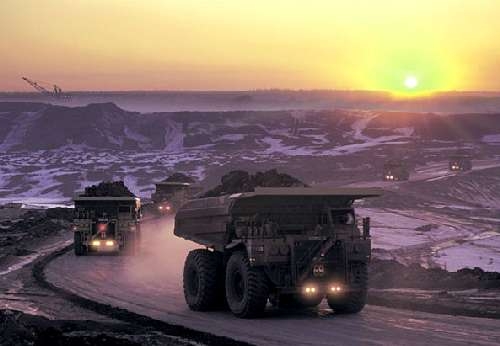
This is a continuation of my previous article (Tar Sands: The Oil Junkie's Last Fix, Part 1) on the challenges facing the Canadian tar sands, in which we looked at the cost and financing issues. Today we look at water, energy, labour and the environment.
Water
Water is another major problem. Tar sands plants typically use two to four barrels of water to extract a barrel of oil. Currently, the water consumption is enough to sustain a city of two million people every year. And after it's been through the process, the water is toxic with contaminants, so it cannot be released into the environment. Some of it is reused, but vast amounts of it are pumped into enormous settlement ponds to be retained as toxic waste.
These "ponds" are actually the largest bodies of water in the region--big enough to be seen from space--and some of the world's largest man-made ponds overall, with miles of surface area. It may take 200 years for the smallest particles to settle down to the bottom of this toxic brew, which also contains very high levels of heavy metals and other health-threatening elements.
According to a recent joint study by the University of Toronto and the University of Alberta, the projected expansion of the tar sands projects will kill the Athabasca River, the only abundant source of water in the area. "Projected bitumen extraction in the oil sands will require too much water to sustain the river and Athabasca Delta, especially with the effects of predicted climate warning," the study said. If that amount of water were used, they warned, it would threaten the water supply of two northern territories, 300,000 aboriginal people and Canada's largest watershed, the Mackenzie River Basin.
Licensed surface water allocations from the Athabasca River and its tributaries. (2005 data, Pembina Institute)
With the tar sands currently producing at the rate of about 1 million barrels per day (mbpd), water levels in the river are already going down. Given such intense water demands, it's completely unclear how production can be increased to the target of 4 mbpd by 2020.
One of the authors of the study, Dr. David Schindler, who is considered Canada's top water expert, says that between the climate change-induced reduction in Athabasca flows and the seven major tar sands plants either operating or planned, the river's water "is fully allocated, possibly over allocated, right now."
Energy
Perhaps the most paradoxical part of the tar sands receding horizons problem is the need for energy.
Typically, tar sands are produced using natural gas to heat the steam that drives the oil out of the sands. It takes a lot of gas to do this: over 1,000 cubic feet--about $8 worth--to produce one barrel of bitumen.
At the current production level of about 1 mpbd, the tar sands operations consume about 4% of Canada's natural gas supply. So quadrupling production would consume fully 16% of the supply, and completely max out the gas market. Nearly all estimates for tar sands operations over the next ten years exceed the projections for available amounts of natural gas!
Canada's natural gas supplies are running out fast. Numbers from the EIA and the NEB suggest that its proven reserves of natural gas will be gone in about eight years.
And plans for pipelines to bring natural gas from Alaska and the Mackenzie valley are currently mired in environmental and financial quagmires. The projected costs for the Mackenzie pipeline have risen so fast that the oil companies have put the project on hold, demanding that Ottawa pay a substantial part of the costs. Ottawa so far has refused.
But the entire planned capacity (1.9 bcf/d) of the proposed Mackenzie Valley gas pipeline could only support tar sands production up to about 3 mpbd by 2025.
Professor Kjell Aleklett of Uppsala University, a recognized expert on tar sands, puts it bluntly: "The supply of natural gas in North America is not adequate to support a future Canadian oil sands industry with today's dependence on natural gas."
After gas, the next obvious choice is nuclear energy--building dozens of nuclear plants to generate the heat needed to create the steam needed to drive the hydrocarbons out of the sand. But by any sober assessment of that alternative, it would probably take on the order of ten years or more to build out that kind of nuclear capacity, with skyrocketing costs. And then you still have the problem of water to turn into steam and cool the nuclear plants.
What's worse, depending on a host of factors, the total Energy Return On Investment (the energy profit, if you will) for tar sands production is typically only around 5% to 10%. In fact, it has even been suggested that the EROI is negative in some cases. But with the current circumstances of stranded and otherwise useless natural gas, oil over $60, an extremely tight global oil supply situation, and a host of complicating factors like tax relief (which we'll get to in a moment), it still makes economic sense, if no other kind.
Even if an alternative energy source could be found, there is still the matter of the hydrogen needed to upgrade the produced bitumen into a useful hydrocarbon. That hydrogen is currently derived from natural gas. According to Princeton geology professor emeritus and peak oil author Ken Deffeyes, there is just one alternative source of hydrogen: water. But as we already know, there's no excess water.
In the interest of scientific fairness, there are some new in situ processes for tar sands harvesting, like "toe heel air injection," which have been demonstrated to produce more bitumen than the traditional process with far lower energy and water inputs. But these processes are still in the experimental phase and have not been proven against the various challenging geological structures in which tar sands are found. They are certainly in no immediate position to become commercially viable, let alone saviors.
Labor
Not only is there a perennial shortage of skilled labor, even at average salaries above $100,000 per year, but a general strike now seems unavoidable this fall. Seven out of 25 key construction unions in Alberta--including carpenters--are contemplating their first multi-trade strike in almost 30 years. They're no fools; seeing the oil and gas companies racking up record profits in the billions per quarter, they want a bigger piece of the action.
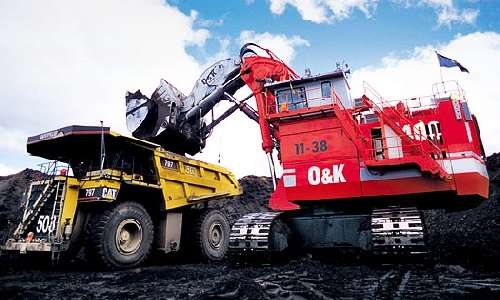
Though wages are high--a journeyman electrician can make $35 an hour--conditions are tough, too. Labor is demanding quality of life concessions, noting the horrors of traveling to and from and living anywhere near the northeastern Alberta work camps, where the living conditions have been compared to the Klondike gold rush days. It's a rough place of rough men, and crime and drug problems are on the rise.
According to one former oil sands worker, a mobile home trailer is going for $425,000. Workers are bunking in residents' basements and parking on their lawns, for lack of anywhere else to sleep or park. And sometimes the fumes coming off the slurry ponds are so bad that the schools have to be shut down. Stores have to shut down for several hours a day for lack of employees. There is a desperate shortage of schools, hotel rooms, police, firemen, and just about everything else that makes a town.
Indeed, the mayor of Fort McMurray, the largest city in the Athabascan region, warned that she could not promise a community that was safe and functional, and had no idea how the expected thousands of additional workers could be housed.
Environment
Naturally, the biggest hit from tar sands operations will be taken by the environment--the one player in this drama that can't speak for itself or charge anyone anything for the damages it suffers.
Former Alberta premier Peter Lougheed recently warned that a clash over the environmental cost of the oil sands is inevitable, and that this will be fought all the way to Canada's Supreme Court. A primeval boreal forest the size of Florida is being utterly destroyed beyond repair, while highly toxic sludge ends up in gargantuan tailings ponds even though laws stipulate that the land must be returned to its original state.
So far, the industry pays next to nothing for causing this environmental destruction, but it seems certain that this won't last, particularly in view of stricter federal environmental legislation.
The Junkie's Last Fix
Now, the above story wasn't easy to piece together. The press is almost universally in favor of anything that sounds like "more oil," no matter the cost. Nearly all we hear about is X billion in new investment announced by Y Company. We don't hear too much about the cancellations, delays and cost overruns. A full reckoning is rarely attempted.
But that's what we're here for.
So let's reckon this.
What we have here is arguably the most environmentally destructive activity man has ever attempted, with a compliant government, insatiable demand and an endless supply of capital turning it into "a speeding car with a gas pedal and no brakes." It sucks down critical and rapidly diminishing amounts of both natural gas and water, paying neither for its consumption of natural capital nor its environmental destruction, to the utter detriment of its host. And all to eke out maybe a 10% profit, if it turns out that the books haven't been cooked, and if the taxation structure remains a flat-out giveaway.
All of that, just to produce enough oil to offset the declining conventional oil production in the rest of Canada. Maybe.
And that, my friends, is what I call the oil junkie's last fix. An act of sheer desperation to stave off just a little longer that inevitable day when we are forced to realize that the fossil fuel game is truly over. No more rabbits in the hat. Done.
In the July 2006 issue of Rolling Stone, Al Gore called the tar sands "crazy," a huge waste of energy and an eyesore on the landscape of Western Canada. "For every barrel of oil they extract there, they have to use enough natural gas to heat a family's home for four days," Mr. Gore told the magazine. "And they have to tear up four tons of landscape, all for one barrel of oil. It is truly nuts. But you know, junkies find veins in their toes. It seems reasonable, to them, because they've lost sight of the rest of their lives."
Until next time,
Chris
Many thanks to Roel Mayer for his contributions to this piece.
Personnel
Archives
- December 2008 (1)
- October 2008 (1)
- July 2008 (2)
- June 2008 (2)
- May 2008 (6)
- January 2008 (2)
- December 2007 (8)
- November 2007 (9)
- October 2007 (11)
- September 2007 (14)
- August 2007 (14)
- July 2007 (10)
- June 2007 (9)
- May 2007 (11)
- April 2007 (9)
- March 2007 (11)
- February 2007 (11)
- January 2007 (11)
- December 2006 (12)
- November 2006 (16)
- October 2006 (13)
License

This work is licensed under a Creative Commons Attribution-Share Alike 3.0 United States License.
Maybe we could recycle the tires on those vehicles for a couple more barrels ...
| The problem will solve itself.
| But not in a nice way.
All,
I have been out of town and extremely busy for the last several days, and so I haven't been able to reply to the comments until today. Please see below.
For further analysis of relevant statistics on tar sands, I would also refer readers to last year's excellent post by Khebab.
--Chris
Energy consultant, writer, blogger www.getreallist.com
Chris
Thank you for an excellent pair of Key Posts! Of course they are not likely to do any good before the oil junkies have blown up that last toe vein and are just stabbing themselves senselessly looking for another place to fix.
Its time to do the heretofore unthinkable, and demand that no more internal combustion engines be sold new in North America, and go full tilt into Alan Drake's Electrification of Rail program. Its the only possibility that has a real chance of success while helping society transition to the inevitable, renewables as the only energy available.
The problem is that its going to require real sacrifice by every industry in the world, and every family in North America. We are going to have to ask the oil industry to change by shrinking by 70% by changing away from fuel refining and marketing to industries like marketing electricity from renewable energy. Its going to kick the value out of every vehicle in North America while many people still owe years of payments. Its going to add another huge area of worthless loans to a financial industry thats already imploding. And in order to stop the exponential growth overseas we are going to have to help the people of Africa and Asia leapfrog fossil fuel to renewables. Only prosperous people cut birthrates, and it will do no good unless we can help them stop what appears to be a drive off the cliff as world demand continues to grow as supply contracts.
Its not unthinkable-society has put entire industries out of business before-look at asbestos-and tried to slowly choke off others, such as tobacco or nuclear until they started expanding again as we looked for another toe vein.
But real patriots have acted against their personal economic interests before with the right inspiration and leadership.
I urge everyone to read the 50 page pdf history of the Big Inch and Little Inch pipelines during the second world war (google Big Inch Oil Pipeline) and also remember the Marshall Plan, where the US aided Germany and Japan to rebuild into modern industrial countries after the horrors of WW II. The Oil business actually destroyed millions of dollars worth of pipelines to get the steel and valves to build the first transcontinental oil and products lines at less than its cost so the Allies had enough fuel to invade Europe. The industrial might of the US was used to rebuild the industries of Europe so that they could become our only real economic competitors because we realised that was the only way to stop the horrible wars that kept convulsing the world.
And its now our turn to step up to the plate, but we can't do it without actual leadership that transcends the normal boundries that are used to seperate the world's people. Global warming isn't a liberal or conservative issue. Peak cheap energy isn't a Republican or Democrat issue. And living on the same planet with billions of hopeless poor people that have a huge population growth transcends any label. But we have to get actual leaders on this, not demagogues that want to divide us so they can rule us,.
Bob Ebersole
Actually, China cut their fertility rate to replacement level while they were still desperately poor, in the 1970s.
The missing ingredient in much of the world is a truly powerful state.
Absolutely superb piece.
Every economist and every trader who sits in a clean little cubicle somewhere on the planet should visit the tar sands. Smell it up close and personal.
What are we doing? In God's name, what are we doing?
What in the world is going to be the true cost of this last little rabbit?
We should also be concerned about being overwhelmed by the avalanche from the dead-bunny mountain of previous consumption.
When you're done pulling out your hair. Get into the garage and dust off that bicycle. Get a bus pass.
Driving a car is explicit support for tar sand development. Make it a moral issue. BECAUSE IT IS.
Now why would anyone have to go there and smell it for, all one has to do is look at those old promo pieces Suncor put out where the oil sands and wind power walked hand in hand transitioning into a brave new and clean future. Yes I bought that pap but at least I got out a year ago when that smell reached me, in my little cubicle. I thought I was investing in a company that saw the end of oil and was moving to a clean power. I don't even believe in clean power any more. Every bit of new 'alternate' energy we come up with is not going IMO into saving the planet just into adding that much more energy for us to abuse it with.
Sorry for the rant and really it isn't directed at you personally, just a general shotgun blast. I just got pissed with the sudden thought of all the people who eat chicken but say they wouldn't kill a fly. No one ever looks at what their pension plans hold(or even RRSP mutual funds which are pretty darn transparent).
BTW I am not a professional trader if that is any excuse for not taking a closer look where my investment money was going.
Yes, please. What kicked me over from opposed to oil reliance for intellectual reasons to disgusted by the sight of it was being a passenger in a car as it drove past an oil refinery. That smell was unforgettably foul, worse even than mountains of uncomposted cow dung. Most people associate memories strongly with smells, so I think it's a very effective way to drive a point home and make it stick.
Would it be possible to use a passive filter to reclaim the toxic water, as in a solar distiller? Angled clear plastic or glass, some tubing, and whatever the sun supplies.
The wastewater problem is indeed huge, but it doesn't have to be as bad as it currently is. I would probably be correct in surmising that the composition of this wastewater is not unlike a combination of petroleum refining effluent and coal process wastewater.
As such, a variety of conventional wastewater treatment technologies could be applied to greatly improve the quality of this effluent. Coagulation and seettling followed by metals precipitation, sand filtration, and then some form of biological treatment, with perhaps a carbon adsorption 'polishing' step would probably effect at least a 97% removal of most the various chemical constituents.
Given the large volume of wastewater generated, such a treatment system would not be cheap, but it is technically doable. I am a bit surprised (though perhaps I shouldn't be) that the Canadian government didn't require some form of wastewater treatment to be in place even before the whole thing went into operation. In any event, some form of treatment is inevitable, as they cannot store this wastewater in ponds forever. And the longer they wait, the harder it is going to be, because they will not only have to treat the new wastewater as it is being generated, but also will have to work off the huge inventory of old wastewater accumulated in those ponds.
Even if a treatment system is 99% effective, the absolute pollutant loading in terms of lbs per day of the various chemical constituents will still be large and will still represent a considerable negative environmental impact on whatever receiving stream it is discharged to.
While they can make it not as bad, but they can never make it good.
Hello everybody. Has anyone seen evidence that the oil industry invests anything at all in order to pilot test and foster development of the technologies they need in order to solve the crucial water problem? I somehow doubt that this is an active area of industry investment. If a technology were proven, then the industry would experience pressure to actually use it. Without adequate technology, it is easier to make the argument to simply release the polluted water back into the rivers, or to create huge artificial lakes full of polluted water
Below is a reference to an article on research done by Sandia National Laboratories, on the bench scale, on a technology, called capacitive deionizatsion, to handle a similiar water problem, produced water from Coal Bed Methane. Worthwhile technologies like this are well documented to exist, but have received insufficient pilot testing. Competent due diligence has also been lacking. To date, the state of New Mexico paid for a small pilot to test this particular technology for arsenic remediation.
http://pubs.acs.org/subscribe/journals/esthag/40/i03/html/020106tech.html
Sandia's website on this new technology, called capacitive deionization, may be found at
http://www.sandia.gov/water/desal/research-dev/alternative-tech.html
dragonfly -
As a (retired) environmental engineer, I would have to say that treating the wastewater from tar sand operations to an acceptable level does not require any exotic new technology, but rather the application of existing best available treatment technology, based thorough pilot testing and good engineering design.
The problem, of course, is that currently nobody is making them do anything other than hold the wastewater in giant earthen impoundments. As I said, this practice cannot go on forever, and eventually some form of treatment will be required. The situation reminds me of US industry in the early 1970s: if a gun was not held to their heads to install pollution control systems, it just wouldn't happen.
I suspect that the area where some real innovation can be applied is treated wastewater recycle. I don't know enough about the tar sand process to be specific, but I would think that for some of the operations water quality is not that critical and might be successfully served by (partially) recycled wastewater. As water availability appears to be one of the limiting factors in Alberta tar sand operations, I would think that there should be a strong incentive to explore wastewater recycle possibilities.
Thank you for the comment. One would think that what you say is true, that there would be a strong incentive to explore waste water recycle opportunities. Howevr, I don't see much evidence that industry has agressively or even non agressively, pursued opportunities to innovate here.
A key technical concern when recycling waste water is the rapid build up of salinity, removal of which becomes the limiting step. Therefore, not only does salinity ( and "t.d.s.", total dissolved solids) need to be removed, but it needs to be done with high water recovery, in order to maintain the aim of saving water. Technologies that treat t.d.s are few, and tend to be older than the alphabet. Use of any existing technologies in order to achieve high recoveries with produced water, which is likely to have compounds that would tend to foul water treatment systems, would in and of itself be an experiment.
Therefore, any technology would be a new technology when used under these conditions. Some of the older technologies, such as R.O ,have been tested to death., while promising new technologies have received insufficient or incompetent due diligence
Generally, salinity build-up only becomes a problem when one goes to very 'tight' recycle systems.
I would venture that if the tar sands process can use recycled wastewater at all, it would probably be able to tolerate at least a 75 percent recycle rate, which would reduce net water consumption by a factor of about four.
However, once one tries to tighten up the wastewater recycle much beyond that point, various problems with salinity, corrosion, scaling, bio deposits, etc. can rear their ugly head.
I think that given the critical water supply situation in the Alberta tar sands, wastewater recycle is an area well worth exploring.
It will never be cleaned up. What the businesses are doing is stockpiling the waste in holding ponds and piles; when the bonanza is over, they will claim they don't have the money to clean it up and/or go belly up and dissolve.
cfm in Gray, ME
"a solar distiller?"
Unfortunately, this is probably just wishful thinking. Alberta is rather closer to the pole than to the equator and solar is notably less effective there than is commonly thought.
My wishful thinking goes for heating using radioactive waste from nuclear power plants. Radioactive waste in suitably engineered containers can become quite hot from the radioactivity. Engineering problems that I can forsee are corrosive compounds in the water and in the radioactive waste eating away at the containers, leading to radioactive release into the environment.
I got back from Alaska a few weeks ago. You'd be quite surprised how much sunshine they get on the summer side of the year between the equinoxes. Granted, it's not Las Vegas hot, but it does shine for 19 hours per day.
Concentrate it, and there's the distiller.
Nice one geek! You have outdone sarcasm itself itself. We need a new word here, maybe make it out of 'corrosive sarcasm'...corsarc??
There's not enough direct sunlight that high in the artic, pus immense amounts of water. 6 barrels per barel of bitumen, and a barrel equals 42 gallons. So thats roughly 250 gallons of fresh water per barrel a day of production which is 1 million barrels of syncrude a day. My hand calculator is out of zeroes. Bob Ebersole
This is why I suggested the filter be "passive" and use "whatever the sun supplies". It's the cost of the setup, and no continuing energy costs, and runs unattended, and better than nothing.
You are probably assuming that a certain rate of evaporation needs to be achieved to be successful. Currently, the amount of captured evaporation is zero. Any amount of capture is infinite improvement compared to where we stand now.
Instead of angled glass, domed glass could be used to trap additional heat and increase the rate of evaporation.
Hand calculator? You mean you can't do that computation in your head? 252 million gallons of fresh water per day. What if passive evaporative reclamation could knock even half a percent off of that for less than the per-gallon cost of the current water supply?
Solar water distillation is slowwww. There is no way it could manage the amount of water we're talking about here, unless it were an installation occupying hundreds of acres (and addding significantly to the costs).
Various forms of water treatment are obviously possible, but there is absolutely zero impetus to require them--and I'd be willing to bet that if they were required, it would seriously put a crimp in the tiny profit realized by tar sands ops.
In any case, even if the water problem could be solved, it would still leave the natural gas problem. And the studies I've read that actually attempted to do the math on using nuclear instead have concluded unanimously that there is no way that the number of nuclear plants required to increase production signficantly, beyond what's possible with the available natural gas, would ever be built--not in the next few decades, anyway. Though I would entertain any references to serious studies (e.g., more than wild hand-waving) that show otherwise.
--Chris
Energy consultant, writer, blogger www.getreallist.com
So would I. Please link these "serious studies" you claim conclude nuclear-powered tar sands extraction is infeasible.
Providing documentation is not only for people who disagree with you.
No docs Doc, so this might not be fact at all, but I have been led to understand that a rather heavy duty electrical grid is necessary with nuclear plants for safety sake and that the prairies, even now, still have more grouse than gauss.
My perspective on the water issue probably won't be popular here, but I suspect I've read more about it and heard more presentations on it than most posters in this thread. Like Pitt the Elder, I also want to say up front that I'm not an apologist for development of the oil sands and that much of the development scenario bothers me.
That said, I take exception to the depiction of withdrawal in the water licencing diagram near the top of the key post. Yes, the oil sands industry is the largest user of fresh water in the basin. However, relatively speaking, that use is not large, a point missing from the discusssion. Here I'm going to quote a small section of text from the 2005 annual report of the multi-stakeholder group responsible for something called the Regional Aquatic Monitoring Program, an effort supervised by Alberta Environment partly to provide a scientific basis for discussions like the one we're having here. The full report can be downloaded from http://www.ramp-alberta.org/archive.php.
There is a discrepancy in your article and one thing you fail to mention as the key driver of the oil sands: profits. You say "all to eke out maybe a 10% profit," yet they are making billions and billions in profits, likely more as oil prices inevitably increase in coming years. If production is ever ramped up to 3-4 mbpd, they would be making staggering amounts of money at today's oil prices. And we must realize that these projects are not so much more ambitious than the extremely deepwater operations in the GOM, North Sea, etc.
Sina,
If you would like to provide some documentation on the companies that are making "billions and billions in profits" from oil sands operations, I would be happy to review it.
If you believe that production can be ramped up to 3-4x what it is today at today's oil prices then you don't understand the dynamic of receding horizons. It just doesn't work that way.
--Chris
Energy consultant, writer, blogger www.getreallist.com
Shell made $651M in profit from oil sands in 2006 alone, and their operations give them a profit of $22 per barrel. Across an industry of ~350Mbbl/yr, that'd suggest somewhere in the neighbourhood of $7B of profits per year.
Even if we assume without evidence that Shell's operations are unusually profitable, that's still strong evidence for billions in profits per year for the companies working the oil sands.
Care to provide some evidence to support your claim? The need for documentation goes both ways, after all.
Sorry, Pitt, I have no more time to waste on the likes of you.
--Chris
Energy consultant, writer, blogger www.getreallist.com
All I ask is that you back up your claims with evidence. How does that threaten your self-described goal of helping and educating people?
Why are you so unwilling to provide evidence to back up your claims?
Oooooohhhhh... Having gone to the web site you work for and seeing what you left off of this version, I think I may have some idea why. The concluding section in the original version was:
I suppose that explains why you were so ready to accuse me of being an industry shill - it interfered with you pimping your $800-per-person seminar.
When people are paying you through the nose for your "wisdom", I guess you might be a little less concerned about what the evidence actually says.
Pitt, once again you are going off and making claims about things you don't actually know anything about.
In the interest of keeping the record straight--only, because I have no time or interest in continuing to argue with you--that final bit about the investing seminar was not left off by me, but by the TOD editors who re-posted it here. In fact I restored that bit when I re-posted these articles to my blog. So you can stand down on that.
Speaking of reading carefully, you should also note that I have never accused you of being an industry shill...although that would not surprise me.
It quite amuses me that you continue to claim that I don't offer sources and evidence even after I have offered sources and evidence and explained why I do not routinely include them in my articles (because my publisher doesn't want them).
Your rants are repetitive and full of unfounded insinuations and I find them quite boring. Carry on trying to hijack this thread if that floats your boat, I won't be around to watch it. Hopefully other readers will find better things to do with their time as well.
--Chris
Energy consultant, writer, blogger www.getreallist.com
I stand corrected.
However, I don't see that that makes much difference. That last section makes the piece read like it's intended to scare people into believing they need to attend your seminar. "The world is going to hell but I can save you!" has been used by snake oil salesmen for centuries.
Let's look at that:
You clearly agreed that I was a "professional concern troll". If that does not mean industry shill, then what does it mean?
Not for any of the claims I've asked for evidence about.
You've provided this German report to say that SAGD uses a lot of energy - which everyone already agreed on - and that it has a steam-to-oil ratio of 3 or less, which is utterly meaningless because (a) you haven't given any indication of what that means in terms of water consumption, and (b) that says nothing about recycling of water which, as had already been pointed out to you, allows 90-95% of water used for SAGD to be reused.
So that "source" addressed none of my complaints, and provided no useful information. It was, though, the only reliable source you provided.
You provided Google as a source, saying that 39,000 hits for something showed you were right, notwithstanding what the National Energy Board's report said on the matter. That something is on the internet doesn't mean it's true.
You provided a blog post, from this site, as a source, saying that it supported your 1mcf/bbl contention. That post quoted precisely the same source that I had already given - the NEB report - meaning you added nothing but a layer of obfuscation by citing a second-hand source. More importantly, that source does not say what you claim. Figure 1 shows tar sands oil production, with about 1.3mb/day in 2006; figure 2 shows natural gas consumption, with less than 1.1bcf/day, and simple division shows that to be a number significantly less than 1.0mcf/bbl.
You provided Byron King's article, which simply asserts what you asserted with no evidence or argument. When a private individual says something unsubstantiated in an opinion post, that's not a reputable source for anything other than his own opinion.
Finally, you provided some guy's blog as a "source" for evaluating the THAI process, and that post is again little more than unsourced opinion.
So you seem to have a fundamental misunderstanding of what I mean by "evidence" and "citing sources". Blog posts are not evidence! They're opinion, unless they cite their own sources, in which case you should be citing those. Blogs citing other blogs as "evidence" is as reliable as a game of Telephone...and the whole point of that game is how unreliable it is.
That would be because you still have not backed up your original claims with evidence!
I'm taking you to task for very specific claims, and you keep trying to weasel out of providing evidence to support them.
Hijack?
All I'm trying to do is to get the author of this article to back up the claims he makes in the article. That is wholly on topic and appropriate.
No matter how desperately you wish people would just shut up and believe you.
Thanks Pitt, nicely put.
You Tube Video About Boomtown Growth in Fort McMurray
Great article!
I don't know what deserves the title of the most destructive practice that man has come up with (so far) for extracting energy. Tar sands, or mountaintop removal (to get at coal).
In any event, mountaintop removal is much easier for average people to see and experience. Tar sands is far too remote for most people to experience, so to average people it is just another way to get oil.
Some great (I mean horrible) pictures of the ponds and mines;
http://www.oilsandswatch.org/album/mining/projector.php?slide=index
Great article!
The environmental impact of bitumen mining is incredible for a developed nation today. Esp one with generally left-leaning social policies. I guess greed tops everything in the final analysis. Not mentioned by the author is that the royalties are tiny, so its a case of public cost, private profits.
For chapter 3 more numbers would be interesting. The author says that the water input is 2 - 4 barrels of water to extract a barrel of "oil" (synoil output?). Also useful would be the ratio of waste water output to synoil produced. That would let us estimate what Alberta might look like in 5 - 10 years (a measure of sustainability).
The natural gas data discussion is critical, but the numbers don't add up on my envelope. I have not seen estimates that Canada will run out of nat gas in 9 years; that implication from EIA reserve numbers seems a bit alarmist. Still, this seems a weak link in the bitumen expansion plans. Canadian consumers want the gas; the US wants the gas; and the bitumen miners want the gas. They cannot all have it. Who will pay the most?
Or can we import "cheap" LNG to meet everyone's needs?
"I guess greed tops everything in the final analysis."
It's easy, especially as a lowly consumer to distance oneself from the criticism of 'Pure Greed'.. I think a more useful target is to challenge the illusion of the 'cleanliness' of our energy, coal, oil, etc.. and the massive land-impact it has. The energy that arrives in our tanks and at our service box is as unoffensive as the neatly wrapped chicken breasts in the grocery store. We have been able to compartmentalize ourselves away from the unpleasant realities that our consumption is nonetheless completely tied to.
The pictures at the head of the article, and linked in the post above yours are really good to have in our faces, to be steadily reminded of the hourly costs of this lifestyle, and how we need to be committing constant energy towards changing our individual roles in that equation.
Bob Fiske
This is my first post to TOD. I have been reading for nearly a year. After viewing the photos on souperman2 post I felt compelled to add this.
Engineers and Their Codes of Ethics
American Society of Civil Engineers
The first cannon – “Engineers shall hold paramount the safety, health and welfare of the public and shall strive to comply with the principles of sustainable development in the performance of their professional duties.
Institution of Civil Engineers (UK)
The first principle - "Members of the ICE should always be aware of their overriding responsibility to the public good. A member’s obligations to the client can never override this, and members of the ICE should not enter undertakings which compromise this responsibility. The ‘public good’ encompasses care and respect for the environment, and for humanity’s cultural, historical and archaeological heritage, as well as the primary responsibility members have to protect the health and well being of present and future generations.”
Professional Engineers of Ontario
“A practitioner shall, regard the practitioner's duty to public welfare as paramount.”
As a question of morals and ethics; how can any Professional Engineer involve themselves in any undertaking with the obvious negative environmental and health hazards of the quantity and magnitude that will be the legacy of tar sands extraction and processing?
I'm a student at an Ontario university at the moment, and I'll tell you one thing for sure: they do not teach anything about PO, or even energy security and its importance for that matter, in the course that every Canadian engineering uni offers equivalent to something like "professional engineering" - in fact it's mandatory at most uni's. They definitely don't lecture about the environmental impacts of the Athabascan operations either. What they do teach is that if you want a starting salary of 100k your first year, and 200k after 5 years, go to the sands!
A.J.Wald
Chris and Roel. Thanks very much for this emotive piece.
This is one of the best Dooom passages I've ever read.
A couple of technical questions:
Is that eroei of 1.05 to 1.1?
and
A little elaboration please..
Euan,
Yes, an EROI of 1.05 to 1.1. See Byron King's article
Re: natural gas, there are many studies, but Dave Cohen's article has a good overview of the Canadian natural gas situation. I'm sorry I don't have the time to dig up more references, but they're out there.
--Chris
Energy consultant, writer, blogger www.getreallist.com
Your link goes to an article that does nothing more than make a bald assertion about EROI; he offers neither evidence nor argument to back up his statement.
In other words, there's still no evidence for your claim.
Byron is a very smart observer on energy IMO and a trained geologist. Feel free to argue this point with him.
--Chris
Energy consultant, writer, blogger www.getreallist.com
And so are some of the analysts at IEA and EIA, yet most people here don't seem to be willing to take at face value the claims of those smart-and-trained people that oil production will increase for decades to come.
So, it seems, "smart and trained geologist" has been deemed insufficient for people here to accept a person's claims as gospel truth. You'll need to do better for "evidence" than "a person I like said it's true".
Hi Chris et all,
The following NEB report looks at Canada's short-term picture (2006 to 2008):
http://www.neb.gc.ca/clf-nsi/rnrgynfmtn/nrgyrprt/ntrlgs/ntrlgsdlvrblty20...
It's been awhile since I've gone through it in any detail, but as I recall, conventional supplies in the WCSB are now in terminal decline and coal bed methane is picking up the bulk of the slack.
The NEB's long-term forecast can be found here:
http://www2.nrcan.gc.ca/es/erb/CMFiles/2005_Review_and_Outlook_English20...
Cheers,
Paul
Many years ago, one of our managers, went out to the sands, to see if there was anything there we could make a profit on. He brought back a sample of the waste water, as being a problem which we might solve. Our engineers and chemists gave up on it. Some weeks later I was doing some work on water soluble proteins, solubizing and precipitating, with bases and acids. A mention was made aboutchanging the charge on the surface as one result.
I thought back to the oilsands problem. I took a sample from the waste water drum which was still around, added a small amount of N5 sulphuric, and the solution cleared immediately with a clay like mass ending up at the bottom of the beaker. But my Boss was not interested anymore! No patent applied for, try it out.
Chris,
The water shortage will provide the needed impetus for the oil sands industry to find ways to use less water and to recycle water. If you want to make the argument that water is a bottleneck you are going to have to show that it is an unsolvable bottleneck. I doubt that is the case.
If the water can be treated with existing conventional waste water treatment technologies (and other posters say it can) then the question we need to answer is "At what cost per barrel?". If the answer still leaves the cost of bitumen oil below $70 per barrel that technology can remove the water bottleneck as soon as the water supply becomes the bottleneck. If the cost makes the oil cost another $10 or $20 per barrel then we'll just have to wait 2 or 3 years until oil becomes even more expensive.
The natural gas cost brings us to a similar question: At what cost of natural gas does nuclear power become a competitive alternative? Does natural gas already cost so much that nuclear power is cheaper? If so then what is probably holding back a big move to nuclear power is an industry fear that natural gas prices might fall.
So far I do not see that you've proved either a technical or an economic argument for why bitumen oil production can't be scaled up.
Even the environmental argument is not convincing. Lots of industries have cleaned up their acts when forced to and in most cases they did so at lower costs than they projected when they were arguing against environmental regulations. The real problem with pollution in the Fort McMurray area comes from lack of political will to force the oil industry to clean up their acts. They can do it.
Honestly, I think this is it, the last hope really.
If a way can be found, within 10 years, to use nuclear energy to replace Nat. Gas in sizeable, significant quantities (or whatever the marketplace will have decided by then if its still there) that would be great. But this is a prime example of how much work and innovation has to be done on a massive scale and fast.
This project as it currently stands is a monumental failure. An EROI of 5-10%, for all practical purposes is a waste. We could have saved more building bicycles or putting solar panels on our roofs. However, if, and this is a big if, the energy return could come up to an EROI of 1.5-2, more uranium sources are found in Canada (there have been a few recently that are very promising) then this may not be so bad. The Nuclear reactors would be great for Edmonton, Vancouver, Boise, Seattle, and the rest of the region (within 1000miles) for some time. A grand transition to post fossil fuels maybe.
However this is only an if. Lots of things have to fall into place, and they have to do so quickly. North America will go down the drain if this doesn't turn around. Northern Alberta has already been flushed. Lets hope the credit crisis doesn't do some real damage to this timeline.
Where's the evidence for an EROI of 5-10% from bitumen oil extraction?
http://www.energybulletin.net/22358.html
Thats a link to an assertion with no citations and reads like classic bullshit.
Gee the credit crises was my current last hope.
What is this 'timeline' you speak of? Is it the one that somehow in some mysterious way allows us to continue the growth necessary to feed, clothe and house our ever increasing population with it's ever increasing demands for more of everything?
FP,
If you'll look at some of my other responses in this thread, my perspective is pretty clear. I believe that if the operators were forced to leave no contaminated water behind, that it would seriously impact the operations' profitability.
Waiting for oil prices to go up to some sufficient level to change that is futile because of the problem of receding horizons.
The reasons that nuclear cannot substitute (in any significant volume) for natural gas are many; cost is just one. There is also the problem of just getting all the materials, the approvals, the labor, and so on to build all those nuke plants. And the EROI would be atrocious. Undoubtedly it would be much more sensible, if one is going to build all those nuke plants, to just use the electricity directly rather than using it to produce liquid fuels from tar sands. Using nukes to produce tar sands is, IMO, a classic case of going to untenable lengths to maintain a failing regime.
As for your belief that the tar sands industry could be forced to clean up their act environmentally and still show a profit, I think that's all that it is: a belief. I haven't seen one shred of evidence to support that. Just because other industries have done it doesn't mean that this one--a veritable poster child for unsustainable enterprise--can.
--Chris
Energy consultant, writer, blogger www.getreallist.com
How do you know that the problem of receding horizons will happen with bitumen oil extraction? Seems more likely that technological advances will make the oil extraction easier.
Nuclear power costs: There are market prices for labor and materials. Labor and materials availability are included in costs. Then there are approvals. Well, I don't see the Canadian government stating it is against granting new nuclear power plant approvals. The only issue here is costs.
The question in my mind: At what price of natural gas does nuclear power become cost competitive? If you can't answer that question you can't assert with any assurance that nukes can't substitute for natural gas for bitumen extraction.
Evidence: We can't predict the future. But we can observe trends and look at scientific limitations. Our technologies keep advancing. I do not see any scientific limitations that will prevent us from developing cheaper ways to clean waste water or make nuclear power plants more cheaply.
Could you perhaps provide any credible evidence for that? Its not likely in the least, given nuclear has rather large energy return as is. While cost, politics, licensing and the like may well provide insurmountable barriers to adoption, energy accounting is an unlikely argument.
Where, when and how? Drawing the line from here to there isn't as simple as that, nor is replacing hundreds of trillions of dollars of infrastructure dedicated to liquid fuels.
Its a classic case of supply straining to meet demand. Electricity is in relatively high supply with low demand compared to liquid fuels.
Don't say you were not warned. There was some article by some energy analyst which I can cite only from memory:
"The greatest mistake of enviromentalists is they think oil will be replaced by clean and renewable technologies. In fact it will be replaced by the most economical and dirty technologies known to humans - tar sands, oil shale, CTL."
And the facts are supporting this claim - already tar sands are producing more energy than all alternative energy sources combined. For example the whole world wind industry (of ~70GW) is producing the energy equivalent of 250,000 bpd. while tar sands alone are producing 1mln.bpd. Biofuels are some 500,000bpd - and they are already causing problems by themselves. This means that "clean" alternative energy is already far behind "dirty" alternative energy and all indications are that it will stay that way - consider the $$$ invested in each.
You are right that there are some contraints over current tar sands production. But you have to spend more time to prove these are not just short-term bottlenecks. For example the water problem can be solved with building pipelines from nearby lakes or even from the sea. Wastewater can be further treated and recovered. And there is a very easy (and dirty!) way to go around NG shortfall - burn the tar sands themselves, potentially doubling emissions. And it will be a very long time hydrogen for the upgrade process becomes a problem - NG used as a hydrogen source is of relatively small amount compared to the NG used to produce the steam.
The bottomline is that it will require a paradigm shift to stop what-is-already-on-the line from hapenning. We have to build electric transportation, we have to build more nukes, wind and solar. We have to simply ban and phase out ICEs and fossil fuel power plants. As long as those exist they will be fueled and they will spew their pollution. Our capitalist economy is unstoppable in doing this - corporations will greenwash projects like tar sands with couple of wind turbines or purchasing carbon "offsets" or whatever they come up with... and politicians will be bought and sold by the dozen to participate in this theater. In the end all of us will collectively trash this planet with our clean and greenwashed conscious untroubled.
I wonder if it was Severin Borenstein who made that devastating, but probably correct, prediction.
I heard him say something similar, but only mentioning coal.
I'm sorry, I don't remember and all my googling efforts were in vain.
I know it is awkward when someone claims "someone somewhere said something" to support his claims, but the paragraph I cited was one of the most striking things I read in the beginning of my research on Peak Oil. It formed a significant part of my opinion of what is most likely to happen and what needs to be done to prevent it. I did not want to present it as my opinion (only).
A barrel of oil is 5.8Mbtu, so 1Mbbl/d is 5.8Tbtu, or 2.1 quads/year. Worldwide energy production from alternative sources (geothermal, solar, wind, wood/waste electric) was 3.9 quads in 2004, or almost twice as high.
Moreover, that power was in electricity, which tends to be much more valuable per btu than fossil fuels (which is why we burn the latter to get 60% less of the former), making the effective difference even more. Taking into account a 2-to-1 conversion factor (about the efficiency difference between bad electric and good fossil fuel transport), it's unlikely tar sands production will surpass alternative production within the next few decades.
Which is a good thing, of course - oil production from tar sands is much more damaging than most alternative sources, so it's encouraging that alternatives aren't starting from quite such a low base as you'd suggested. There's obviously still a lot of work to be done on getting them ramped up, though. I don't agree with you that this can't be done within our current model of society, but I suspect we'd agree that efforts at the private level - both to change our own habits and to push government into changing the incentive structure of society to favour lower consumption - are sorely needed right now.
Your number included wood and waste, which I did not. Wood by itself provides more energy to humanity than all the other alternative sources combined. And wood has been around for centuries, it can hardly be called an "alternative" source.
The electricity vs energy point has some validity but it does not change the picture much - just makes the discussion more complex. It could be argued that liquid fuels are more valuable than electricity, otherwise we would probably choose to burn tar sands in power plants, instead of going to all the trouble of liquefying them.
With as fond as energy companies seem to be of digging, I'm very surprised they haven't invested in large scale geothermal.
All the heat we could ever need for steam generated electricity is only 2-3 miles away.
In a silly simple scenario, take one of those tunnel boring machines, stand it on it's nose, and let 'er dig as far down as she'll go. Removing the tailings it leaves behind, of course.
Put the generating station at one mile down, and the water pipes going to the bottom. Build a closed loop system, so you don't have the issue that the geo project in Basel, CH ran into. It's non polluting, not an eyesore, silent and a virtually endless source.
Damac,
I'm as big a proponent of geothermal power as you'll find. But I don't think that it can save the tar sands. Harvesting as much heat as they require from geothermal would mean boring a lot of holes 2-3 miles deep, and the costs would be very signficant--undoubtedly, enough to blow these already marginal tar sands projects out of the water. And geothermal resources can't be harvested continuously and indefinitely--at some point you have to "rest" the fields for a period of years and let them warm up again.
Energy consultant, writer, blogger www.getreallist.com
"Undoubtedly"? Based on what evidence?
Shell claims they're making a profit of $21.75/bbl on their oil sands operations, or almost twice what they're getting for the rest of their barrels; how is that "marginal"?
You might be right that geothermal would make tar sands projects unprofitable, but it's not a claim that can be reasonably accepted without evidence to back it up.
Feel free to accept it or not; I have already disregarded your objections. I am not aware of a single study that might address this, therefore I know of no available evidence, pro or con. Since I know that geothermal projects have high start-up costs, and since my assessment is that the profitability of tar sands is marginal (if one takes into account the environmental "externalities," the tax advantages, and the other things I mentioned), I say that geothermal is a non-starter here.
And while we must take Shell's profit claim at face value, since there is no independent validation of it, I believe that if we knew how they arrived at that number, we might view it quite differently. They have made masterful use of the tax laws, and, I assume, the accounting.
Anyone who reads my comment without jaundice will realize that I am offering an opinion on this point, and nothing more. But you read everything I say with as much jaundice as you can muster and try to twist it to denigrate my opinions. Your complaints are tiresome.
--Chris
Energy consultant, writer, blogger www.getreallist.com
Thank you for reviewing the tar sand situation. The technology employed in exploiting the tar sands is simply not sustainable or viable in the long run. As an alternative to fossil fuels we need a resource that is plentiful and renewable and also which is not variable. It is important in our modern society that energy must be secure and plentiful for its growth. A company called Genesys, LLC, web site: www.genesys-hydrogen.com has come up with a technology that addresses that issue. The technology is based on cracking the OH bond in water. The only ingredient is heat and water. Since these two elements are in great abundance, this approach could in the long run solve both global warming and peak oil issues.
This article is tremendously biased, and appears to be cherry-picking the worst statistics it can find, even when there's strong evidence those statistics are not applicable. For example:
From the June 2006 National Energy Board report, p.38, we learn:
"Between 2 to 4.5 barrels of water are withdrawn...to produce each barrel of synthetic crude oil (SCO) in a mining operation....In SAGD operations, 90 to 95 percent of the water used for steam to recover bitumen is reused, but for every cubic metre (6.3 barrels) of bitumen produced, about 0.2 cubic metres (1.3 barrels) of additional groundwater must be used."
i.e., the claimed statistic of 2-4x as much water is only true for mining operations, which appear to be playing a decreasing role, and can't even access most of the resource base anyway (due to depth). The newer technologies, such as SAGD, use vastly less water - apparently 10-20 times less, after recycling - so claiming the consumption rate for mining operations applies to all tar sands operations is highly misleading.
One area where mining operations are more efficient is in their use of natural gas; figure 3.8 (p.17) points out that it's only those water-efficient in situ methods that use 1mcf/bbl, while the mining operations use 40% less natural gas. So, in fact, there appears to be no class of methods that consumes as much water and natural gas as the article claims.
The EIA says that Canada's natural gas reserves have fallen from 65Tcf to 56Tcf in the last 10 years, despite production of 65Tcf. Simply dividing the proven reserves by the production rate and pretending that gives a sensible estimate of the productive capacity of a region completely ignores historical evidence, and is grossly misleading.
In the face of gross errors such as those, bald assertions such as:
are extremely difficult to believe. Without evidence, the article has no credibility to anyone who does not already agree with its conclusions.
"Scientific fairness" is a nonsense phrase composed of two pleasant-sounding buzzwords almost certainly intended to paint a thin veneer of objectivity over a deeply-biased piece of writing, and makes the piece sound intentionally deceptive.
(Google "scientific fairness" if you don't believe me - the only use I've found of the phrase is the Scientific Fairness for Women Act, which is about breast implants and emergency contraception for minors.)
Of course, that's hardly the limit of the bias:
A totally misleading statement. What is actually true is that the amount of boreal forest which would be destroyed if all oil sands deposits were exploited would be less than 10% of the amount claimed. Current operations cover well under 10% of that, meaning that the amount of land being "destroyed" is less than 1% of the amount claimed.
Before anyone starts jumping to conclusions, keep in mind that I'm not saying the tar sands developments are a good thing, or a wise thing, or an environmentally sound thing. What I am saying is that this article contains virtually no evidence to support its claims and is demonstrably wrong in so many fundamental ways as to render it entirely unreliable as a source of information.
Just because something agrees with you doesn't mean it's correct; more people here need to remember that.
Thank you. I too would rather be informed than emotional.
Recipient of AA, Alberta Advantage
well, ok how much of the tar pit can be recovered by sagd and how much by mining ?
From p.38 of the NEB report I cited above, only 18% of the established resource base can be recovered without in situ methods. Figures I've read about the total resource base suggest 90% requires in situ methods such as SAGD.
That being said, projected tar sands projects include a substantial increase in mining operations over current levels, from 0.8mb/d to 1.6mb/d by 2015 (eyeballing the graph on p.14), so mining operations are seen as forming the majority of production for the next 8 years or so.
Pitt,
I do not provide references or footnotes for my weekly Energy and Capital articles because my publisher prefers not to have them. But my data are based on research, despite your totally unfounded assertions to the contrary.
From the National Energy Board presentation you cited, in situ production methods currently account for only 30% of mined+in situ tar sands production, vs. 52% for mining ops. And although the portion from SAGD is expected to increase to 46% by 2015, mining will still account for the majority: 54% (and I am dubious that SAGD will achieve the projected levels). This hardly invalidates the studies I used in my research, and I think you may be just as easily accused of cherry-picking the evidence you like.
The water consumption of SAGD is indeed less than that of mining, but SAGD still uses an enormous amount of energy and water: 1500 MW per 100,000 bpd production, and a steam-to-oil ratio of 3 or less. (Source) In any event, I would bet that if you regaled Dr. Schindler with the 1.3 barrels of water consumption rate for SAGD vs the 2-4 rate for mining, he would simply shrug and repeat that it doesn't change the fact that between the climate change-induced reduction in Athabasca flows and the seven major tar sands plants either operating or planned (which is to say, we know what kind of technology they're using and we can predict their water consumption) the river's water "is fully allocated, possibly over allocated, right now."
The 1000 cubic feet of natural gas per barrel of bitumen figure is widely cited: a Google search turned up 39,000 references. Dave Cohen used it in an excellent post on oil sands last year:
So your claim that "there appears to be no class of methods that consumes as much water and natural gas as the article claims" is patently false--and I challenge you to prove otherwise.
Your assertion that "Simply dividing the proven reserves by the production rate and pretending that gives a sensible estimate of the productive capacity of a region completely ignores historical evidence, and is grossly misleading." is likewise silly, and wrong. Again, I refer you to Dave Cohen's post. Canada's natural gas production has been in decline for years, and at the rate it is being consumed, there is little hope for significant future oversupply. If you think that is going to dramatically change, then you need to prove where the additional gas is going to come from, and at what rate. Most of the remaining gas in Canada is stranded, and if you don't believe that, then start doing your own research.
As for the EROI figure of 5-10%, it is also fairly widely cited. Byron King's article on the tar sands is one such source.
Regarding the destruction of forests, you are obviously being totally disingenuous to state the issue this way:
Only a fool--and I am not one--would fall for this sleight-of-hand. "If all oil sands deposits were exploited," according to your cited article, means fully exploiting the 80% that can only be recovered using in situ techniques--again, some of which are still in the experimental stage. Roel is citing facts about current operations, and you're citing pie-in-the-sky assumptions about mere possibilities that are far in the future. Spare us from such games.
And for all those out there who believe that THAI is going to save the day for oil sands, I will remind them that it is still an experimental technology. (Source) I like to stick to the realities of today. I don't peddle futuristic hopes. Sorry if that disappoints some of you.
And now I have spent another hour of my life just to try to keep the record straight. Thanks for nothing.
--Chris
Energy consultant, writer, blogger www.getreallist.com
You wasted your efforts on a professional concern troll.
(Sigh.) I know that's what Pitt is. But new visitors to TOD, and my regular readers, may not. So I felt it necessary to set his misleading claims straight. If you don't fight the lies, they have a way of gaining credibility, especially online. The average person out there who doesn't read about energy every day has no way to sort out the fact from the fiction, and so I have made it my task to help them.
--Chris
Energy consultant, writer, blogger www.getreallist.com
Then how about you start with CITING YOUR SOURCES!
I'm not asking for much here! All I'm asking for is evidence to back up the claims people make. Is that so hard?
(Well, it is if one's claims are wrong. So prove they aren't, by supporting them with evidence...)
Y'know, I bet the average person could learn a lot from a guy who cited his sources. All of that extra information would be really useful, and seeing all of the wild claims backed up with hard evidence would be really convincing...
(Notice a trend yet?
I don't particularly care what people say here, so long as they support their argument. People who make dubious claims with no supporting evidence tend to get a lot of flack from me, in general because dubious and unsupported claims are almost always wrong, and I fundamentally object to people spreading misleading information.
Search around and you'll find I've pointed out bad arguments from both "sides" of the argument, although mostly from the hardcore peakers side simply because they're the apparent majority here, and hence by simple numbers make the majority of bad arguments.)
Since you yourself don't provide any evidence for what you claim, I fail to see your point.
If you bothered to read any of Pitt's posts earlier in this thread you would have noticed his provided citations in the links.
Chris,
I'm afraid your sources don't rate very high mate.
Keep hunting and you will find more worthwhile
information.
That someone disagrees with you does not make them a paid astroturfer from Big Oil.
If you'd care to refute any of my points, though - with evidence - then please do. I'd be more than happy to concede that I'm wrong on a point, if the evidence - not just popular opinion - shows that I am.
You confident enough about your beliefs to put up or shut up? Are you willing to publicly state that you were wrong if hard evidence shows that to be the case?
You misunderstand. I don't assert that your claims are not based on research; I assert that your claims are wrong, and I provide evidence to back up that assertion.
Accordingly, providing water-and-gas consumption for both, or for the weighted average would have been reasonable.
So why didn't you do that? Why is it even remotely reasonable to ignore the 20-times-lower water consumption of a new technology that (a) already accounts for a third of production, and (b) is growing in share?
Without seeing your sources and methods, we have no way to understand why your numbers do not match those of official publications. In such a situation, we can't trust any of your numbers.
Please explain.
I have linked to my source - an official governmental study of the industry - and have done nothing more than point out that their numbers don't synch up with your numbers, and that your numbers have no supporting evidence to lend them credence.
How, precisely, is that "cherry-picking the evidence"?
Actually, he would probably recommend you read more carefully; that's 1.3 barrels of water per cubic metre of oil, or 0.2 barrels of water per barrel of oil.
With the currently-proposed projects, yes. If water consumption becomes the bottleneck, though, the fact is that there are different technologies available to extract that oil, one of which uses 10-20x less water.
The amount of water licensed to mining operations is nearly a hundred times larger than the amount licensed to in situ operations, despite the fact that mining accounts for less than twice the output that in situ does. Tar sands production could increase enormously without using a drop more water, simply by shifting water allocations from mining to in situ operations.
Then the National Energy Board would be interested to hear from you, since their report notes on page 18, figure 3.8, that mining operations take 0.68mcf/bbl -- well below your claimed level -- and notes on page 38 that in situ operations take 0.2bbl water per barrel -- an order of magnitude below your claimed level. So the "mining" class and the "in situ" class both don't fit your claim. What other classes of methods are there?
So how about you show us a class of oil sands methods that does consume as much water and natural gas as you claim? How about you BACK UP YOUR CLAIMS for once, instead of insisting that the burden of proof is on anyone who disagrees with you?
Really? Let's parse this:
You appear to be assuming that I'm claiming Canadian natural gas production faces no peak; I'm claiming no such thing, and your continued insistence on failing to read what is actually written does not help give your article credibility.
What I am claiming is that even the most cursory glance at the data shows your simplistic analysis is so unreliable as to be useless.
Which it is. Unless you'd care to explain how producing 100% of reserves from 15% of reserves supports your point?
You do realize that "full oil sands exploitation, including areas that require experimental techniques" is a larger area than "current operations", yes?
So my talking about full exploitation should give an affected area that's much, much larger than the currently-affected area?
So my demonstrating that the maximum above-ground area which could be affected is much smaller than what you were claiming means that the current area is much, much smaller?
Read the link I gave. The total area with oil sands under it is the size you cited - the size of Florida - but the total area affected by existing mining and tailings ponds - accounting for the most space-intensive half of operations - is only 350 square km, or about 0.3% of the area you claimed was being destroyed.
If you had carefully read and cited sources for your claims, you wouldn't have nonsense like that in there - you'd look up references for the extent of current operations, see that they didn't support what you wanted them to say, and would then (I hope) change your article to reflect reality.
Really, those are the two key problems with your article, and with your attempted rebuttal:
Not only does this give readers little or no ability to judge the merit of your claims, it gives you the ability to keep repeating things that are outright wrong. When you cite authoritative, numerical sources for everything you claim, it's very hard to remain ignorant and end up spreading false information and looking like a fool.
You've misread not only what I've said, arguing against positions I've never taken, but you've misread the references I've given, wanting to keep believing you're right so strongly that you mixed up cubic metres and barrels. If you're going to be putting your writing into the public space - especially if you believe yourself to be educating people - you need to be very careful to check that you're reading what things say, not what you wish they said.
No, you do not provide any evidence.
You cite some report from the NEB a thousand times, not exactly an impartial organization, and then claim you have proven something. But that's not evidence.
And you ask for specifics? Appear to be decreasing?
That same NEB report, as Chris states, says they will be increasing. What gives?
20-times-lower water consumption? Says who? That same lonely NEB report again? Chris sure didn't. SAGD is not a new technology, it's over 20 years old, and on it's 30th anniversary will still -at best- not account for even 50% of production, despite its oh-so-great advantages, and despite the fact that in 10 years production will be much higher than today (or so they think).
With Chris, I highly doubt SAGD will ever make good on its expansion claims. A good reason for that doubt is this:
From: Death by a Thousand Cuts, the Pembina Institute.
And here you top off yourself, by proving you know nothing about the industry. You imply one method can simply be replaced by another. Back to Tar for Dummies. Even the industry itself would never have the guts to publicly make such claims as "could increase enormously without using a drop more water".
As for the EROEI question, you haven't provided one splinter of anything, but still claim to know better than Byron King, David Hughes,
N. Shanmuganathan, Rep. Roscoe Bartlett (before US Congress, February 2006), Dave Cohen, Robert Rapier, and I could go on for a while.
Again, you started your post with: "I assert that your claims are wrong, and I provide evidence to back up that assertion." Well, you haven't proven anything in all the hundreds of words you have written here so far. But you keep claiming that Chris is wrong, even though you don't know his sources. Foot in mouth.
Some issues, like tar sands EROEI, are so obvious, and uncontested, and so often repeated, people should be trusted to be capable of finding their own confirmation. That goes for you too.
Chris explained why he doesn't cite his sources. You can either accept that, or continue whining about those same sources. If you treat him with respect, he will be glad to provide them, I'm sure. But you show no respect whatsoever.
Your comments here embarrass you. I suggest you go do your homework, learn some basic social manners, and then come back. Calling on people to produce evidence, while doing nothing yourself, is not productive, it just takes up space.
Thank you Pitt for exposing this article for the complete farce that it is. I am shocked at the number of people that bought into it. I am disappointed that TheOilDrum would even publish something that is so inaccurate. It puts into question the good work that other posters have done.
I second that! Valid point, good call
For those who may have missed it....
http://canada.theoildrum.com/node/2907#more
I have been saying for years that if the natural gas consumption issue cannot be resolved, tar sand oil is almost a crime.
On the environmental issues...what can we say? I am from Kentucky, where we are now using mountaintop removal blasting to get to the coal....and Al Gore gets himself all wound up about the Canadian tar sand, when right here in a border state of Tennessee, we are blasting to bits one of the most ecologically diverse biosphere's in the world....last year, East Kentucky was the largest consumer other than the military of explosives. It is a horror, as millions of acres are destined to become "mono cultural" landscapes, replacing rare flowers, insects, ferns, mosses, trees, and animals with what is essentially a rapidly istalled cover crop in the so called "reclamation".
The propaganda is working though, the coal companies fly over and take a picture, and say see, it's green, we fixed it. :-(
Back to the tar sands.....if something like THAI doesn't work, we can be rest assured that as soon as the stranded gas runs out, and the tar sand developers have to buy natural gas at world market prices....Fort McMurrey will be one of those legendary Western ghost towns.
RC
I reckon the THAI oilsand extraction process is very interesting and very promissing. For a great intro to THAI Check out:
http://www.petrobank.com/webdocs/presentations/petrobank_corporate_prese...
Pages 11 through 18 relate to the THAI process on their Alberta land/leases.
Petrobank (the commerical developer)has gone from approx $2.00 CAD/share to $33.00/CAD per share In 33 months.
http://finance.yahoo.com/q?s=PBG.TO
The company now has a market cap of $2.5 Billion+ Canadian Dollars.
Even after a gain that large I'm still thinking of buying shares in this company. Big growth potential not yet fully priced into the stock.
I also find it interesting that so many people on this site
give Oilsands a hard time before for doing any research or knowing what they are talking about. Get informed.
Technology development in the OS industry is incredible.
Good one, Stock Pumper...I mean, Optimistic Kiwi.
The only thing more incredible than technology development in the OS industry is the amazing pile of wild-eyed assertions about its future.
THAI is, again, an experimental technology. I haven't been able to find any statistics on its current level of production but it looks to be somewhere around 1%. Woo-woo. If that excites you, then I'll be happy to take your investment money for a new cold fusion project I know of...
--Chris
Energy consultant, writer, blogger www.getreallist.com
Be careful Chris.
How am I a Stock Pumper? I don't even own any of stock.
You will lose your creditibility real quick around here if you start calling posters silly names like that without any proof.
Petrobanks THAI process produces about 3,000 barrels of party upgraded Bitumen @ 16 API. Not bad for only three producing wells.
Petrobank can set up THAI extraction at about
1/4 of the capital costs of other In-situ processes.
and with the bonus of higher API product.
Then there is the operating costs too. About 1/4 of the cost of conventional In-situ.
Did I forget to mention that the process uses water from
underground souces and does not touch the water flow of the beautiful Athabasca River?
It sounds to me like you have already "deceided" that it is not going to work.
How long have you actually been following the Oilsands for Chris?
Kind regards
Clint
On the THAI process, I am going to take the middle path between Optimistic Kiwi and Chris.
I am very wary until I see more, but it does show great promise. I have read the company documents until my eyes are sore, and googled and Wikipedia'ed all the links I can find....this process is still a gamble, to be sure.
But it passes the "common sense" test at least in most major ways, and the founder/technicians of the company have some good credentials/resume's, it doesn't have the feel of a "scheme", and we know there have been many of those in the tar sand black gold rush.
I am certain of this (and as the old saying goes, "it ain't what I don't know that gets me in trouble, it's what I know for certain that just ain't so....:-):
THAI or something damm near like it is the only way the whole tar sand debacle makes any sense. The only way forward will have to be some type of "in situ" extraction. This whole idea of digging out and hauling around massive tonnage of Canadian countryside simply NEVER made sense. It would be like having to dig out all the land over an oil field to get to the oil, and then having to wash it all with natural gas instead of drilling and extracting the oil: completely idiotic. I have never understood how it gained backers at all except for the "greater fool" theory of investing, i.e., pump the investment, get in first and get out before the roof caves in. I can't believe anyone could think the production would ever pay for the costs, even given a free pass on water, environmental and permitting issues.
As for investing, I would like to ask Chris if he knows who the big Petrobank shareholders are? The amount of money they have raised is not chump change. Somebody knew something back at $2.00 a share. That's the advantage of being hooked up and getting in early....they could cut and run now and still would have made a fortune!
Information about the investment side of Petrobank is hard to come by here in the States unless you are hooked up on the Canadian exchanges (I am working on that!), and again, I would love to see what T. Boone Pickens, Matthew Simmons and Co., Richard Rainwater, etc., would say about the idea. Helll, I would even like to hear from the old "sunny days" crowd at CERA! :-) For a major energy investment banker, this whole thing should be of great interest. Or are they already there and keeping their mouth shut?
By the way, my invitation to draft Robert Rapier for an unofficial non-binding opinion on THAI still stands....:-)
Roger Conner Jr.
It looks like 25-30% of their shares are owned by about 50 institutional investors (mutual funds and pensions, I assume, due to their being listed on several major TSX indices), according to WallSt.net ("Profile" tab). There hasn't been much activity by insiders ("Insiders" tab) - a tiny net purchase of stocks in the last 12 months.
For whatever that's worth.
In my relatively-uninformed opinion, Petrobank is in a similar situation to biotech companies; it has one major new technology (THAI) that could be hugely valuable if it works out as they hope, and effectively worthless if it doesn't.
Before tests were running on that technology, it was mostly speculative, and hence added little value to the company (whose shares had been flat at a few dollars for years). When positive test results starting coming back in, the probabilistic value of the technology - and, hence, the company - started going up. As test results kept being encouraging, expected value kept increasing, driving the stock price up rapidly. That'll continue, I expect, until the company enters major production - meaning the value of a mature technology will be fully factored in - or finds problems with the technology, lowering the probability of major payout at the end. Basically like a small drug company - huge value if the drug works, nothing if it doesn't.
Mind you, that's pure opinion on my part, so take that with a healthy grain of salt.
Thanks for the feedback, Pitt....
And your call sounds good from what I have been able to see. I have read the bio of the founder, and he apparently has some other activity and good connections going on in Latin America, but not enough to really change the equation unless he can open up some heavy oil by way of, yep, the same THAI technology.
RC
Kiwi,
Is that sort of like out of sight out of mind? Now why is it I would rather see the dog turd out in the open, rather than blindly find it in the high grass? Hmmmm?
I'm not sure the relevance of name calling or even labelling - "running dog capitalist company shill" - "money grubbing peak oil lobbyist greenie " I have to assume everyone on this site is lying, as anyone else can make the same claim that I do: I am a oil company CEO or maybe a thermonuclear tar sand extraction expert. (If you care I'm a 'small' commercial pilot who burns hundreds of litres of jet fuel at work and rides a bike or an electric scooter).
However, I am suspicious of 'energy' industries that cannot economically (using traditional accounting, not even counting life cycle costs or externalities) use their own products. I have heard a rumour that some ethanol plants use coal for distillation. If true that is poor evidence for efficiency, and evidence of a tax loophole or political subsidies. Is there any ethanol plant that burns ethanol to distill ethanol? Is there a tarsands company that uses syncrude to power the extraction?
Heel to Toe Air Injection appears to use subterranean combustion of the tarsands to extract the bitumen. This implies that the product is 'cheap enough to burn' to produce syncrude. Perhaps the advantage lies in not pumping out and processing the fuel.
I haven't personally seen the tarsands but I lived in Yellowknife for a few years where climate change, the Mackensie Vally NG pipeline and tarsands news is much more local, and I heard a lot of unpleasant information. Just the 'normal' foothills gasfield extraction infrastructure (seismic cutlines, well heads and collector pipes) appears very disruptive from the air. I can only imagine open pit sand mining.
Yes bryantheresa
Alberta In-Situ Oil Sands Company Opti Canda Inc. (opc.to) Burns the "bottom of the barrel" to run its extraction process and and upgrading.
As you point out, the THAI process if fully tested to be reliable and scalable, does most of the work of extraction underground, and partly upgrades the bitumen at the same time, that key is a massive advantage over mining and even OPTI's Process. (Plus CO2 reductions/containments and reduced water requirements, 70% recover factory Vs. 25-30% for In-situ etc, don't get me started).
Disclosure:
I do own Shares in OPTI Canada.
And Please note, ChrisN: I do not yet own any shares Petrobank. As soon as Petrobank pulls back close to $20-$24 CAD I'm in.
Kiwi
So essentially what it looks like, looking at the Opti site, is that your investment money in Opti goes to a company that fuels it's operation by burning 'road tar'. That must smell good!!
By the way I just love your doublethink, or is that double con?
and then the following,
Who knows how in or out you are!
You can download an mp3 of the classic radio piece "Canada's Tar Baby" at:
www.ecoshock.org/podcasts/011406GBTarBaby.mp3
It's 11 minutes of hilarious facts about this hideous project.
Alex Smith
host
Radio Ecoshock
www.ecoshock.org