
 | The Round-Up: August 24th 2007 | The Oil Drum: Canada | Extracting Heavy Oil: Using Toe to Heel Air Injection (THAI) |  |
Tar Sands: The Oil Junkie's Last Fix, Part 1
Posted by Stoneleigh on August 25, 2007 - 10:00am in The Oil Drum: Canada
This is a guest post by Chris Nelder. It was originally written for Friday's Energy and Capital. Part II will be available next Friday.
For this week's article, I collaborated with energy journalist Roel Mayer, a freelance writer on earth, energy and economy, based in Canada. Roel is a keen observer on energy, and the Canadian tar sands in particular, so he was a natural research partner for this short study on the state of oil production from tar sands.
He was also the one who coined "The Law of Receding Horizons." For those who missed my previous articles on receding horizons, it is a simple concept: as the cost of energy rises, the cost of everything else made with energy (like building materials) also rises. So an energy project which was expected to be profitable when energy costs were x amount higher than today, turns out to still be uneconomical when you get there.
Shallow oil sand deposits in open pit mining: yes, this was a boreal forest from time immemorial.

And the tar sands of Alberta are shaping up to be the oil industry's poster child of this phenomenon. With oil well over $60 today, the low-grade sludge called kerogen that we recover from tar sand--actually more like a putty, at room temperature, which is why I refuse to use the whitewashing term "oil sands--should be highly profitable.
But paradoxically, the impending decline of global crude oil production, which is now coming clearly into view, has led to a mad rush to produce the tar sands. And this, in turn, has led to skyrocketing costs...such that now, the real "profit" in producing the tar sands seems to be in government tax breaks, not in actual profit on the resource itself.
In fact, the Canadian tar sands operations are facing a whole host of challenges, beyond economic--so much so, that one wonders why we try to harvest them at all.
In an area the size of Florida, Alberta's tar sands are said to hold 315 billion barrels of crude oil.
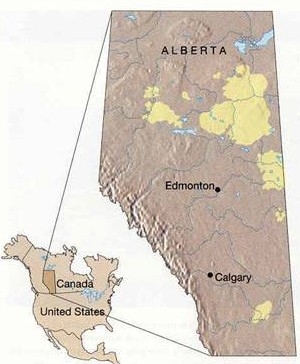
But trying we are: according to the respected energy analytics firm Wood Mackenzie (WoodMac), about $117 billion is going to be spent on the tar sands by 2015.
Let's look at some of the challenges.
Cost Inflation
In a fine demonstration of the receding horizons paradox, WoodMac issued a report in March entitled "The Cost of Playing in the Oil Sands," which showed a 55% cost increase since 2005 for a peak flowing barrel of oil derived from the tar sands.
They further noted that in 2006 alone, many of the large tar sands developers announced cost increases and project delays, as they experienced an average 32% cost increase for integrated mining projects, and a 26% increase for in situ projects.
For example, last year Shell Canada shook investors when it revealed that its Athabascan tar sands operation would cost $11 billion Canadian to expand its operation by only 100,000 barrels per day-six times the original cost estimate, which was made only about eight years earlier.
Around the same time, a research report by Merrill Lynch said the cost increase would mean that the Athabasca project would only make about a 10% return on its investment if oil were to remain at least $50 per barrel!
WoodMac analyst Conor Bint issued a clear warning about the tar sands' receding profitability horizon, saying, "Companies in the oil sands will have to control capital expenditures going forward to ensure that project breakeven prices do not exceed current levels in order to remain profitable."
And what are the cost-inflating culprits, according to Bint?
The usual litany: labor shortages and skyrocketing material costs. "With the sheer number of oil sands projects together with the future arctic pipelines and conventional oil and gas developments in Alberta, labour demands in Canada will be pushed to their limits."
Which sort of calls bullshit on their helpful tip that good project management and contractor scheduling will help keep costs in line. No doubt, you must carefully watch your labor hours when your typical field hand is pulling down "combat pay" in the six figures. But that isn't going to help you a bit when tires, steel, machines, and basic metals are all going through the roof under the crush of increasing global demand, primarily driven by Asia, and primarily due to high oil costs. For example, the price of steel is up 70% in just the last five years.
In a recent essay on the cost inflation of conventional oil projects ("Upstream Economics and the Future Oil Supply"), oil analyst Dave Cohen made the shrewd observation that "the situation presents a classic Catch-22," where "the cure for industry inflation is a slowdown in upstream activity, whereas the initial goal was to accelerate upstream development to meet growing global oil demand."
Cohen notes that the cost of finding and producing oil has outpaced the growth in the price of oil. While oil has risen about 32% since 2005, costs have increased about 79%.
Given that the cost of finding and producing conventional oil is in the neighborhood of one-fifth that of producing tar sands, this is not an investment-friendly scenario.
Finance
Naturally, the aforementioned factors are leading to questions about the long-term viability of the tar sands industry, and slowing the pace of financing for its projects.
For not only are costs rising, they're rising faster every year, across the board: for labor, materials, and energy. And in all likelihood, taxes and pollution-related costs will soon join the list.
Each of these trucks weighs more than two 747 airplanes. "It's like driving your house downtown."

For example, Canadian Natural Resources Ltd. said in March it wouldn't move forward with its plans to build an upgrader plant due to runaway costs, and Synenco Energy Inc. shelved its upgrader in May. Likewise, last year France's Total SA announced that it was pushing its tar sands project back by three years, again due to soaring costs for labor and materials.
"I don't think it's an anomaly," says Mark Friesen, a Calgary-based analyst at FirstEnergy Capital Corp. "I think it's an indication of how difficult the environment is. If we're not careful, more projects may end up being delayed or cancelled."
Delays are now becoming endemic to tar sands operations. Major equipment such as cokers and metallurgical towers now have waiting times of two years or more, more than double the wait of three years ago. (Now there's an obvious investment opportunity.)
A shifting landscape of taxation also dogs tar sands ambitions. The removal this year of a significant tax advantage for Canada's income trusts, which have been among the largest backers of tar sands projects, caused Canadian Oil Sands, one of the largest trusts, to post its first net loss in its 10-year history.
An accelerated capital cost allowance that was initially offered to drive investment in the sands has also been removed this year, which should net the federal government an additional $1.4 billion or so.
But perhaps the biggest financial threat is a change in the royalty rates. For over a decade, Alberta sought to attract financing by offering a mere 1% royalty rate until the initial costs of the projects are paid off, at which point the rate reverts to 25%.
It's no surprise then that tar sands developers appear to be gaming the system by extending their "initial" investment in phases over a period of years, effectively stretching out the time they can take advantage of the 1% rate.
That rate typically translates to less than 50 cents on a $70 barrel for Alberta's coffers. On the roughly $15 billion in tar sand revenue in 2004, Alberta took home only $700 million. And the $905 million that Alberta took in last year was actually less than it garnered from lotteries.
Consequently, Alberta is eyeing some additional changes to its tax structure for tar sands. It doesn't want to be accused of bait-and-switch tactics, but it's also facing the aforementioned increasing costs for all public services. At the same time, it is looking at an overall decline in income, due to the winding down of its conventional oil and gas operations, which pay up to 40% in royalty rates.
And let's face it: given the immense challenges ahead of us for liquid fuels, thanks to peak oil, and the desperation of oil companies to find anything worth investing in at this point, a 1% royalty rate seems an outright steal of natural capital from the people of Canada. No wonder that a public consultation process on the taxation of tar sands projects is now under way.
If the royalties on the tar sands were allowed to rise to anywhere near the normal levels for oil-around 40%, not 1%-the entire industry would cease to be. The profit would vanish, simple as that.
Next week, we'll look at the rest of the tar sands' troubles: water, energy, labor, and the environment.
Until next time,
Chris
Many thanks to Roel Mayer for his contributions to this piece.
Personnel
Archives
- December 2008 (1)
- October 2008 (1)
- July 2008 (2)
- June 2008 (2)
- May 2008 (6)
- January 2008 (2)
- December 2007 (8)
- November 2007 (9)
- October 2007 (11)
- September 2007 (14)
- August 2007 (14)
- July 2007 (10)
- June 2007 (9)
- May 2007 (11)
- April 2007 (9)
- March 2007 (11)
- February 2007 (11)
- January 2007 (11)
- December 2006 (12)
- November 2006 (16)
- October 2006 (13)
License

This work is licensed under a Creative Commons Attribution-Share Alike 3.0 United States License.
Tax subsidies, eh?
Canadian ethanol.
Thanks for the great article. Well presented, clear explanantions without overuse of technical terms, and a horrifying picture or two. Well, I personally find it horrible that we're considering strip mining an area that size. I hope against hope that the entire operation will grind to a halt, but fear profitablility will continue to be provided by our ever-generous to large corporations government.
The removal this year of a significant tax advantage for Canada's income trusts
For those who don't know that may be talking about, income trusts were essentially a tax loophole that had major corporations re-defining themselves as income trusts, to avoid what are already low corporate profit tax rates. It was a rare sensible taxation move from the conservative government.
"Well, I personally find it horrible that we're considering strip mining an area that size."
Yeah? Funny know no seems to have a problem with mountaintop removal blasting in the hills of the U.S. Appalachian Mountains in one of the most ecologically diverse areas in the world, not even even that great greenie Al Gore, who lives within less than a day's driving distance. Instead, effort is expended at fighting windpower and laughing at solar development.
Our bizarre fuzzy logic is sickening.
RC
The explosives used for "mountaintop removal" in West Virginia are equivalent to 270 Hiroshima bombs, every year.
Good analysis. The twin limits of financial risk and actual or impending factor limitations are actually - literally - crowding out much-needed conventional and conservation-related investment.
A good example of forced savings: The prospect of steady and growing (post-peak!) returns for 25-30+ years in tar sands makes oil and gas drilling with uncertain near term price outlook, especially in blowdown, uneconomic. We are neglecting near-term drilling for long term payout. The reverse of usual North American commercial practices!
Huge amounts c. $100k plus per flowing bbl or another $400 billion (plus escalations) to get to 5mm bbl by 2020, as some wish, start to crowd out and increase cost of all other kinds of investments. Result: Conventional oil and gas and most other energy investment has been dead money for three years. Remarkable at this stage.
I thinmk tar sands will top out at 3.5 mm bbl maximum and take many more years tif ever to reach 5 mm bbl. Unless, of course, large subsidies like water are forthcoming.
Suprised there was no mention of the THAI technology gail mentioned last week:
http://www.greencarcongress.com/2006/01/petrobank_ready.html
If this is all its said to be cracked up to be 5 million barrels a day may be a low number.
Antidoomer...
What's your upbeat assessment of the strip mining photo...
Any ideas on who gets to finance the clean-up?
The stip mining is not good, but if you look at the THAI technology in the link, no strip mining in necessary. It appears to be clean and relatively uninvasive.
Antidoomer,
What's THAI technology? Any good links?
Toe-to-Heel Air Injection (THAI) sounds good in theory. but many questions remain.
How resource-intensive is this process, especially in terms of water? I do see a waste stream chart, but I am not sure of the size of the project it is related to.
Speaking of waste, the analysis of pollution generated seems to focus on storing contaminated water from doing the THAI process. I do wonder what additional effects the process will have that are presently unknown or simply not convenient to talk about.
As with most enthusiastic releases of partial information about new technologies, I see no real breakdown of project costs and benefits. The all-important issue of externalities is also left undiscussed.
It is swell to be enthusiastic about new technology, but in addition to questions of real costs and benefits, one might also ask whether or not the whole project of expending so much of our current resources on extracting even more stuff to burn in cars is really the best focus.
Of course the Free Market knows all, so not to worry. The Free Market is God, as we all know. Does God exist? Or if God exists, must God be the Devil?
The "market forces" driving this development are predicated on completely false models of reality, are they not?
Smart people in the neighborhoods I work in maintain careful suppression of such questions about the way in which our rather fragile coccoon requires destruction of our larger and real ecological economy.
Whether doctor, banker, lawyer, or engineer working on biofuels, few are yet willing to acknowledge -- let alone critically examine -- the human cultural dimensions which are the core response our ecological predicament calls for.
THAI seems to me to be another tool in the toolbox for maintaining intentional ignorance about our ecological economic predicament, which is far more serious than any financial economic predicaments we can imagine.
Used in a limited way, THAI might be helpful -- but also not economical in terms of our current understanding of economics
Used in a conventionally economical way -- if that does work out -- THAI will be integrated into a system that has already mortally wounded our habitat, demands ignorance of this fact, and refuses to countenance critical examination of our human predicament in order to allow for poitive strategies of healing to emerge.
E. O. Wilson put it best:
"The human hammer having fallen, the sixth massextinction has begun. This spasm of permanent loss is expected, if it is not abated, to reach the end-ofMesozoic level by the end of the century. We will then enter what poets and scientists alike may choose to call the Eromozoic Era -- the Age of Loneliness. We will have done it all on our own, and conscious of what was happening. God's will is not to blame."
(From "The Creation" Chapter 10, "End Game," page 91)
I do discuss THAI, briefly, in part two, coming out next week. But I don't regard it as being terribly significant because it's nowhere near commercial deployment in volume yet.
--Chris
Energy consultant, writer, blogger www.getreallist.com
The Oil Junkie's Last Fix, indeed. That phrase pretty much says it all.
Superb article. I do think that the maps and photos help to understand the huge investment we have in continuing the status quo.
I question why we put so much into "developing the oil sands" rather than in examining our human relationship to energy and other resources and our habitat in general.
This relates back to questions regarding the Iron Triangle and also to the strange combinations of characteristics our species possesses at this time with regard to our inability to act in favor of our own survival.
Homo sapiens occupies a small niche in a large, complex shared habitat. Our self interest is best served by preserving the habitat of our planet for the great variety of species with which we share it. Our conventional strategies for survival actually kill off other species by destroying their habitat with increasing fury.
So the oil sands seem like another chapter in the biography which chronicles the self-destructive behaviour of a junky gone mad for another fix.
A bit of culture change is long overdue.
More people should pay attention to archeology, and cultural anthropology. The world is filled with examples of earlier civilizations that went extinct because they used up their resources, or succumbed to some natural catastrophe. All you need is a shovel. I'm sure those civilizations had the same kind of discussions and such that we are having today.
"More people should pay attention to archeology, and cultural anthropology. The world is filled with examples of earlier civilizations that went extinct because they used up their resources, or succumbed to some natural catastrophe."
(oh boy, time for a little rant)
What point does that make? They would have never been civilizations at all if they hadn't got off their stuupid azz and tried to do something, so we would not be able to use them for examples of anything could we?
The one sure way never to make a mistake is to never do anything.
Now, having said that, I have said from the start I felt that the Tar Sands were a dead end, for purely economical reasons and becuase of the waste of natural gas in producing it. Do I feel it will in fact be produced?
Probably so, but not as a commercial fuel. The tar sands and the North American oil shale can provide the U.S. military establishment with all the fuel it will need to remain a great world power for at least the next two or three centuries, if nuclear is used to extract it.
Hidious thought you say? Maybe. But the military establishments of the world do not have the terror of nuclear power the civilians do. The still live within yards of working reactors everyday (on subs and aircraft carriers)
Plus, they are already up to their azz in nuclear waste to deal with anyway, what's a few more tons going to matter if it extracts high quality liquid fuel for the most modern military machine in the world.
So, they wait for the civilians to fall on their face and agree to come and "rescue" the industry for national security purposes.
See, the problem is that the folks at TOD think that a phrase such as "our lifestyle is non-negotiable" is a freakin' joke.
It''s NOT. We have soldiars suffering and dying everyday in the deserts of Iraq and the hills of Afghanistan. Do you think the security systems will balk from the fear of a little bit of nuclear activity out in the middle of the arctic outback?
These people aren't foolin around. They are their supporters will die to avoid having themselves and their children going back and livng like a bunch of fvckin' apes in the trees whose biggest earthly accomplishment is pickin' the ticks out of their azz. Some may dream of that. Let them go do it.
Many will fight it to the last blow. Sorry, that's just the way it is.
If you don't want the oil sands and the nukes and the shale, or at least just want to stay the helll away from it, you best be helping come up with better alternatives instead of laughing at all attempts.
(end of rant...and all names were omitted to protect the guil.....opps, the innocent! :-)
RC
You missed my point entirely. I've mentioned in other threads that we will fight over the table scraps. But history can teach us some useful lessons if we are smart enough to listen.
As for the military, please don't presume to lecture me. I spent 20 years in the USMC to preserve your's and every other citizens right to bitch about whatever blows your skirts up. I swore an oath to protect and defend this country against all enemies, foreign and domestic, and I've never gone back on it. Have a nice day, and go a little easy on the drugs and alky.
And just so you do not misunderstand, even not knowing your history, I was in no way attempting to lecture you. If it was taken in that way, you have my apology.
On the military issue, first, let me do the right thing: Thank you for your service in what is a hard and under rewarding profession. I live next to a military base that my father worked at for over 30 years, have uncles and great uncles who have served thier life in the military. I have not served myself, and due to that great peacetime run we had after Vietnam, I was never called to.
And to make my point clear, it was that the efforts of the American government and military should indicate to anyone that we do in fact intend to continue on a modern state and a world power. Some may differ with those goals. That is their right. But those are the facts on the ground.
The "cost structure" and goals are a bit different when it is a security issue. No one really argues about the exact retail price of an F-18 or an aircraft carrier if it is percieved that is what needed to survive and prevail.
On history, that is a bit closer to an area I have dealt with than the military.
I absolutely agree that study of history in our current situation is vital to assist understanding of paths taken. However, it is easy to misinterpret history. Caution must be taken. G.W. Bush for example used history as an example, and cast Saddam as Hitler, all who questioned the Iraq war as Chamberlian in 1938 England and himself as the Churchill. Was that a correct use of the lessons of history? You be the judge. But it silenced all opposition at the time.
To America's ememies I beg you...do not underestimate the resolve of this government and this nation to survive. Please do not. The human suffering has already been great in making that error. Bin Laden and the gangs who desire our destruction (and despite the knee jerk anti-Americanism we often see, they are very real) can get a few of us. But they did not bring a big enough dog to the fight to win their stated prize of our destruction. Instead, they have assisted in bringing real horror on the whole of the Middle East.
Was that their goal? Educated Muslims and Arabs should ask themselves that question.
Back to point.....nuclear devices in the tar sand and the oil shale regions to extact millions of barrels of usable oil? They'll do it. The Canadians will do it, because they, like us, will in the end refuse to be carved up by our mutual enemies.
And if that sounds fueled by "drugs and alky" you go back over it and let me know where you proved me wrong. All lessons will be taken as a gift thank you.
RC
al Queda & friends whipped the Russians soundly - they bled them and bled them, no matter what was thrown at them. The Soviet Union, as we'll recall, crashed and burned after spending themselves in Aghanistan.
Now the United States is caught in the same trap. 150,000 troops pinned in Iraq, a half a trillion dollar crater in our national balance sheet, another division's worth of troops in Afghanistan not getting near the beating we're taking in Iraq, but Pakistan(nukes!) is sliding into chaos, with Waziristan breaking free, and the British abandoning their position in Iraq so their troops can face real threats in Afghanistan.
The military we've constructed to defeat the Soviet Union in an organized land battle in Europe is not quite useless in a low intensity conflict in Iraq. Should We, The People decide to conduct a genocidal war in Iraq in order to control their oil it may again be effective. This strikes me as madness, but I look at our neocon assclowns (industry term - diplomacy) and I think that this will be the case.
There is some debate as to what caused The Soviet Union to collapse. As I understand it, there is some consensus here that it was caused by Saudi Arabia (on orders from America) flooding the world oil market with cheap oil. Russian oil revenue quickly shriveled, and then did their empire.
The United States is not in the same trap as The Soviet Union. We still control Saudi Arabia, which is to say, we still control the world oil market. Russia never did.
We still control Saudi Arabia
“I would work with our friends in OPEC to convince them to open up the spigot, to increase the supply. Use the capital that my administration will earn, with the Kuwaitis or the Saudis, and convince them to open up the spigot.”
http://www.ontheissues.org/Celeb/More_George_W__Bush_Energy_+_Oil.htm
I'm sure Bush understands, as we do, that there is no spigot to open. This is rhetoric. Next! :)
The articles in Foreign Affairs indicate we've flat burned that relationship by our stupid, unipolar actions in Iraq. Yeah, we're the big dog, but we're half blind, toothless, and peeing on the carpet ... the Saudis, the Syrians, the Turks, and the Iranians are all delighted(NOT) by our antics. History is full of examples of what happens to empires that overreach in the face of no opposition ... the smaller players gather round and form a thwarting party.
bmcnett,
Are you sure you don't have the control relationship reversed, "white slave" ?
The Saudis didn't open the tap to destroy the Russians, they did it because Jimmy Carter's energy policies were working, an demand destruction from high prices. Go look again at the charts of world consumption and price history, and read what they said at the time. Attributing anything to Reagan except White House naps is on awfully shaky ground.
Bob Ebersole
I will go give it a look, thanks Bob.
The control relationship is not as simple as "white slavery."
We need them because they have a lot of cheap oil, and we need to control who gets it and on what terms.
They need us, because without our weapons, their monarchy would collapse.
Perhaps I was a bit harsh. This (misunderstandings) is the primary reason I dislike controversial discussions conducted on the internet. It's far too easy for everyone concerned to get their dander up. 'nuf said. Perhaps we can start over on a more amicable note.
My name is Gene. I'm in my '60's, on my 3rd career (avocation rather than a "job"), married for 36 years, reasonably comfortable in life, and expect to be around for another 20 years or so if family history is any guide. Pleased to meet you.
Just as a point of technical interest, you ( and others )may or may not be aware of an organization called DARPA. If not, I'd recommend visiting their website. In particular, this http://www.darpa.mil/dso/thrusts/physci/index.htm may be a good starting point to see what sort of basic science is being done that will likely have civilian as well as military applications for energy interests. You won't get a lot of detail, but the site is quite extensive, and extraordinarily interesting and informative.
And if you have a potential solution applicable to one of their thrust areas, they will be glad to throw some money your way.
For anyone who wishes to harm this nation, and who might be reading this, they would also do well to review this site. It may change their minds. Keep in mind that this is all public information, so one can infer that "more interesting" work is also being done. :)
These are the folks who actually did invent the internet by the way.
Gene,
I'm glad you found The Oil Drum and are sticking around and commenting. Your service is your best credential, it shows your sincerity and sense of honor. The best part of being a Marine is your loyalty to each other and to the rest of us in this country.
I suspect we disagree a lot politicly, and I was one of the immature assholes that couldn't appreciate the true patriotism of men who saw their duty and no matter what, did the deal. These days I can see how wrong I was then, and I'd like to thank you for your service to the country and the rest of us, even when we are wrong. Semper Fi sums it up.
Bob Ebersole
Gene,
I'm glad you found The Oil Drum and are sticking around and commenting. Your service is your best credential, it shows your sincerity and sense of honor. The best part of being a Marine is your loyalty to each other and to the rest of us in this country.
I suspect we disagree a lot politicly, and I was one of the immature assholes that couldn't appreciate the true patriotism of men who saw their duty and no matter what, did the deal. These days I can see how wrong I was then, and I'd like to thank you for your service to the country and the rest of us, even when we are wrong. Semper Fi sums it up.
Bob Ebersole
Maybe not so much (re: political views). Career military folks have a somewhat more long term view of things than this or any former occupant of the White House or Congress. Many people misunderstand from the getgo where the militaries loyalties truly are. It's not with any individual. It's to the Nation as a whole, regardless of who happens to be in office at the moment. Politicians of whatever persuasion sometimes forget that, and need to be gently reminded from time to time. Even the Commander-In-Chief.
It also works in the other direction, at some degradation in efficiency but it's worth the cost. There is a reason the US Military does not have a single service, but rather several "branches" with some overlapping functions and cooperative tasks, but with separate chains of command (USAF,Army, Navy, Marines, etc.). It is to preclude one branch from having too much power, thereby avoiding the kind of military dictatorships that consume many other countries. Periodically someone will propose that the services merge for the sake of cost efficiency, etc. Bad idea, and never goes very far for the reason stated above.
Do you think that Bush has cultivated personal loyalty within the military, or perhaps I should say loyalty to dominionist sensibilities above service to the nation?
I think this, a former girlfriend who is a reserve captain shares that view, and an airforce major I dated before her had done the academy thing and while she wasn't forward about her beliefs I think she was in favor of that whole Christian Embassy thing ...
I'm curious to hear the views of someone who served prior to the Bush administration's poisoning of every single institution we have.
:) "I'm curious to hear the views of someone who served prior to the Bush administration's poisoning of every single institution we have."
I have to smile a little at that. I've heard this nearly identical statement more than once in the past 40 years or so applied to every President since Eisenhower. "Poisoning of institutions" ( such as the military for example ) isn't quite as easy as you seem to think. In general terms, every elected leader since G. Washington has tried to "cultivate personal loyalty" to a greater or lesser extent. Usually unsuccessfully, since we have a thing called "Term Limits" - at least for the Presidency - so career people know they will be around long after that individual has departed. Lends a different perspective. As has been said: "Patience grasshopper, this too shall pass." :)
In any case I think my personal political views of Pres. Bush are mine. I don't mean to sound uncooperative, but I don't discuss personal politics, religion, personal finances, and several other subjects with anyone, let alone complete strangers. Sorry.
Gene
I spent most of last year in El Paso, and the motels I were at were full of career Army, Army Reserve and contractors that were retired military. I got to be friends with some of them, and was very impressed.
One thing I'd like to note in particular-the Reserve kids were truly fine young men and women. They'd mostly joined as a way to work their way through college without crippling debt, they represent the best kids in our country, they have a great work effort and a sense of duty and service. And, the administration has horribly abused them by putting them in this war.
The retired military and professional military were first rate too. The retired guys were a little more vocal, but it was easy to tell they didn't support the war, but, they'd taken the money and they were going to follow through with their duty, it was both a personal sense of honor and loyalty to their fellow servicemen.
So it was a real eye-opener to me. I began to see that we all need to see our common heritage as Americans and celebrate the things that we all hold in common-we all love this country and do what we do out of the same motives, we want the best for the country and the world. Sure, there's some nut and sociopaths that would rather divide us because they see manipulation as their personal path to power and wealth. Unfortunately, way too many of them are in politics and the media.
But, my father was a marine in WWII and Korea. My grandfather was an Army Medic serving with the Marines at St. Michael, the Argonne and Belleau Woods. I was born at Quantico, but Viet Nam kept me from being a Marine, and I'm not sorry about that. As I said, thanks for your service!Bob Ebersole
Bob, I appreciate your comments and your views as well as those of others. I really do. But, I fear this subthread may stir up peoples feelings on one side or the other of past or present disputes, or dredge up ancient history, or digress into areas that will likely only end up in acrimonious and pointless arguement. So, if you're agreeable, I'd just as soon end it here.
I pretty much agree with the military aspect. This week's North American get together was probably more than Hi, how are you.
As for your thoughts on wind the other day,
"The reports of my death are greatly exaggerated"-Twain
I don't mean to be flippant, just that I think that wind has a long way to go, and will. Though perhaps not off Long Island.
"As for your thoughts on wind the other day,
"The reports of my death are greatly exaggerated"-Twain"
I hope your right.
RC
ThatsItImOut wrote:
You presume that civilization is a good thing. Civilization is, in fact, a kind of fire that burns away the natural world, until cheap fuel runs out, when it collapses, destroying those who supported it.
The Inuit (Eskimo) and Kalahari Bushmen have no civilization, but peak oil won't be any problem for them. They won't even notice.
I refer you to Jared Diamond's article for "Discover Magazine," "The Worst Mistake In the History of the Human Race."
http://www.agron.iastate.edu/courses/agron342/diamondmistake.html
bmcnett:
You said:
This seems to me to be a really bizzare thing to suggest. Both the Innu and San cultures have been deeply changed by the dominant societies that have surrounded them.
It would be way "off thread" to detail this but please let me suggest that you do some basic research into current conditions.
A few links however...
Archbishop Tutus appeal to the Gov't of Botswana and others to refrain from further efforts to destroy the San people (they want the lands for diamond mining and "eco-tourism", and now AIDS is getting a foothold there):
http://www.survival-international.org/news/2016
Wade Davis speaking at TED on the state of the "ethnosphere"
http://www.ted.com/index.php/talks/view/id/69
Of course these people have been deeply affected by agriculturalists and fossil-fuel-using cultures. I never said otherwise. What I said: if gasoline were to spike to $10 a gallon tomorrow, it would not affect the daily life of traditionalist Inuit and Bushmen.
if gasoline were to spike to $10 a gallon tomorrow, it would not affect the daily life of traditionalist Inuit and Bushmen.
O.K. lets see if we can bridge this gap here...
If I'm a present day "traditionalist Inuit" in the north I'm living in a house heated with oil, who's electricity is produced with a desiel generator. The people and goods that come into and leave my community move on a gasoline powered aircraft and / or an oil powered supply ship.
When I go out on the land for part of the year to hunt and fish I'm using a gasoline powered outboard motor, skidoo, or quad-runner.
How am I immune to increases in fuel costs?
If I'm a "traditionalist" San chances are I'm in a forced "resettelment camp" due to a policy of ethnocide on the part of the national government to clear the way for mining development. I suppose you could say that the price of gasoline is the least of my worries at this point...
http://www.brightcove.com/title.jsp?title=340419304
We would argue over your definition of "traditionalist." There do exist hunter-gatherers today who use no fossil fuel at all. Some are Inuit, some are Bushmen.
I don't get out much, but I've seen Inuit on TV in 2007 whose primary transportation is sled dogs. They may have grown dependent on cheap guns, but that problem could be solved.
As for the "San" hard times indeed. Similar problems for the indigenous peoples of the Amazon, who are now succumbing to mass industrial destruction of their land.
The true traditionalists - the ones who reject all fossil fuels - will not be hurt very much by $20 gasoline. There are vey few such people, but they do exist.
Not saying your wrong, just that I can't find data, so could you tell me what you base your assertion on that there are still some Inuit living totally "fossil free" i.e. more or less pre european contact lifestyle in the north?
I do agree that there are still primary culture hunter gatherers elsewhere on the planet...
Hi Thatsit,
Oh Boy! a Rant! Thanks, that gives me the opportunity for a counterRant.
You carpetbaggers (american and canadian) think that civilization is the accumulation of more and/or new goodies and the head is for gobbling them whether they are Big Boy candy bars of Game Boy computor games or just more stuff. I doubt that we have had a civilized life since we used to sit on our azzes and picked ticks out of them. A lot of hubris and little ideation. (ideation doesn't reallly fit it, we think with our heads instead of deep down where we live, we think like we are out of our trees, we think in narrow little bands of expertise.)
Thatsit, I don't see that as a joke but as something that might at least save the planet. I have begun to feel that mitigation of the approaching catastrophe will merely feed the beast, We are hell bent on destruction and throwing in more new energy and so called energy saving devices does nothing to reduce what is already being used it will only extend the period it will happen in. The population increases, energy use increases, energy inputs increase energy outputs decrease, markets wobble and are propped up by temporary and inflationary measures while the electric grid throws sparks and brownouts and all the while ma nature does a tap dance on our vacuous heads
Your military needs more than oil to run on, it needs a working US infrastructure which is running on empty now. The guys that penned and used that phrase are not looking for any false salvation by mitigation they are just going to run till the tank is empty, just faster than us clever people would do it, thats all.
I believe the link stated the water ratio was 2 barrels of water for one barrel of oil.
'All three well pairs are expected to be on production by the end of 2006.'
So, were they? ... thats 16 months ago now!
Xeroid.
Here.
"we proved it in the laboratory, but we needed to prove it in the field. We've done that; now we just have to optimize and enhance it."
While Petrobank is coy about just how much its three pairs of wells at Whitesands produce, output rates of as much as 1,000 barrels a day of crude appear to have been achieved."
(By the way, the end of 2006 was only 8 months ago. It is still 2007, you know...)
I am just curious, looking for an update ... the article is from 16 months ago, and makes comments like
" expected to be on production" ... so, clearly wasn't on production when the article was written.
also from elsewhere ...
"output rates of as much as 1,000 barrels a day of crude appear to have been achieved." raises even more questions ... for how long? ... was it finacially viable? ... etc etc
Nearly all the alternatives to conventional crude (even if they are acceptable with regard to their effects on catastrophic climate chaos or are sustainable) seem to me to be " just around the corner, all we need is a bit more money and we will have a viable solution " examples: nuclear fusion, safe storage of nuclear waste allowing nuclear fission, oil from shale, batteries (in volume and at a reasonable price) for electric vehicles, photovoltaic solar panels (in volume and at a reasonable price), bio-ethanol that doesn't need huge subsidies, celulosic ethanol ... and on and on. This THAI technique on the face of it appears to be no different.
On closer inspection, for almost anything captured for the use of mankind the 'law of receding horizons' often applies or if the good or sevice is traded 'export land theory' applies and production of most things seems to 'peak' as well.
Xeroid.
Thus my advocacy for mature, widely used (outside the USA) non-oil transportation and geothermal heat pumps.
The Trans-Siberian Railroad was electrified in 2002 (as are most of the railroads of Western Europe & Japan and elsewhere).
It is possible to build massive amounts of Urban Rail. France now has only 5 towns of over 100,000 population w/o a tram or plans for one as their building spree moves to ever smaller markets.
Bicycles (with & without electric assist) can have a revolutionary impact.
http://www.lightrailnow.org/features/f_lrt_2006-05a.htm
Best Hopes for Proven Solutions,
Alan
Hmm - that link appears to be paywalled, but perhaps this one is not.
It's R&D; unsurprisingly, the company isn't releasing full details to the public. However, it appears financially viable enough that "the company plans to develop an initial 10,000 b/d commercial project, which, at capital costs of roughly $15,000 a flowing barrel, could cost about $150-million and be constructed in a year">
$15k/bbl, if they achieve it, is about one-seventh of what other technologies are costing.
Define "reasonable price". Americans in a sunny area can already buy solar panels cheaply enough that their cost for solar electricity will be no higher than what many Europeans pay for grid electricity, at least for an industrial-scale installation ($0.21/kWh).
Thermal solar might be a better approach, though, since thermal storage allows it to provide baseload capacity.
Define "reasonable price". Mass-market cars with large battery packs are already wildly successful (e.g., Prius), and all-electric vehicles are being produced as we speak for both personal (Tesla) and commercial (Modec) applications, and by all accounts are doing so fairly successfully: Tesla Motors will be making a profit on the Roadster within its first year of production.
The Tesla Roadster's battery is just made of the same cells that go in a laptop battery (about 7,000 of them), so they're certainly available in massive volume. Those 18650-type cells can be had for less than $5 online in tiny quantities; with a manufacturing cost of well under $2, though, the estimated bulk price is about $2.50 per cell or about $18,000 for the Tesla's battery pack; I'd call that reasonable for a sports car.
For people who don't need sub-4-second 0-60 performance, and who don't need a regular daily range in excess of 200 miles (which is almost everybody, even in the US), the battery pack could easily be much smaller and cheaper. The average American commute is 32 miles round-trip; most people would be fine with a 100-mile range, and many with a 50-mile range for daily use. Renting a car for the few times one needs to drive hundreds of miles in a day is quite cheap for most people.
Already exists, and Brazil produces huge quantities of it. The problem with ethanol subsidies is mostly an American thing.
Except tarsands. And electric rail. And heat pumps. And carpooling. And efficient turbodiesels. And electric rather than petroleum heat in industrial applications. And...
There's no lack of alternatives, it's just that oil in the US is so cheap there's no impetus to bother with them. Both of those will change.
Thanks,
you confirm just what I thought.
IMO, Brazil can't fuel the whole world with bio-ethanol ... maybe not even itself!
The Tesla Roadster is an all-electric sports car. It costs $90,000 and doesn't come out until next year ... so not available yet! ... even then it's batteries will need replacing regularly ... there are >600 million cars in the world - 7000 x 600,000,000 is a lot of batteries to make every 3 or 4 years.
The solar power example is the best though ... where I live it is cloudy and I use around 20 Kwh per day (despite things like solar panels for hot water, gas heating etc) ... so, from your website I would need to spend >$75,000 on the panels and the power would cost >82 cents a Kwh ... even if I had the space to put the panels!
I could go on and on but I think I will just leave it at that ... except to say there clearly aren't adequate alternatives at the moment.
So, as you say, something will have to change ... IMO, most likely ... less of everything ... which is a recession.
Xeroid.
Perhaps, but I certainly didn't confirm what you wrote.
What you wrote was that the technology required for alternatives was not yet viable. I showed that you were wrong, and then you tried pretending you'd said something else.
For example, I showed that bio-ethanol as a transportation fuel not only is viable without subsidies, it's been produced in high volume that way for years. You then came up with a ridiculous non sequitur about trying to fuel the whole world with Brazil's output. Precisely how many billions of gallons can be produced is a separate issue from the fact that ethanol can be produced in great volume and without subsidies.
Similarly, I showed that photovoltaics for generating electricity in large volume are not only viable with current technology, but could be used by an electrical utility right now to generate electricity for the same price half of the Western world is paying. You then came up with another ridiculous non sequitur about your house and putting solar panels on it, which is especially funny since you specified "volume" in your initial claim about photovoltaics. Your home improvement desires are a separate issue from the fact that photovoltaic panels can be used in large volume to displace fossil fuel consumption for electrical generation.
I could go on and on, but why bother? You made some claims, I showed - with evidence - that those claims were wrong, and you deluded yourself into thinking I'd actually supported your claims. It seems like it would be pointless for me to continue - not all the evidence in the world can change a closed mind.
Antidoomer....my thoughts from a week ago THAI is very close to going commercial...Petrobank will apply for a 10,000BPD permit this year for Whitesands....one year to construct/startup.
sorry....subthread url
http://canada.theoildrum.com/node/2889/228643
Dave, I'd like to discuss tar sands with you privately, please email me...address in my profile.
--C
Energy consultant, writer, blogger www.getreallist.com
If we ever get to the point where we have to dig "crud"/bitumen out of the ground to make gas from, that would be really silly....
Oh wait.......
Good look at an effect we may be be seeing a lot of:
Google Earth will get a good satellite view of this operation. Even some of the trucks are visible.
Do you have handy the Latitude/Longitude for the Google view?
No, I sure don't but it's easy to find. Very large areas of dirt, sort of rust red, and some strips that have grown back. About where the colored areas are on the map at the top of this thread. Dirt roads etc. are easily visible. Really ugly stuff.
57° 1'36.25"N
111°39'45.12"W
http://maps.google.ca/maps?ll=57.026807,-111.66271&z=17&hl=en&t=h
57° 0'50.66"N
111°39'35.99"W
http://maps.google.ca/maps?ll=57.014014,-111.65988&z=17&hl=en&t=h
Thanks.
Amazing that you can really see the truck.
When you pull back you see the scope of the operation in that the whole thing is almost 5 Km by 5 Km, Pretty big hunk of land taken down to dirt levels.
From looking at the overall sclae of this operation I get the idea that there needs to be some more infastructure added. Some kind of water cleaning operation. Using Solar radiation to distill the dirty water into clean water, so that you aren't totally wasting the resource.
I can see in my head how to make the devices needed, has the Industries tried to do this yet? Clean and recover the water they use!
Check out the zooming in and out, between ranges 2 km and 1 km. The up close shows these patches to be clear-cuts but in close there are trees and green growth at the 1 km resolution, but at the 2km resolution you see them as grey patches. I was zooming out and noticed them, wondering what they were.
Seem the forest in this region has been getting clear-cut for a while. Are these old tar-sand sites, or just regular forest harvesting sites?
Lots of the world's forests are getting chopped down and the Old growth while it can be called Old Growth does not do well in small patches. It will be like the Amazon and fail as whole region when it gets broken up into to many small patchs.
On a sad side note, I wonder how long the forests would last if everyone used Wood as our only energy source?
Chris:
Good post, thanks, looking forward to the next chapter.
Just a small question though. You said:
I was under the impression that the raw hydrocarbon being mined from the "tar sands" was Bitumen, a very viscious liquid, and that Kerogen was what is in "Oil shale" a solid insoluable material with a higher molecular weight than Bitumen which needs a different process to produce "crackable" oil.
John - the very point I was going to raise. Kerogen is the immature organic material present in oil source rocks. The tar in sands is the oil leaked from deeper reservoirs, water washed and degraded by bacteria on the way to the surface. Mainly bitumen and long chain HCs.
But apart from that an interesting piece. Hello Roel! Wellcome back to the real world. And with the worldy wise Dave Cohen in the mix - it almost feels like old times:-)
Royalty free syncrude being used in tax free jet fuel is an interesting mix. How much would it cost to fly if both syncrude and jet fuel were taxed at 40%?
Hey Euan, good to see you too, indeed. You like my law?
Hello Roel - that was a great disguise - I never guessed.
"The Law of receding horizons?"
I wonder if this is where traditional economics meets energy economics. If the EROEI is low then no matter what you do, even with state subsidies, you can't make it work?
I'd be very interested in comparative figures for SAGD (steam assisted gravity drainage) and mining - both in terns of EROEI and financial viability. I decided a couple of years back that the mining had no future, and so bought Encana as my favoured bitch sand play. Encana then had the most and best "deep bitch sand" acreage.
I'd also be interested to know how much direct solar or wind generating plant you can buy for your $54 billion? Down the thread, The Transition mentions $2 million per 2MW of wind. Thats 27,000 windmills, 54,000 MW installed capacity, with 30% load factor, that's 16.2 MW available to charge the Li Ion battery in your Tesla.
I was to dinner with a Shell engineer a few weeks back who said that part of their global strategy was to pursue sour gas assets. This sounds like a company with no future. And it is a great shame because we could have hoped that the energy companies deployed their capital properly today in order to secure our future. I guess they will hang.
This whole EROEI thing presumes that there is a profit motive. Being alive another day in a world that will allow your children to do the same is genetically profitable. I think we're going to see a move to take the measurement of progress away from the virtual person corporation and the associated DJIA fixation and instead focus on something more broad and human focused, like the misery index, but it'll need a better name and a basket of yet to be defined positive inputs.
Euan,
That is exactly what it boils down to. As EROEI approaches gutter values, you need an exponentially increasing amount of cash to keep it above zero. And you also need an exponentially increasing amount of energy to do the same.
Chris doesn't really like the fact that I want to keep coal, oil and natural gas out of the Law of Receding Horizons. My reason for that is that these are fundamentally different: they fall prey to the Law of Diminishing Returns. They have been successfully exploited on a large scale, and just run out.
Receding Horizons apply to just about any alternative form of energy I can think of. These cannot, and will not, be successfully exploited on a large scale.
Scalability is an important factor in this. The tar sands will fail because you can't get out enough, fast enough, on a large scale. The same goes for ethanol, where the corn or the willow or whatever feed simply doesn't grow fast enough. It goes for wind and solar, nice on a small scale, but you ain't never going to see a billion turbines or PV/thin film panels.
It harks straight back to the limits to growth.
I've likened the difference between coal, oil and natural gas vs all the rest to the difference between finding a loaded wallet on the street vs having to work for your daily meal.
NB: the first time I thought of this was when reading Deffeyes' Beyond Oil, in which he says of oil shale that every time, and there were 4 or 5 in the past century, people thought the time had come where it would be profitable, it no longer was. There's a pot of gold under that rainbow, but the little green guys will keep on hauling it away from you.
I'll beg to disagree on that one for the time being. I'm currently working with Luis into looking at the replacement rate required for wind / solar in an FF depleting world. I'd agree entirely about biofuels. But still hold out hope for wind, direct solar and nuclear. We can argue this one another day.
ACK!
You are so correct...I knew that, it was as a brain fart on my part to put "kerogen" there...it's what I get for having no technical review of my articles. Thanks for the catch and color me chagrined!
--C
Energy consultant, writer, blogger www.getreallist.com
Canadian Oil Sands Trust might post a loss, but isn't that a maneuvre to accumulate losses before the tax break for trusts is removed in 2011, so that it can continue to balance future profits past 2011 vs accumulated bookkeeping losses 2007-2011?
A trust can pay out dividend from cash flow, it doesn't have to show a bookkeeping profit, right? They still give a dividend of 5.5%. Dividends don't lie. And they just increased their dividend from 3% to 5+%.
I am invested in COS, btw.
Hm, interesting point, I hadn't considered that (I stopped looking at investments in oil sands some time ago). Thanks for that.
--C
Energy consultant, writer, blogger www.getreallist.com
So as an energy analyst, re coal, Chris: Peabody or Penn Virginia Resource Partners?
I haven't looked too closely at PVA, but after a cursory look, I'd say it's a good stable bet, esp. right now with the volatility of the energy sector generally, but not a big grower. Better profit opportunity in BTU over the long run IMO.
--C
Energy consultant, writer, blogger www.getreallist.com
OK, thanks anyway. My energy investments overseas are COS.UN, PWT.UN, PEY.UN, ERF.UN, STP.V, Anadarko, Chesapeake.
Hmm. Well, some folks invest in oil sands, "financial instruments", and so on. I invest in Smith and Wesson, Ruger, Winchester, black powder, good fences, fertile soil, and the old equipment to work it without anything more than a mule. My dividends are fresh veggies, venison, and chickens. Betcha I win :)
Thing is, I invest in that too. In fact the majority of my assets are in land, especially local forest here in Sweden.
And I own and live on a small farm (mostly pasture, end of road, superior and high location, water assets (including my own lake) yada yada yada), which I work myself using as old fashioned methods (and that includes bringing in the hay using a scythe and a good ole pitchfork) as possible producing meat, wheat and vegetables with some surpluses beyond family needs. And in my root cellar there is a years supply of home grown potatoes.
And I am a net energy producer, selling more energy as firewood (on a sustainable level, ie less than my forest grows) than the entire farm and household consume, including fossil fuels.
And I may not have invested in a Winchester, I prefer finnish Tikka.
But, yeah, some 40% of my assets, all net, no debt, is put into energy stocks and some very interesting off the radar Swedish alternative energy companies which you have not heard about. And yes, I will put up a wind turbine in the not too distant future.
Everyone with assets isn't clueless. I live in both worlds and will, if alive, come out on a relative top regardless of a pessimist or optimist outcome.
Tikka is good. :) They make some excellent world class weaponry.
I think we are probably set about the same in terms of land, etc. from your description, except it's a bit warmer here in Mississippi, so we can grow most anything. :) This little farming/ranching community has only been here about 200 years, w/plenty of game, woods, water, livestock, etc. Not a long time, by European standards, but long enough to be self sufficient if necessary without electricity or fuel. Like most such communities, we have all the basic skills and tools. I really hope it doesn't come to the point where we have to relive the dark ages all over again, but it's nice to know we could if we have to.
Regardless of many of the opinions here that big densely populated cities will fare better than rural communities, archaeological evidence indicates that it's the large metro areas that will suffer the most when resources become scarce.
Stay well, and good fortune to you. :)
Cornucopia, we get very little in the way of European points of view, thanks for taking the time and trouble to pst here! We do have at least a couple of Swedes though, so I know Swedes are good citizens of the world. I wish we had some Russians and more Africans and Asians, too.
You said you had some Swedish Alternative Energy investments. If you could tell us about any of them I'd be very interested in knowing what others are doing with their investments, and I'm sure others here would,too.
Bob Ebersole
Bob, I've invested in a group of private companies centered around a group of patents on electricity generation. The companies are called Seabased, Current Power, Vertical Wind and EnergyPotential, the last being a holding company for the other three.
All companies are upstarts.
Current Power makes powerplants for ocean-current energy. The first prototype is about to be deployed within a year.
Vertical Wind makes vertical wind turbines. It has working prototypes, and I believe they are negotiating their first commercial installations right now.
The most interesting of the three is Seabased. They make wave power-plants using buouys and bottom-based linear generators . They have the largest prototype installation in the world, a 20 buoy (or so) field which has been up and running, generating power for a year now, so they have great field data. And their first prototype was put into the water 2004-2005. The company have at least three contracts on full-scale powerplants, one british and two Swedish, each powerplant consisting of thousands of buoys, and costing hundreds of millions of dollars. One of the contracts is with the Swedish government owned utility Vattenfall, and is submitting environmental permits right now, and doing community consensus meetings. But who knows, it all may go BANANA.
Neither company have good webpages, and all articles in the media is in Swedish. The companies tries to hold a low profile, a luxury a private company can have, as they don't have to suck up to the markets. Low profile means more management time for developing the companies, instead of chatting with the press.
Some information is available at the Seabased homepage, http://www.seabased.se/engelsk/ , but most info is in Swedish. A picture of a buoy can be found at http://www.seabased.se/aktuellt/index.html . Some numbers may be found at the Vattenfall project page http://www.seabased.com/demoanl.php , but the text is in Swedish.
Perhaps something Matthew Simmons would like, he's been talking about ocean energy as the future. And I know that Kjell Aleklett of ASPO is one of the shareholders.
This is probably the most important issue worldwide for oil production post peak. Governments are used to taking a hefty tax from oil/gas developments. As cost increase the government is getting squeezed out. But you don't squeeze out the government. What this means is world wide new projects well stall. You mention receding horizons I think the process is closer to a start going super nova then forming a black hole.
In effect the majority of the oil still in the ground will become trapped beyond this event horizon never to be developed. In my opinion this breakdown of the oil industry itself is the biggest threat we face post peak. Thanks for the article and its important that we watch how the oil industry adopts to peak oil.
Plus the critical personnel issue. Back in 2000, I saw two studies that indicated that as many as 50% of the experienced oil and gas professionals then employed might be retired by the end of the decade.
This limitation on human resources worries me far more than does all the talk of financial gloom and doom. With finance problems, we can probably find a way to deal with them. It is not clear to me how we can deal with a critical shortage of chemical engineers and petroleum geologists, just to mention two specialties.
There is a real economy of humans doing labor, tangible machines and actual land; then there is a huge financial superstructure built on top of this. When the financial structure crumbles, you get idle land, idle labor, idle capital (plant and equipment), and thus financial concerns cannot be brushed aside. But from my perspective, our lack of engineers is going to hurt us far more than any financial limitations. We're going to need a lot more machinery and a lot of people who know how to operate it to deal with the consequences of Peak Oil, and you cannot just retrain an unemployed real-estate agent to be an experienced rail-car manufacturing worker.
At the same time that I expect massive unemployment, we will also have very serious shortages of people who can make things and who can keep complicated machinery going. Suppose we decide to expand our nuclear generating industry: Where do we find the nuclear engineers? Where do we find the Ph.D.s to teach a new generation of nuclear engineers? We can probably find ways to finance a great expansion of the nuclear power generating industry, but I'm at a loss to figure out where the human resources will come from. Thus, in my opinion, our lack of human resources is going to be a critical factor (and perhaps THE critical factor) in limiting our ability to adapt to the harsh realities that will emerge after Peak Oil.
You've touched on something that is all too common. Another forum I frequent also discusses the general issue of useful education and skills and the severe lack of adequately trained people in many vital industries. We've all read the horror stories regarding drop out rates, graduating kids that can't even read or do basic math, etc. I don't have any answers, but before I retired, the company I worked for spent millions on helping local schools with their curriculum and providing employee's with special skills to the school as part time teachers to help kids, out of pure selfish business interests. Many companies do the same, creating partnerships with local school districts to ensure a supply of future useful employees. It's a huge expense for many industries, but they feel it's worthwhile, and it is in the long run.
Thank you Chris for a well written, simply presented piece on the Canadian Bitumen Sands!
I've been trying to make the same point for awhile-that to get to 5 million barrels a day, about 35% of the current US imports of oil, its going to cost as much as the attempted conquest of Iraq has cost, and that's not including the production costs, pollution clean-up costs or the transportation and refining of the syncrude.
Each barrel requires 6 thousand cubic feet(MCF) of gas to heat and hydrogenate the sand and product, and several barrels of water. A cubic yard of the sands and clays containing the bitumen make at least as much waste as is mined as the raw bitumen sand material in place take up in the formation.The bitumen coats each grain of sand, and the bitumen removed is replaced by the water used in washing and cleaning the material. Most mining operations produce more waste by volume than the rock originally took up in the ground.
The operators are disposing of these waste by unlined open pit disposal, a practice made illegal in Texas about 1970 because it ruins the water sands of the farm or ranch for irrigation or stock watering.
Because of the toxicity of oil field waste water, it must be pumped into a disposal well or used for waterflood operations. Some of crude's constituents, naptha and benzene, are known carcinogens. While I don't know if these are present in tar sands, much heavy crude has other contaminents like heavy metals and sulfur.
The royalties are another serious flaw. Hugo Chavez had a similar royalty on the heavy crude in Venezuela- 1% , then escalating to 1/6th at pay out, or 16.666667%. When he attempted to raise the rates after years of negligable revenue and force the sale of 1/2 interest so Venezuela would share in the profits from selling the product, he was accused of "nationalising"the resource.
The same thing has happened in the deepwater offshore blocks in the Gulf of Mexico. During George H.W. Bush's administration, the Minerals Management Service issued leases with zero royalty to stimulate offshore drilling despite oil prices of $10-$12. The Minerals Management Service of the Department of the Interior "forgot" to put in an escalation clause when prices rose, or the projects reached payout, the US government would receive royalties, most commonly 1/6th in the Federal Gulf Waters. This is what the big oil companies are calling punative taxes in the Democratic Energy Bill. About half the oil companies that received the leases have agreed to renegotiate these leases, but their lobbyists are resisting, saying a signed deal is a deal.
I predict Alberta is going to have the same troubles as the US Government and the Venezuelans.
Gail the Actuary brought up the in situ thermal production processes which show promise for reducing costs substantially.I'm not at all familiar with Canadian Environmental laws. Will this result in massive CO2 pollution? Bob Ebersole
Perhaps Gail or somebody else with more knowledge of the thermal in-situ processes (like THAI) can respond more fully, but I don't think that those processes would "result in massive CO2 pollution" because the thermal cracking is done underground.
--C
Energy consultant, writer, blogger www.getreallist.com
My understanding is that CO2 pollution is lower than with current methodology.
I am working with someone on a guest post now that will look at some of the questions about THAI more fully. I don't know how soon this will be published - probably in the next week or two.
There is a diluent shortage in Alberta. There were acres of bitumen, but to send it down the pipeline to a refinery, one needed something to dilute the bitumen with like natural gas liquids. Natural gas liquids were more expensive than oil. To get diluent to the tar fields will require pipelines, rail cars, or trucks. The cost of recovering diluent from the bitumen blend is high as it is in the lighter part of the blend that was favored for gasoline production. The NGL's were also favored in petrochemical producton for their ethane content. The tar sands are not a quick fix for industries accustomed to cheap oil.
For those of us ignorant of the chemistry behind this - I thought the heating of the sands also involved some sort of 'cracking' - creating shorter chain hydrocarbons. Is this something that must be done in a more controller environment than the process that separates the tar from the sand?
I think you need to check your math Bob. 6,000 mcf of natural gas is equal to the 1 barrel of oil in terms of BTU's. The EROEI for bitumen production is much higher than what you stated.
Rainsong
I wouldn't doubt it, But I said 6 MCF of gas, still on checking, they use 600 cubic feet, or 0.6 MCF.
I know that the oil companies use the conversion figure of 6 MCF=1 BOE, or barrel of oil equivalent, but that's not accurate, either. Tar has more BTU per barrel,I think, but cubic feet are a volume comparison, whie BTU's are a thermal measurement. Coal has a higher BTU than either oil, gas or tar per thousand cubic ft, but costs a lot less than oil or tar on a volume comparison. Also different grades of oil or gas have a different BTU comparison economicially.
Even on a Dollar comparison the conversion falls down. Natural gas sells for about $7/MCF this year, while oil prices have been hovering in the $60-$75 barrel range. So when a company claims to have replaced their reserves on a BOE basis, they've actually produced a lot more of their future revenue than they found in Natural Gas on a revenue basis, and the Security and Exchange Commission allows this, which I consider a kind of securities and accounting fraud, because an oil company must replace about 200% of their reserves on a BOE basis to come up with the same future revenue on a real-world cash basis, because its an apples to oranges comparison.
But, be that as it may, I'm terrible at arithmetic
and please always double-check my figures! My ideas and observations are generally OK, but my maths are lousy. I wasn't a liberal arts major for nothing. Thanks for catching my mistake, Rainsong!
Bob Ebersole
What is the mechanism by which the law of receding horizons gets overlooked by corporate planners?
That's a great question, Nate, and one I have struggled with. I have to think there's a component of faith/wishful thinking. Then there is the process by which initial cost estimates are made, then revised, etc., and I suspect there are more than a few places in that where certain considerations can fall through the cracks. Or perhaps there are back-channel assurances offered by gov't to the developers that no matter what, they'll make sure that the ops are profitable. But I can only speculate.
--C
Energy consultant, writer, blogger www.getreallist.com
I wrote about belief and optimism here.
Last weeks Peak Oil ASPO review showed how 'optimistic' recent government energy projections can be:
So, its very possible that corporate planners use government forecasts when they should be reading TOD instead!
Politicians project optimistic visions in order to get elected. Corporate planners do something quite similar, but with a twist. Their first concern is shareholder value instead of votes.
When Chris and I started talking about this piece, it was around my question how on earth Shell could build a $54 billion upgrader for an eventual 400.000 bpd of production. It made, and makes, no economic sense. A realistic view, once you include my Law, says that a profit of $10 per barrel is a really good return for these projects. That would give Shell $4 million per day, $1.46 billion per year, at which rate it would take 37 years just to recoup the initial investment. That is, for lack of a better term, nuts.
There's more. The entire Shell upgrader project is supposed to take 20 years. Alberta's present inflation rate is 5.2%. That means a doubling rate of 13.4 years. Ergo, the total cost with that inflation rate would surpass $150 billion. But that doesn't yet include all the other factors that cause these crazy cost overruns, the prices of labor and materials etc. It's common these days to see projected project costs double every 2-3 years in the tar sands field. Of course they all say this will stop, but it keeps on going, and exponentially so.
So why do they do it? So far, I've come up with 2 main answers to that. First, as Chris writes, as long as they smear out the investments over a loooong period, they only pay a 1% provincial tax. That's free money. Shell CEO Jeroen van der Veer recently suggested taking the tar sands away from the main company, because the profits on today's bitumen are much higher than conventional oil. Shell rakes in profits from Canadian oil sands unit. He will regret that one yet, when Alberta raises their tax rates. It would make investing in the tar sands unit much more attractive, of course, so money could be raked in.
I think there is a more important reason for the investments in the oil sands, though. The main capital for an oil company is the reserves in their books. Shell needs those badly. And they're not thinking about their reserves in 20 years, but the ones in the books for 2007-8. No matter how idiotic their investments are in Alberta, the reserves will be there in the books, and the share price will remain strong. Which is the board of directors' prime responsibility.
The economic sense lies in the short term only: propping up share prices. What alternative do they have? Read TOD? And then what? Step up to the mike at the next shareholders meeting and say: it's too stupid to do this? No, they will go for the rosy picture. Even if that will bankrupt the company long-term, something that is inevitable anyway.
I was telling Stoneleigh yesterday that compared to the industry's multi-$100 billion investments, it would make a lot more sense to use the giant shovels to dig a hole and bury a few million in paper money every day in the forest. Much cheaper, and less destructive, Think of all the money you would save on water, gas, taxes and pollution credits.
The logic you are looking for doesn't apply to the decision makers in the oil industry. Even if they understand, they can't go public with it, since it would destroy the company's value. And somewhere in their contract, you can be sure it's stipulated that that is against the law. Our economic system doesn't allow for company executives to express views that do not promise more growth.
The long term view for the smartest among the corporate decision makers, I'm convinced, is identical to Louis XIV: "Après moi la déluge".
I'll refer to that as the Law of Louis XIV...;)
(probably quite robust)
This number $54 Billion is so high as to invite comparisons with what I thought were *far out* alternatives. It could be possible to build 20-40 1 GW nuclear reactors for that price (at least in China), the range depending on how much new plants end up costing. These in turn generate 1.8 PJ - 3.6 PJ worth of electricity each day that in turn could be used to generate 1.4 PJ - 2.8 PJ of Hydrogen via 80% efficient electrolysis. 400,000 BPD of Oil has an energy content of 2.4 PJ, so depending on the chemical engineering required to turn Hydrogen into hydrcarbons we're close to the cutoff price of Oil mining.
One could substitute Wind for Nuclear in the above calculation, then at 2 Million dollars per 2 MW turbine and with 30 % duty factor, we get 1.4 PJ worth of electricity. So I would guess that some places in the world are only a factor of two away from profitably making Oil from wind.
I should research the chemical engineering required to turn hydrogen into hydrocarbons.
Syngas. You can start with CO2 if you have extra hydrogen.
Its C02+H20+H2 if your going for syngas in general you would not generate hydrogen but would optimize the RWGS.
http://spot.colorado.edu/~meyertr/rwgs/rwgs.html
The actual core ingredient is CO carbon monoxide.
It has a friend reaction.
http://en.wikipedia.org/wiki/Water_gas_shift_reaction
Happy hunting from syngas its a choice of well known chemistry.
Making oil from water (and CO2) - with a sprinking of pixie dust? I'd guess the shortest route to this would be to plant corn or rape.
The financial considerations / absurdities are interesting to work through - but I can only guess that they lead to a net energy sink.
CH4 + 2O2 ------ CO2 + 2H2O
This reaction releases energy. To make it go backwards will consume energy.
2H2O ------ 2H2 + O2
This reaction consumes energy.
I think making "town gas" by reacting steam with coal makes your CH4 from H2 released from the H2O
4C + 3H2O ------- CH4 + H2 + 3CO
All the products here are combustible. The CO is also "toxic" thereby providing a cheap and easy way of keeping the depressed element of society in check.
Energy has to be added to this to make it work - and I'd guess more energy is added than eventually released (there must be data on the energy balance somewhere). The reason for doing this then is to up-grade the energy quality which I have decided is a vitally important concept. But the notion of quality varies enormously between applications and is not confined to the physical state of the fuel.
It gets worse. The same applies to friends, coworkers, and spouses. Nobody wants to hear the bad news. If you start talking bad news, they all slowly vanish into the woodwork.
This is why nations of millions may have the education to understand peak fuels, but don't have the will. Who wants to transform himself into the guy with the sandwich board that reads "THE END IS NEAR?"
I appreciate this reference in the original french language.
FYI, it is "le déluge", not "la déluge".
ChrisN are you going to mention radio frequency or microwave extraction methods?
Check Raytheon and Global Resource Corp, both claim 4.5:1 EROEI tar sands and shale
http://www.upi.com/Energy/Analysis/2007/07/20/analysis_oil_from_shale_co...
Bigelow: No, I didn't mention those processes because they're being applied mainly to oil shale, not tar sands. Although that article states "Raytheon's methods had been tried successfully with Canada's tar sands and should work with the heavier oil sands" we don't have any details on this assertion.
The fact is that many processes have been purported to make oil shale harvesting economical for the last three decades or more, and we still don't have a single commercial oil shale operation. The standard joke is: "Oil shale: fuel of the future...and always will be."
And as noted above, although there are a handful of new methods being applied to tar sands as well, I'm not really interested in them until they can prove their commercial viability...they'll have to get beyond the pilot project stage to pique my interest.
--C
Energy consultant, writer, blogger www.getreallist.com
I suggest that it may have a lot to do with the fact that recursion is not something dealt with well in human intuition, and the (brilliantly apt) concept of the "Law of Receding Horizons" is as recursive as a hall of mirrors. Or, if you like, an intersection of hells for linear thinking.
Corporate planners that admitted to being worried about peak oil but guessed its arrival too soon would be out of work. They'll keep at business as usual until it gets rammed down their throats. We're starting to see that now with the food price changes ... people are noticing something is happening.
I see a lesson here for those advocating CTL. Strip mining Montana as its governor advocates will use the same giant trucks the oil sands can't get enough of as well as similar equipment for the conversion process. We are running up against resource constraints in drill rigs for petroleum, the need to replace aging refineries, ethanol projects, and wind energy. On top of that there is a lack of technicians to build, operate, and repair this equipment.
We see movies where the space aliens are coming to rape and pilage our planet and our heros safe all of us from the aliens who are just going to strip mine the whole planet and leave it a bare rock in space.
Where are the heros to save the planet from the humans? Who seem to be just like the space aliens, only we don't have giant space ships to go to the next planet to denude.
Are there any plans in the works to repave those bare spots with the forest and the plains that they strip off to get to the oil sands?
Sleeping inside us, of course. Where do heros ever come from?
Is there any cause to root for mankind other than self-preservation?
Nothing glaringly obvious comes to mind.
If we had saved a lot of energy to divert planet-killing asteroids, you could make a case that humans had something to contribute.
As it is, the breeding plague of delusional fire-monkeys is worse than useless. Personally, I'm rooting for the cetaceans & refused to breed to give my selfish genes their comeuppance.
Bach.
Géricault.
Milla Jovovich's ass.
If you can't find anything of value in mankind, you're just not looking.
Perhaps the era of the whopper project is drawing to a close. Conservation we can all do at once on our own initiative. Home energy in the form of solar or wind (mind the NIMBYs) is next, and a water furnace if it makes sense in your part of the world. Ditch the SUV and buy a Nissan Versa. Get one of those Yamaha Vino scooters for the nice days.
The concept of profit is outdated. It worked for an expanding economy but its a miserable, one dimensional sort of thing now, much as the DJIA is a miserable measure of our collective well being here in the U.S. I welcome alternative measurements of success ...
Can the Tar Sands be burned like coal can for energy producton? I know it will create nasty smokestack wastes, I am just asking if it can be burned.
The Oil-Shale in the USA seems to have been burnt in the past in stories I have read about how it was first discovered.
Can the Oil-Shale be burned like coal?
The reason I ask this, is for general knowledge and as research for a story idea. What prevents later humans from taking these two mineral rock/sands and using them in power plants, when they do not care about the outcome of the waste products?
Thanks.
While this isn't exactly an answer to your question OPTI and NEXEN have formed a partnership to use what they call the ORCrude method to separate asphaltenes out of the bitumen to use as a synthetic fuel gas as an energy source for their SAGD processing instead of using natural gas. See link -
http://www.nexeninc.com/Operations/Athabasca_Oil_Sands/Long_Lake/SAGD.asp
CEOJr1963: "Can the Oil-Shale be burned like coal?"
The answer, I believe, is yes. Estonia is currently burning their own oil shale in a powere plant. This process is very polluting, and the EU wants them to stop
-
James Gervais
Hello CEOJr1963
First comment here around, hope to add some insight in a attemp to answer part of your question.
Yes, oilshale can be burned like coal (depending of the water content), oil shale is common in the Baltics and have been used as a power source for many decades. In the 90s its use increased manyfold, due to the starting of serveral commercial powerplants in Estonia, Russia/Sankt Petersborg
more info
One of the major problems is the ash produced (waste/dirt), as noticed elsewhere in this thread it is an immense problem, (PDF)
For a couple of years ago there was a discussion about building a powerplant in Greenland using their oilshale
Best regards
CEOJr 1963, the answer is yes, the in situ combustion techniques that Gail mentioned are that process, only in rock formations underground where the operators think they can control the process better and cheaper than just mining the bitumen for direct burning. Bob Ebersole
Thanks all of the above.
Welcome to The Oil Drum, Amager. Have you been reading long? You just got an account in the last 5 hours to post to this thread, and you seem knowledgable to the issues involved.
I knew the Oil-Shale, or Tar-sands would be dirty. Cleaning the smoke stacks and such would be one of the processes I'd use if I were in charge of using this resource.
Another Question.
Is using the Oil-Shale/Tar-Sand as a fuel source for electric generation, more cost efficient than digging and making syncrude out of it? I would think that with syncrude there is to much use of water, and Natural Gas, and that the simple burning of the stuff would not waste those two resources.
Thanks CEOJr1963. Yes i opened an account to answer your question (partly) and I have been lurking around for a looong time (started at Yahoo/Energy resources many years ago).
I was reading the yahoo groups in 2001, but moved over here a little over 2 years ago, because I found the information a lot more detailed and knowledgable.
I do still wonder about the use of Oil-sands as they are for a power generation fuel. Though it might still produce the waste products that mining and converting them to syncrude do. Just a thought.
Pictures of that place look like something from waterworld or mad max. Looks like the armageddon is with us! Presumably, any wildlife that may live there would be obliterated and restoration of the areas will never happen? All of this, just so that Joe 6-Pack can drive a "car" with the efficiency of a Model T Ford.
"Nobody needs to go anywhere else. We are all, if we only knew it, already there." (Aldous Huxley "Island" 1962, p38)
Not necessarily. Take a look at Syncrudes homepage at http://www.syncrude.ca/users/folder.asp?FolderID=5909
At no small cost they actually reclaim processed land, put back topsoil, plant new forests, put out herds of forest bison etc.
In 2006, more than $30 million was spent on reclamation activities. To date, we’ve reclaimed over 4,600 hectares and planted around 4.5 million tree seedlings.
First of all the requirement of 100% land reclamation, written in law, is absurd, since a 10.000 year-old forest cannot be rebuilt in a few years. What's worse is that no-one's even trying very hard to fulfill the legal obligations, neither the companies nor the government. This could change very soon, though, and then everybody has a huge headache on their hands.
And then the Receding Horizons will pop up again and in full force: the industry's investment in land reclamation would need to rise exponentially. This is quite likely to happen, since Alberta doesn't need to change a law for this one, just enforce the existing one.
Still, Syncrude boasting about their reclamation efforts is nothing but lies and nonsense.
In reality, when you re-plant a historic forest, you swap slow growth trees and high bio-diversity with fast growth high turnover soft woods, how do you transfer the 000,yr evolution of bacteria, funghi and insect life?! You can't. How do you protect any endangered species if you destroy so much land?! These places are so huge that I doubt you could ever properly survey them.
"Nobody needs to go anywhere else. We are all, if we only knew it, already there." (Aldous Huxley "Island" 1962, p38)
My question: Will the capital and operational costs of bitumen extraction remain high or eventually drop?
Steel has gone up in price due to Chinese demand and other demand growth. But steel making is profitable. Won't the industry expand and prices eventually fall and profit margins narrow?
As for labor costs: Won't housing in the oil sands region eventually expand enough that labor can come in and labor costs fall?
Which costs of bitumen extraction will fall or remain high? I see natural gas as likely to rise in cost. But at what cost of natural gas does nuclear power become competitive as an alternative way to power bitumen extraction?
FP:
All reports over the past 3-4 years, and probably before, point in one direction only: both capital and operational costs of bitumen extraction will not remain high or eventually drop, they will rise exponentially.
When you watch this going on for an extended period of time, while none of the prospectors of these projects escapes this cost trap, it gets hard to believe those who once again sing the same refrain of costs that will lower. On what grounds would they?
There is some sort of consensus that says costs normally should and will go lower as scale of production increases, but in the tar sands we see the exact opposite. That too is predicted by the Law of Receding Horizons. Steel production cannot. and will not, be increased indefinitely, and you can't pop out expert oil service crews at will, housing or no housing. And as WT stated, lots of the existing experts will retire soon.
Nuclear energy for the tar sands looks like a no-show: it is impossible to have any of it going before 2020 at the earliest, while Canada's natural gas runs out 5 years prior. How to solve riddles like that while at the same time the industry is set to triple production? They're already stretched at all ends.
If nobody comes up with the answers very soon, to problems of energy input, water use, hydrogen supply, and various sorts of pollution, as well as the financial conundrums and taxation boondoggles, the tar sands industry won't be alive in its present corporate form in 2015. Stalin could run it, but the Shell CEO cannot.
I'm not convinced by the pessimistic argument on costs.
Again, what is going to keep going up in price per unit of oil extracted? I see several components:
A) Labor. Near as I can tell the cost rise here is in cost per unit hour, not in hours per barrel.
B) Steel. The price went up because demand has risen, mostly due to China.
C) Energy. That cost has gone up. But what will determine economic feasibility is energy return on investment (EROI or EROEI). The cost of the energy inputs seems like they have a ceiling set by the price of nuclear power. New nuke costs have risen too. But that's again mostly due to higher unit costs of labor and higher steel prices. Won't both those come down?
D) Water. That could limit production. But more efficient ways to use the water might help here. Also, what's the price of piping in the water hundreds of miles?
E) Taxes: The Alberta government isn't so dumb as to kill the goose that lays the golden eggs. Besides oil prices will rise and increase the incentive to extract the oil.
Yes, short term prices seem set to rise. But CANDU reactors could be functional 4 or 5 years after the green light is given to build them. I'm expecting once the reality of Peak Oil sinks in the resistance to nuclear reactor construction will nearly vanish.
FuturePundit,
Alberta is giving big subsidies in the form of extermely cheap royalties, not enforcing any enviromental laws, and highways, roads and goverment services to the workers in the Alberta bitumen fields. Without the subsidies, the deal doesn't fly. How long are the citizens of Canada going to be willing to finance big oil with their taxes? Most of the syncrude goes to the US to be refined, so the Canadians are financing the US drivers and big oil companies. Thank's Canada! That's very Christian of you!
Bob Ebersole
Bob,
The Alberta oil fields are so profitable for Canada that the Canadian dollar has reached near parity with the US dollar. Canadian oil exports are driving up the value of the Canadian dollar.
The Canadians who are migrating to Fort McMurray to get high paying work see the oil fields as economically very beneficial to them too.
You simply have asserted (without proof) that the Alberta bitumen extraction doesn't fly without government subsidies.
Whereas you have simply asserted that it does. Not much progress there. You have also simply asserted that the tar sands are the reason for the Candian dollar's surge against the US dollar. Not much there either. You ask for all sorts of proof, which is fine, but then why don't you provide proof for your own statements?
Not in the post you replied to he hasn't.
What he did do was point out that an unsupported claim was just that - unsupported. He's made several other claims, but has not actually claimed that tar sands production is profitable without government subsidies.
It's almost certain it is, though, considering Shell makes a profit of $22/bbl from its oil sands operation, so the burden of proof is very definitely on anyone claiming otherwise.
You're right, there's a bit much implying of implying going on there. Shell's cheerleading $22 profit talk is just that, though. They want to take the tar sand unit separate, to raise more investment cash, and so they paint a nice and shiny hologram.
And anyway, it's not just the taxes that will cut into their profits, which is the whole idea behind the article. It's taxes, labor, materials, water, natural gas and more. Projected project costs rise at double digits every time you turn your back, and there's reasons for that.
Shell are a desperate company that badly needs reserves in the books. Full cost accounting falls by the wayside.
This is the post-Enron world - if they're making false statements about their operational profits, Shell executives could go to jail. If you'd like to claim that they're lying about their finances you're welcome to do so, but extraordinary claims require extraordinary evidence - the burden of proof is squarely on you.
I didn't start out the assertions. My contra-assertions are meant to show there are other possible assertions here. Also, I do not see the Alberta government coming out with financial reports that indicate it is under severe financial strain due to the high costs it suffers from the expansion of the oil sands production. Where's the evidence for this?
My basic complaint about the TOD site is the tendency of doomster commenters who make lots of unsupported assertions about how things are terrible and how economic disaster is just around the corner. Now, I'm willing to accept that economic disaster is around the corner if someone wants to prove it. I'm willing to entertain it as a serious probability if even some evidence with some unknowns can be demonstrated. But simply to assert that Alberta oil sands extraction is only made possible by government subsidies is hard to credit.
Future capital and labor costs are key to predicting the future viability of oil sands extraction. If someone wants to argue that capital costs will keep going up they need to demonstrate either:
A) That profit margins on inputs such as steel will stay high and even grow without new entrants into the market (and I'll be curious to know how this can happen).
B) The costs of inputs for creating the steel and other materials used for capital equipment will rise due to shortages. e.g. show that iron ore mines are running out of iron ore right now or that coke for steel is running out.
I could even buy B if one could show how peak oil will cause steel prices to go up as fast as oil prices. But I'm skeptical that someone can show that since there are other energy sources available to drive the production of steel and some of those energy sources aren't going to peak any time soon.
You may dislike what you see as a pessimistic view, but why do you think labor and steel costs will come down? In the past five years they have gone up exponentially. What would halt the process? I haven't seen one single indicator that tells me what or why.
The goose lays no golden eggs, that's the point. When 4 tons of scooped-up land give you a gross revenue of 25-50 cents, you're doing something very wrong. Alberta land sales revenues for oil and gas went down a tad:
Alberta makes more on gambling than on tar sands, and the revenue is going down. Yes, they will kill the goose, unless it starts laying. This whole thing is so ridiculous, they will have to raise the tax limits. Someone will figure out soon that Alberta actually pays to have its land destroyed. For real!
Real revenue has come from conventional oil and gas. Want to guess at how fast that's depleting? Just about all income for the tar sands has to be put into upgrading infrastructure, hospitals, housing, police yada yada in the oil patch.
If you would do a true and thorough calculation, I bet you, they're running a loss. We are living in the hologram.
The Law of Receding Horizons says it does definitely not work that way. When oil prices rise, production costs rise with them, and they often rise faster. That is the whole problem. That and the fact that scaling up doesn't make production per unit cheaper in these cases, but more expensive.
Yes, that worker can do two barrels instead of one per day, but he wants 25% more money, and the barrel itself went up in price, and inflation rises etc etc etc.
heisofly,
I may think the environmental costs and water needs should preclude tar sand development, but FP raises some valid points that should be addressed specifically. The assertion that the past 3-4 yrs has only shown labor and steel increases has little bearing in and of itself to the premise that labor will fall as housing catches up and camp conditions improve. His point that steel, while having increased 70% in the last 5 years, will not continue this increase indefinitely is certainly valid, and is supported through history by steel and every other commodity.
If I understand your position correctly, it is that incipient increases in oil or energy for steel production will from now on keep the price of steel one step beyond the cost effective point for tar sand extraction. This should be spelled out, and I would also appreciate links or sources to the reports you mention first sentence in your first reply. These references are always given obliquely in news reports of tar cost overun, but I've never seen them. Are they from the annual reports of the companies, or from the province?
With steel, I had an uncle in the business-his company constructed the plants- who lamented the flight of the industry from the lake states. As he watched it flee at first to the south for the cheaper labor, he maintained to his death that it would be back, for he stated the south didn't have the water for the industry. He passed before the Asians controlled the industry, but I wonder, as US wages continue to fall, if it won't come back to the lake states. Unit coal trains to Chicago, water and ore. It's all still there, but granted, my knowledge of the industry is minute.
Finally, the point about the goose. I would imagine total collections, not just oil and gas receipts, but also the increased sales, GST, income, other real estate taxes and other business generated by all the activity is hard for the province to ignore.
Thanks for the post, I look forward to the next part.
Doug, you bring up some good questions, and I think they can be answered to a large extent.
First answer: Westexas says in this thread:
That looks like housing is not the main problem when it comes to personnel.
Still, even if you had people, you can't just make a town 10 times bigger in 1 year and have no problems. Towns are more than bunches of homes patched together. No social fabric means tons of problems. The local drug dealers and pimps in Fort MacMurray do golden business, and there's a reason for that.
The same problems of scale will apply to steel production. Demand may go up 10-fold, but that doesn't mean you can prodcue at that level, not even in 10 years. We're dealing with the real world here, not some economist's model. You talk about things that happened in steel in the past, but you do have to realize that total demand today is factors more than it ever was.
And you may think that production capacity will be ramped up to today's demand levels, but even if that were possible, what would be next? Would demand stay put, at the same level as capacity? Or would it continue to rise, "forcing" production up with it? Or would it go down, making the latest additions in capacity losing investments for the industry? In all cases, the price would have to go up, certainly for the foreseeable future. Moreover, steel is not a free market product, a handful companies have the market cornered.
Receding Horizons says that you must hit a break point. You may be able, with a lot of effort, to overcome the steel problem, but you won't solve that plus the water, the personnel, the new techniques -THAI-, the tax, the credit, the pollution etc etc. You will be swamped by problems. And then you will leave. There will no longer be an economic sense in staying.
Both the profit margin and the EROEI are dismally low. No matter that Shell is so jubilant about their tar sands revenues. Shell is a desperate and cornered animal, it'll say anything. It's dying, and there's no cure.
The return on investment in the tar sands is 10-15% today, before issues such as more taxes, more pollution credits, higher salaries, more external costs, like highways and housing, even come into play. Steel is but one issue, and solving that solves very little.
As for the taxes: you mention a whole slew of them, and I feel Alberta will have to start collecting. But that will kill the profit margin. It's easy: a profit margin of 10%, and a threat of a tax raise for that same 10%, and I'll see you another 10. Boom, you're dead.
By taxes, I was mostly referring to all the taxes which the development will generate-taxes from the merchants to serve the workers which generate their sales, etc to serve the oil cos. Not oil company paid taxes.
You and Receding Horizons may be correct, that this will fall flat on its face with ethanol and shale oil. I believe Alberta, Yukon, the NWT are some the best places left on the globe. Hopefully, tar or no, this will continue.
I originally thought likewise with tar sands, but presently alot of doubt enters. The more I read about global warming, the Northwest Passage, and the race for the arctic by many nations, the more worried I become that cost and the environment be d***ed, this oil will be extracted. A growing voice sees Canada trading autonomy to the US for security. And in this trade, with Canada admitting it can't defend 3 coasts, provides the resources. Ontario hydroelectric, uranium, and northern oil and gas. It doesn't become a state, I doubt the US will ever desire another state, but rather a protectorate, much like the relation with Puerto Rico. Given the military aspects spoken above, these lands will be developed for the liquid fuel.
You might want to spend a second or two checking the facts before making claims that turn out to not only be false, but obviously, laughably so. Arctic sovereignty has been a big issue in Canada recently:
"It's a sovereignty operation"'"
I know a lot of Canadians; none of them are interested in that autonomy-for-security trade you suggest. If you hear a "growing voice" saying that, it's in your head.
Canada's largest naval operation pales like a sailing regatta to the naval forces of Russia or the US. At present, it will not even direct its sonar downward in "its" Arctic waters, for fear of US/Nato reprisal. After Canadian uproar over the passage of the Manhattan, and a later US icebreaker without so much as asking, we have the new US-Canadian don't ask, don't tell policy. In this, US will notify Canada when it will cross, not ask, Canada agrees to never say no.
I'm quite aware of Mr Harpers latest visibility in the Arctic, and think it wears well on a politician. However, international law, and a majority at the UN, are rallying behind laws which would treat the passage as an active strait, similar to Gibraltar. This would negate much of the posturing, and prove a nightmare on defending a "strait" with unfettered passage thousands of miles in length.
Russia's forays to the pole are more than just placing flags. Their basis is the underwater Lomonosov Ridge, which bisects the arctic and from which they claim territory. It's a strong argument. The US may agree with this, for under the Law of the Sea treaty from which these assertions are made, US claims climb dramatically.
The majority of Canadians at present may abhor US domination, and rightly so, but in the crazy world of declining energy supply and worldwide recession, this will change quickly. Wealthy, conservative Canadians are aghast at losing US markets, it is the economic engine for the country. I recall a trite, syrupy Canadian pop song during the Vietnam War which elevated the US to godlike status, and rocked both Canadian and US charts. In perilous times of the past, the two countries move closer.
Finally, neocons or a replacement administration, North America is moving ever closer together. NAFTA is hated on all three sides of the borders, yet only becomes stronger. While US politicians wail about immigration, nothing effective is done to stop it. The US knows neither Mexico nor Canada can defend themselves, and by default they must assume the task for their own security. The partial payment will be in energy.
Irrelevant; the issue at hand was your claim that Canada was "admitting it can't defend 3 coasts", and the fact that the opposite is true.
Evidence for this claim?
Link?
Irrelevant.
I'm not asking you to build a case for the passage being international or not; I'm telling you that specific claims of yours are factually mistaken.
Changing the subject doesn't change your original error; it just makes you look stubborn and unwilling to admit a mistake to yourself.
As do Canada and Denmark.
Not that that's relevant either.
And your evidence for this analysis of Canadian national psychology is? Other than a decades-old pop song, I mean.
I'm not saying whether you're right or not; I'm just pointing out that you're making all kinds of claims without evidence, right after having been outed for making false claims. You can see why I might not take what you say about Canada at face value.
Again with the claims...
Public opinion in Mexico, Canada and the United States tends to be positive toward NAFTA
Defend themselves from whom, exactly?
Canada only borders the US and has a large enough air force (~100 jets) to repel an amphibious assault, so it can defend itself just fine.
Mexico borders the US, Belize, and Guatemala, beyond which are other small Central American states, so - with hundreds of thousands of servicemen, ~200 vehicles in its air force, etc. - it doesn't need the US's help for defense either.
So - again - you have a claim that doesn't appear to have any basis in reality. You really might want to look into supporting your claims with evidence; primarily, that'll stop you from making quite so many of them.
"Construction firms say temporary accommodation is needed or else the pace of construction will be severely hampered by a labour shortage."
"At present, the top five world producers make only 20 per cent of all the steel used worldwide"
Stop making shit up.
If that was a natural law, you'd have a point. As it is, it's only a theory, and not a particularly well-supported one at that. Giving a wild-assed guess an impressive-sounding name doesn't make it any less wild-assed.
So you're saying Shell is lying about its $22/bbl profit margin in the tar sands? You should immediately contact regulatory bodies - that would constitute massive shareholder fraud on their part!
Oh, wait, that would require you to have evidence, rather than simply be making shit up. Again.
Evidence? Or more stuff you've made up?
(Don't people ever get tired of making shit up to try bolstering a losing argument? Are delusions of doom so much more pleasant than middle-of-the-road truth that they're worth lying for?)
1/ As for the housing and personnel issue, you make no point at all, which makes it impossible to react.
2/ If you would like to doubt Mittal/Arcelor's grip on the world steel market, good luck. As your own quoted article says: “After purchasing Arcelor, we will have a commanding position in Europe and North America.." It's not about steel used, but steel traded.
3/ Wild-assed guess? Prove me wrong, So far, you're wild-assed guessing. If you want to point out flaws in someone's reasoning, it really helps to not make the very mistakes yourself that you try to point to. And no-one so far has claimed Receding Horizons is a natural law. Neither is Diminishing Returns. Want to doubt that one too on those grounds?
4/ Shell is not counting all externalities that it should. Whether that is lying, I don't want to get into. Let's just say it's extremely common in the world today. Talking about shareholder fraud: spending $54 billion on an 400.000 bpd upgrader, that could be labeled shareholder fraud. Twist is, it raises values short-term, so who'll complain? Shell embellishes the picture in order to attract investors. How uncommon would you say that is?
I have wondered, along with Chris, about the reasons Shell announces investing those $54 billion, instead of, say $10 billion. Excuding confidence looks like a good candidate.
5/ "The return on investment in the tar sands is 10-15% today". That's simply in the article, Chris quotes from a research report by Merrill Lynch. If you have a problem with the report, why don't you take it up with them?
NB: There's tons of material on this. Research it. I would add: "the return is 10-15% and shrinking."
So far there is not one thing I have made up, or Chris for that matter. In other words, you look silly at best. You try to make some good points, but lose yourself in the way you try to make them. And then there's not much left.
>counting externalities
If you do not like the laws around business accounting then you should try to get them changed. The coal industry does not count externalities and tabacco only counts it to the extent that class action lawsuits have force it.
According to Shell’s 2006 accounts, oil sands contributed $651 million in profits out of a total of $12 billion for the upstream business of producing crude oil. However, the synthetic crude made from dirty bitumen generates a posttax profit of $21.75 per barrel, compared with Shell’s average profit per barrel of crude of just $12.41.
Shell details $27 billion upgrader
http://www.finance.gov.ab.ca/publications/budget/budget2007/eco.html
The government of Alberta is basing their budget on falling oil prices. Something counter to the peak oil theory.
Over the last two years, strong energy prices and economic growth have resulted in exceptionally large surpluses of $8.6 billion in 2005-06 and $7.4 billion in 2006-07. This $16 billion in surpluses allowed the government to direct more resources to current and future capital requirements and increased savings/investments.
Surpluses are forecast to be significantly smaller, totalling $4.5 billion, over the next three years. These surpluses will be used primarily for inflationproofing the Heritage Fund and addressing capital cash requirements.
===============
http://advancednano.blogspot.com
You appeared to dismiss the idea that a housing shortage was a serious problem for personnel; I gave evidence that it is.
You claimed that a handful of companies had the market cornered; I showed that was not true.
Someone who insists he's right until others prove him wrong is rarely worth listening to. Extraordinary claims require extraordinary evidence, and all that.
That doesn't change what the word "profit" means. You claimed the profit margin was low; you were wrong.
Why? Do you have evidence that Shell execs know that to be a waste of money?
Or are you just making more shit up to try supporting the other shit you made up?
You're making shit up again...
Let's see what Chris actually said:
"a research report by Merrill Lynch said the cost increase would mean that the Athabasca project would only make about a 10% return on its investment if oil were to remain at least $50 per barrel!"
He states that some report which he states was written by Merrill Lynch states that one particular project would have a 10% return on investment if oil prices stay at $50/bbl.
The report was neither cited nor linked so I have no way to check whether his statements are true; however, it's largely irrelevant. The statement is about one project at one price point; you have no evidence for how similar the economics are on unrelated projects, nor for how that project's economics changes with different oil prices, so you have no evidence backing up your assertion that return on investment for tar sands overall is 10-15%.
i.e., you just made that up.
By contrast, this model suggests a 31% rate of return for in-situ tar sands operations at $51/bbl, and an 18% rate of return even for mining operations.
Technically true; there are many things you've made up. Repeatedly and shamelessly, it seems.
HeIsSoFly,
Exponential price increases rarely increase for long. Why? There's a limited amount of demand. There are price ceilings above which various forms of demand just plain stop entirely.
The Alberta government can always increase royalties on oil sands. That becomes easier for them to do the higher the price of oil goes. The Alberta government can fix the tax loophole that allows oil sands companies to delay the day when the royalty figure goes up to the much higher level charged to fields which have finished putting in infrastructure.
This tax issue is a distraction though. What will most determine the profitability of oil sands extraction is the ratio of energy returned on energy invested. Isn't that ratio at 3 or 4?
I prefer to see an analysis with a mathematical model and real facts as inputs into the model before I buy this assertion of the Law of Receding Horizons.
Take steel for example. How much oil goes into making it? How much of that oil is substitutable with coal or electricity from a nuclear plant? It is my impression that steel can be produced with coal. So why does Peak Oil reduce steel production?
My impression is that steel has gone up in price far more due to rising demand than due to the rising price of oil. But I do not know. I just read people asserting that rising oil costs will make the cost of steel too high to build nuclear plants and wind towers and oil rigs. I'm skeptical of this claim. The people making this claim have not provided enough evidence to take the argument seriously.
A first attempt is here:
http://www.theoildrum.com/node/2597#comment-195787
Or with neither oil nor coal, using, for example, an electric arc furnace.
World demand for steel has grown by 60% in 7 years, from 700Mton in 1999 to 1,110Mton in 2006. In that time, the price has doubled, due largely to massive consumption increases in China.
So, yes, it appears that steel's increase in price is demand-based.
Faith.
Ask yourself how many of the doom-based claims have been supported with enough evidence to take them seriously.
Pitt, Your Wikipedia electric arc steel furnace link says it takes 300 kwh to melt 1 ton of scrap steel. But we need info on how much power it takes to process iron ore into steel.
I can tell you it takes 40 metric tons of steel and 190 cubic meters of concrete per megawatt of average capacity. So using scrap steel as the starting point we can make enough electricity to create the steel for 1 megawatt of nuclear plant capacity with just 12 hours of operation of a nuclear power plant: 300 kwh times 40 metric tons per megawatt capacity = 12 megawatt-hours.
But processing iron ore surely must require more energy.
We also need to know the energy needs for iron ore mining and train transport of the ore to the steel plant. Ditto the need for concrete production.
I've seen numbers on the order of 5 to 6 months of a nuke's operation to create as much energy as goes into building the nuke in the first place.
It takes about the equivalent of 2 barrels of oil = 12 GJ = 3,400 kwH to make 1 ton in a blast furnace in a modern plant (Though most of this will be in the form of coal)
Bloomberg running a story that iron ore will increase 35% by next year. 35%. Due to Chinese and Japan demand. Get your rhebar today.
http://www.bloomberg.com/apps/news?pid=20602013&refer=commodity_futures&...
Maybe steel production will return to the US.
Application filed for nuclear plants near Peace River Alberta. Projected completion 2017.
http://ca.today.reuters.com/news/newsArticle.aspx?type=domesticNews&stor...
=================
http://advancednano.blogspot.com
Thx Stoneleigh / Chris for this info
- those "Receding Horizons" are really troublesome - and probably here to stay.
What amazes me is the dependency of precious natgas for this "show to proceed" - will natgas become scarce long before the actual "LONGTERM oil-sand crank up" will take place? ... IN A DECADE OR SO ...?
And if so -
I mean, what are most important-
- producing fertilizers /cooking stove fuel /electricity OR - driving some kind of vehicle with an ICE ?
Worst of all, every inflated dollar driven man hour could be spent on something with a long term future instead of an inevitable downslope to energy penury. There's a labor shortage as it is, but our oil dilemma is forcing us to spend all our energies bailing instead of fixing the leak. Red Queen time.
I guess you drive to work with the oil deposits you have, not the ones you would like. Tough oil, indeed.
Spot on, Petrosaurus!
"Red Queen time" and Rumsfeld's "You go to war with the army you have...." quote adapted to fit the current discussion in one fell swoop. Well put.
We could actually expend our limited resources on things that make sense. Oil sands development is worthy of limited but persistent research in order to see if we could run a long, tiny project -- but not fore corporate profit.
We are better off learning to turn our energy consumption around.
Here in Minneapolis folks want to replace the big collapsed I35W bridge over the Mississippi for cars: some 140,000 per day in stop and go traffic.
I say that we need to replace the bridge to accomodate some truck traffic, a transit train, and plenty of walkers and bikers.
It is a similiar waste of resources to rebuild a huge automobile-oriented structure as it is to expand oil sands production at all costs to produce more oil for those cars to burn.
The culture change we need involves heavy investment in things like continuously productive urban landscapes and lifestyles oriented around active transportation.
We do not need more so-called investment in passive transportation and oil sands energy extraction.
But if one belongs to the Red Queen, I suppose one thinks as the Red Queen does. And if one still believes the political drivel from the Republicrats of the USA, one believes that the whole world will mold itself into any shape needed to maintain the USA's non-negotiable lifestyle.
"Let's see: if six planets are needed for 6.5 billion people to live like Americans, then who will be amoung the 5.5 billion or so who will volunteer to be liquidated so that the rest of us can live for awhile without regard for habitat or other people? Good! Then will those 6 billion people who just raised their hands kindly make their way to the door marked 'EXIT' at the bottom of the alter? Will everyone else (with every eye closed, every head bowed, quietly singing "Just as I am, without one plea..." ) please make it as easy as possible for these lovely volunteers to make their way to the EXIT? And we do mean EXIT. Thank you."
The Junkies continue in quiet song and prayer as the Sacrificial Lambs make their way to the alter....
And if we do not get enough volunteeers....?
Not every Christian thinks that way though.
But I don't think the USA is a Christian nation, it is a nation and it has some Christians in it. By my personal terms of use there is no such thing as a Christian nation in the sense of the word Nation.
My Sci-Fi story "Future Tech". Is centered around a company, Future Tech, who is run by Christian leaders. Ideals that there is a sustainable way to live on this planet and not trash it like an invading army or space aliens; ala "Independence Day" "Rise of the silver surfer" being the two I have watched recently. That there have been methods around for decades that we could use to make all our lives better.
But that is my fictional story, not what is really going on in the world. What is really going on is the name of Christ has been hijacked to mean people who think they can bash anyone that is not "ONE" like them, and trash the world along the way too.
I have called myself a Christian Environmentalist in the past, because I don't see the globe as a big sand box for me to go playing in and mucking up all the time.
I wrote in Winnie the Pooh the last time, this time I am writing in my own name. See my profile for contact info and my blog.
We can all put our beliefs into action, and not let our own footprints be the ones like the tar-sand operation that I am sure can be seen from space now.
Good one, Petrosaurus. Pithy and elegant.
--C
Energy consultant, writer, blogger www.getreallist.com
Chris:
I think the royalty rate is actually 1% of the Gross revenue until the capital cost it is paid off and then 25% of the net thereafter. It is still a very good deal for the oil company but not quite the huge benefit you suggest. Also I think the Alberta government has started to push back on the oil companies in that expansions do not allow the 1% to carry on indefinately. I think Suncor has lost a battle with the Government on this one already.
ergman,
You are correct, it does move from gross to net (well, kind of, at least) , and the net increase will be about ten-fold, not 25. But that's a lot in any book, a 1000% increase. It would mean moving from 50 cents to $5 per barrel. At Shell's projected 400.000 bpd production, and my assumption of a $10 profit per barrel, that would mean an extra $1.8 million per day in additional taxes, or $657 million per year . That's money with a capital M.
Syncrude and Suncor are the oldest operators in the patch, and hence supposed to pay the 25% rate, But that would mean a huge and unfair disadvantage, in Canada, for domestic companies, while foreigners pay 1%. Not going to happen.
So they'll start building, to get back to the 1% rate. Or, they can pay the 25% NET rate, and deduct all the costs from construction projects, which, for all I know, could take them even below the 1% rate.
Besides, even the 25% tax would be, as Chris states, a low one compared to the 40%, or more, that a lot of the revenue around the world actually is.
There's another issue that plays into the topic, which is the choice oil companies in Alberta have between paying revenue on "processed product", or on raw bitumen. Since bitumen prices are obviously much lower, that means another opportunity right there to save $billions. Guess what they prefer.
Shallow oil sand deposits in open pit mining: yes, this was a boreal forest from time immemorial.
For immemorial read 7,000 years. It all changes, give or take an ice age or two.
Could be. I don't remember.
Actual profit for Shell is $22/bbl.
A 25% net royalty rate would reduce that to about $16/bbl, but that's still better than their profit margin on conventional oil, which is $12/bbl.
It doesn't seem like a change in the tax structure is likely to destroy the tar sands industry.
Lest anyone think that giant holes in the ground are dug only in northern Alberta, have a look at
http://www.wikimapia.org/#lat=50.892639&lon=6.410522&z=11&l=0&m=a
move your cursor a bit and see the already authorized (genehmigter) expansions. Villages and small towns are being re-located. These are for lignite, crappy coal.
and
http://de.wikipedia.org/wiki/Tagebau_Hambach
Does anyone know exactly how many litres of gasoline can be generated for each cubic metre of natural gas used in the tar-sand extraction process? And how does this compare to using compressed natural gas directly instead of gasoline?
I think it would be difficult to answer this one accurately, since the amount of gasoline yielded will, I think, vary depending on the degree of upgrading and the particular refinery that cracks it, but lets try some back of the envelope numbers giving Syncrude the benefit of the doubt.
http://bioenergy.ornl.gov/papers/misc/energy_conv.html
gives:
Energy value of 1 US gallon of gasoline = 121 MJ
Energy Value of Natural Gas = 34.6 MJ / M^3
So:
If 19 US gal of gasoline (semi wild ass guess based on this http://www.quoteoil.com/oil-barrel.html) can be produced from a 42 US gal barrel of syncrude thats 45% gasoline
If we say that 45% of the 600 ft^3 of Nat. Gas required to produce that barrel should be apportioned to the gasoline fraction then thats
600 X 0.45 / 19 = 14.2 ft^3 = 0.4 M^3 Nat. Gas per Gallon of Gasoline
in energy terms:
0.4 M^3 X 34.6 MJ/M^3= 13.8 MJ of Nat. Gas energy to produce 121 MJ of Gasoline energy. Normalized this would be 1 unit of Nat. Gas energy to produce 8.7 units of Gasoline energy
This does not include all the other energy consumed in the production process, i.e. hauling the tar sand, feeding the workforce, the energy used to produce the the machinery etc.
I have seen figures that when they go to "in situ" production as opposed to open pit the Nat. gas requirement doubles, but I gather this depends on the particular extraction tech. that is used...
Thanks...that would certainly imply that the process is well worth-while from an energy return point of view. The next calculation to make would be how it would compare to using the natural gas to generate electricity that could be used to charge an EV. In other words, once EVs become commonplace, will extracting oil from tar sands make any sense at all? If not, then companies with a lot invested in the long-term profitability of oil sands are going to see electric vehicles as a very serious threat.
Something very similar is here.
An efficient gasoline car (1991 Honda Civic VX @ 51mpg) consumes 1.92MJ/km (assuming 82% well-to-station efficiency), whereas the Tesla Roadster (assuming 60% efficient cogeneration use of natural gas) consumes 0.88MJ/km, or 55% less.
Using the 8.7:1 ratio derived earlier, we get 3.9 times as many km driven per MJ of natural gas by using it to produce syncrude rather than electricity, which is high enough that no reasonable assumptions are going to change the energetics sufficiently to alter the basic outcome.
(Not that it matters; there are a half-billion oil-burning cars in the world, and even wildly successful electric cars aren't going to replace them in anything less than decades. Gasoline is going to be with us for a long time to come.)
Hmm, a little surprised by that...I wonder if the same will be true in a decade's time, with improved battery technology etc. But if it is, it would tend to imply that it will be cheaper to run cars off gasoline than electricity as long as oil is extracted from tar sands...at least as long as oil can be produced in sufficient quantities to fill the demand of the world's oil-burning cars.
As far as replacement-rate goes, my concern is if the big investors in these projects know that they will only make any significant profits if oil usage continues to increase for at least a decade, then they will have a significant vested interest in ensuring that any technology likely to significantly dampen oil demand does not become a runaway success. Whether this means PR campaigns against PHEVs and EVs, or worse, direct pressuring of automanufacturers to keep production levels low, I don't know. But as long as there is money to made from keeping EVs off the road, you can be sure people will try.
No, it's just that the direct energy inputs into tar sands operations aren't very high, and restricting your vision to only-and-always-energy gives a distorted view of the situation.
Various things - primarily not the direct energy inputs - pushes up the cost of producing a barrel of syncrude to $30 or whatever, or about $0.75 per gallon of gas, or about $0.03 per mile for a typical US car. By contrast, 0.8MJ/mile of at-outlet electricity for an electric car is about 0.2kWh/mile, which costs about $0.02 at current US retail prices. That's retail for electricity vs. production cost for gasoline, and already the electricity is 30% cheaper.
Comparing US retail prices, if we assume $3/gal for gas and $0.10/kWh for electricity, we get 12 cents/mile vs. 2 cents/mile. It's cheaper to run cars off of electricity, and there's basically nothing tar sands operators can do to change that. Heck, burning that gallon of gas in an (old) generator would yield 13kWh at the outlet, which is enough to take a car the same 25 miles burning the gallon directly would take it, so electricity can never be a more expensive per-mile fuel in the long term.
The median age of cars in the US is 9 years, and they're being scrapped at a rate of only about 4-5%/yr. And the US, being rich, tends to hold onto old cars for less time than much of the rest of the world. Couple that with a massive emerging middle class in the BRIC countries, and even a runaway success for electric cars will leave plenty of people burning gasoline and diesel decades into the future. (Barring governmental interventions, of course.)
The number of cars in the world are forecast to increase from about 800M now to 1100M by 2020. Assuming a 4% annual scrappage rate, that's about 75M new cars per year. If electric cars start at 1% of the new car market in 2008 and get 50% more market share every year, there will be 250-300M of them on the road in 2020...and 800-850M oil-burning cars.
If the oil is there, people will burn it; I find it unlikely oil companies will need to attack alternatives. Indeed, if you believe oil production is going to peak soon, they have very limited scope to mount attacks even if they wanted to.
[duplicate]
Fair enough, although I'd personally hope to see a move to reduce oil consumption begin before supply restrictions forced it to...firstly because it will make for a less painful transition, and secondly for the other benefits that moving to hybrid and fully electric transport gives (reducing tail-pipe emissions, and an important step towards reducing GHGs: accepting of course that charging cars with electricity from coal-fired power plants could potentially increase emissions, if any increased demand for electricity forces plants to be run at a higher output rates). It's sometimes hard not to believe that it if weren't for the influence of those with a vested interest in ever-increasing oil profits, EVs would be a commercially viable alternative to ICE vehicles by now, if not commonplace.
I heartily agree, for all kinds of reasons (economic security, national security, environmental protection, public health, ...).
Based on the digging I've done into the Tesla Roadster and Modec van over the last few days, though, I don't see that the battery technology was available until recently to make these commercially viable, and in fact it still may not be - a 220-mile range is good enough for 99% of the time, but that 1% might weigh heavily on many customers' minds.
If the next generation of batteries pan out like tests are suggesting, though - higher power density, fast recharge times, etc. - then I think we'll be solidly into the range where a commercial product is not merely viable, but competitive. And given some of the benefits of fast-charging electric cars (low per-mile cost, vastly simpler drivetrain, stable fuel cost and supply), I expect them to gain acceptance and market share (especially short-range commercial) fairly rapidly, even in a resource-unconstrained setting.
I'm particularly curious about the relative costs of maintenance; what I've read suggests that electric drivetrains have literally two orders of magnitude fewer moving parts than internal combustion engines, and I can't help but think that's going to lead to substantial lifetime maintenance savings.
The big success is the 60 million electic bikes and scooters that are now in China. This will increase to 350 million or more in about 5-7 years. converting the 450 million un-powered cyclists. this could keep cars down to 100-150 million on China's roads. Far better than the 500 million+ by 2025 that might be there otherwise.
Electric bikes and scooters are a price and performance competitive option now and would be easier to improve with the new technology.
=======
http://advancednano.blogspot.com
http://www.thestar.com/Unassigned/article/243459
Alberta oilsands fever moves into high gear
$38 billion in deals last week (last week of July and first week of August, 2007) alone show that investors aren't scared off by skyrocketing costs
===========
http://advancednano.blogspot.com
Suncor $40 billion market cap
http://finance.yahoo.com/q/bc?s=SU&t=5y
Shell $243 billion market cap
http://finance.yahoo.com/q?s=RDS-B
Not every company can make a profit or develop the big deals. Some companies are better than others. Those who are able to make it work win, those that don't sell out.
Strong players buy out the weak managers.
When a hotel company cannot make a profit and has to sell, does that mean that hotels are a bad business ? Sometimes for some markets. But more often it mean that those managers were not able to figure out how to make it work. New managers and owners often have a better plan and team.
an example is the new Aladdin hotel in Vegas
http://en.wikipedia.org/wiki/Planet_Hollywood_Resort_and_Casino
which got bought out and replaced with Planet Hollywood.
When the Aladdin hotel had to sell out did anyone say, Casino gambling is a bad business in Vegas and it will not continue or grow ? The fact that some of you cannot understand certain aspects of the oilsand business may not indicate any true long term challenge to the development of the oilsands but an incomplete understanding of the strategies and dynamics of the business.
==============
http://advancednano.blogspot.com