
 | Home Heating in the USA: A Comparison of Forests with Fossil Fuels | The Oil Drum | DrumBeat: December 15, 2007 |  |
| The Earth and Energy Round-Up: December 12th/15th 2007 | The Oil Drum: Canada | The Finance Round-Up: December 19th 2007 | |
The Finance Round-Up: December 14th 2007
Posted by Stoneleigh on December 15, 2007 - 4:43pm in The Oil Drum: Canada
World bankers resort to firebreak
Never before have the central banks of North America, Europe, and Britain, acted together as such a unified phalanx, but never before have transatlantic credit markets seized up with such violent effect.
"This is a drastic action. The central banks want to place a fire-break to stop credit tensions spilling over into the broader markets and becoming the catalyst for a global economic crunch," said Ian Stannard, an economist at BNP Paribas.
While yesterday's joint move was sketched at the G20 a month ago, and fine-tuned in encrypted telephoned calls over the past month, the final trigger seems to have been the spike in the crucial three-month money rates that lubricate finance. Dollar and sterling Libor spreads have vaulted in recent days. Euribor spreads reached an all-time high of 99 yesterday morning....
...."There's a real danger that this may not work. Both the Fed and the ECB have injected a lot of liquidity before, but the banks are hoarding it. We're still seeing all the signs of stress with Libor and the VIX [fear gauge] at very elevated levels. The reason is that people still don't know where the bodies are buried," he said. "This may be a Made-in-America credit crisis but the Americans have cleverly exported their sub-prime cancer to pension funds all over the world. The risk now is a recession on both sides of the Atlantic," he said.
Fed teams with central banks on credit
"Clearly, the Fed is feeling its way in the dark here. Current conditions are unprecedented in modern times," said Ian Shepherdson, chief U.S. economist at High Frequency Economics.
Analysts said the use of auctions to try to get more money into the banking system was an acknowledgment that efforts to spur direct loans from the Fed to banks through the Fed's discount window had not worked as well as hoped because of banks' fears that investors could become worried if they started utilizing the Fed's discount window to any large extent.
In its announcement, the Fed said it had reached an agreement with the European Central Bank as well as the Bank of England, the Bank of Canada and the Swiss National Bank to address what it termed "elevated pressures" in credit markets....
....The first auction of $20 billion was scheduled for next Monday, followed by another auction of $20 billion on Dec. 20. The third and fourth auctions will be on Jan. 14 and 28 with the amounts not yet set.
The Fed said that the new auction process should "help promote the efficient dissemination of liquidity" when other lines of credit were "under stress."
Fed, ECB, Central Banks Work to Ease Credit Crunch
The Federal Reserve, European Central Bank and three other central banks moved in concert to alleviate a credit squeeze threatening global growth, in the biggest act of international economic cooperation since the Sept. 11 terrorist attacks.
The Fed said in a statement it will make up to $24 billion available to the ECB and Swiss National Bank to increase the supply of dollars in Europe. The Fed also plans four auctions, including two this month that will add as much as $40 billion, to increase cash in the U.S.
Central bankers took the action after interest-rate reductions in the U.S., U.K. and Canada failed to allay concerns that banks will reduce lending, which may send the U.S. into recession and hobble growth abroad. Borrowing costs have climbed as mounting losses on securities linked to subprime mortgages caused lenders to conserve cash.
``This is shock and awe,'' said Fred Goodwin, a fixed- income strategist at Lehman Brothers Holdings Inc. in London. ``The fact that it's coordinated means they have joined together in the war to attack the problem, which is that banks don't trust each other.''
Central banks unite to avert market turmoil
Central banks in Europe and North America unleashed a powerful and rare arsenal of liquidity measures Wednesday meant to stave off the threat of a steep deterioration in credit conditions over Christmas.
But analysts fear the measures will only delay the inevitable balance sheet pain and market turmoil that is necessary to purge shaky debt securities from global markets. And Bank of Canada Governor David Dodge conceded he was unsure the measures would have a lasting effect.
“It's very unusual. But it's also very unusual to see all the world's banks at such risk,” said Sherry Cooper, chief economist at BMO Nesbitt Burns Inc.
“They wouldn't be doing this if they didn't know this situation is very serious.”
As markets opened yesterday morning, the Bank of Canada announced that it had co-ordinated with the U.S. Federal Reserve, the European Central Bank, the Bank of England and the Swiss central bank to deepen the pool of short-term lending available over the end of the year, and make it more accessible.
“It was quite clear that there were a lot of worries about year-end and about the valuation … of assets on banks' books over this year-end,” Mr. Dodge explained in an interview.
“This could mean that financial markets, which had been volatile and not functioning all that well anyway through the course of the fall, could become even more volatile and less functional over this period of the uncertainty.”
But all in all, there is a stigma attached to borrowing from the Fed through the discount window: the banks have to disclose it and it illustrates severe financial weakness to their shareholders and depositors. For example, one source of liquidity that banks and companies like Countrywide (CFC) have been using is the Federal Home Loan Bank system where they don’t really have to tell anyone. This has saved the banking system so far but is tapped out.
So the Fed is considering a “new auction system”. Essentially, what the Fed is doing is taking the stigma away from the discount window--the Fed will lend directly to banks and the banks don’t have to tell anybody. Theoretically, the Fed could make these quiet loans for indefinite periods, thus giving banks more permanent capital (it’s really credit, but banks call it capital)....
....The plan won’t work. Under the repo/fractional reserve system the debt can be hidden because it is spread out among many banks. The Fed lending $10 billion (and thus their balance sheet rising by $10 billion) will turn into $500 billion as other banks lend that money out and only keep a fraction of it for themselves. This is not working. Under the “new” plan the Fed will lend directly to each bank. If they want to create $500 billion of new credit the Fed’s balance sheet will increase $500 billion.
Fed Knowingly Takes Suspect Collateral in TAF Program
In Global Coordinated Panic we discussed actions being taken by the Fed, Bank of Canada, the Bank of England, the European Central Bank, and the Swiss National Bank to address "elevated pressures in short-term funding markets".
One of the actions by the Fed was the establishment of a Term Auction Facility (TAF) program, whereby the Federal Reserve will auction term funds to depository institutions against a wide variety of collateral that can be used to secure loans at the discount window.
Of course the Fed wants this all kept a secret so it will not disclose who is going to this special window. In addition, (and not that this is any kind of surprise) but the collateral the Fed is willing to take for these temporary loans is rather suspect to say the least. It turns out the Fed Is Using Very Old Valuations For The Term Loan Facility Auction.
Derivative Trades Jump 27% to Record $681 Trillion
Derivatives traded on exchanges surged 27 percent to a record $681 trillion in the third quarter, the biggest increase in three years, the Bank for International Settlements said.
Interest-rate futures, contracts designed to speculate on or hedge against moves in borrowing rates, led the increase with a 31 percent increase to $594 trillion during the three months ended Sept. 30, the Basel, Switzerland-based BIS said today in its quarterly review. The amounts are based on the notional amount underlying the contracts.
Trading surged as investors bet on losses linked to record U.S. mortgage foreclosures and policy changes by the Federal Reserve and the European Central Bank to offset the credit slump. The Fed cut its benchmark interest rate by half a point to 4.75 percent in September, the central bank's first reduction in four years.
``The turbulence in financial markets led to the busiest trading on record,'' BIS analysts Ryan Stever, Christian Upper and Goetz von Peter wrote in the report.
Mish: Derivatives Trade Soars To Record $681 Trillion
Already banks no longer trust each other and/or are so capital impaired they cannot or will not lend to each other overnight. Washington Mutual is the latest casualty in that regard.
Now we find out that there appears to be a growing suspicion about the possibility of counterparties defaulting on derivative deals. Given that derivatives are ten times the global economy that suspicion sure seems justified....
....I have a failsafe prediction: Several hedge funds are going to get carted out on a stretcher all at once and cause a cascade of defaults. Many hedges are in place that are based on other counterparty hedges paying off in the event of "an event". When "the" event comes, those hedges will prove to be worthless.
Long Term Capital Management (LTCM) will look like a picnic in the park compared to the derivatives mess we are currently building up. For more on LTCM and the inherent systemic risks of leveraged derivatives please see Genius Fails Again.
Global economy is exposed to America’s houses of cards
It is one thing to borrow to make an investment, which strengthens balance sheets; it is another thing to borrow to finance a vacation or a consumption binge. But this is what Alan Greenspan encouraged Americans to do. When normal mortgages did not prime the pump enough, he encouraged them to take out variable-rate mortgages - at a time when interest rates had nowhere to go but up.
Predatory lenders went further, offering negative amortization loans, so the amount owed went up year after year. Now reality has hit: Newspapers report cases of borrowers whose mortgage payments exceed their entire income.
Globalisation implies that America’s mortgage problem has worldwide repercussions. America managed to pass off bad mortgages worth hundreds of billions of dollars to investors (including banks) around the world. They buried the bad mortgages in complicated instruments, buried them so deep that no one knew exactly how badly they were impaired, and no one could calculate how to re-price them quickly. In the face of such uncertainty, markets froze.
Those in financial markets who believe in free markets have temporarily abandoned their faith. While the US Treasury and the International Monetary Fund warned East Asian countries facing financial crises 10 years ago against the risks of bailouts and told them not to raise their interest rates, the US ignored its own lectures about moral hazard effects, bought up billions in mortgages, and lowered interest rates.
But lower short-term interest rates have led to higher medium-term rates, which are more relevant for the mortgage market.
Falling into the liquidity trap
We learned this in the 1930s, when, after first shrinking the money supply enough to pull prices down by about 25%, the Federal Reserve of that era tried to force-feed liquidity into the economy with the hopes of pushing it out of its slump. It didn't work. Lenders were reluctant to lend, while potential borrowers did not want to borrow.
Banks were struggling under mountains of loans gone sour and were in no frame of mind to throw good money after bad. For their part, most firms were not willing to assume new debts, since falling sales and earnings led them to conclude that there was little productive use they could make out of these borrowed funds. The great economist John Maynard Keynes dubbed this phenomenon a "liquidity trap." It was perhaps the first realization that the Fed's powers were not as great as previously thought....
....This is because the markets lack confidence. As I wrote two weeks ago, "fear, and not a lack of liquidity, is what's freezing up the credit markets ... and ... it's going to take a lot more than infusions of liquidity to thaw them." You know that fear is stronger than greed these days when banks refuse to lend to each other - never mind to businesses or to consumers.
All Canadians could pay a price if banks fail to come up with an agreement to save the troubled sector of the country's debt market and $300-billion worth of leverage is allowed to unwind in a worst-case scenario, David Dodge, governor of the Bank of Canada, said yesterday....
....The non-bank ABCP market seized up during the August liquidity crisis amid fears the complex derivatives were tainted by defaulting U.S. sub-prime mortgages. Players in the market agreed to voluntarily freeze dealings and work out a bail-out that would prevent a fire sale of the assets.
Led by chairman Purdy Crawford, the bailout --known as the Montreal Accord -- is due to be completed by Friday.
Mr. Dodge said the dangerous aspect of ABCP is leverage, which can multiply losses.
"Because they're levered, the amount of global assets that would be affected if all this went down would be eight or 10 times the nominal value of the notes, so you're starting to get into the $200-billion, quarter-trillion-dollars' worth," Mr. Dodge said.
"So everybody, including the international banks, have a real interest in trying to somehow get this thing resolved because if these go down and a whole pile of SIVs [Structured Investment Vehicles] elsewhere go down, then you've got an immense number of these assets being dumped on the market at the same time."
ABCP proposal to offer range of losses
The committee seeking to revive $33-billion of stranded asset-backed commercial paper (ABCP) will propose that investors shoulder a range of losses under a restructuring to be unveiled by the end of the week.
The group is on track to work out an exchange of the troubled short-term notes for new classes of healthier, long-term notes, according to people close to the discussions. The proposal calls for a multistep process where most of the frozen notes will be swapped for new floating-rate bonds with maturities of up to nine years.
How much investors get back will depend on valuations that the committee's adviser, J.P. Morgan Securities, has assigned to dozens of series of ABCP.
It is understood that the range of writedowns will vary dramatically according to the current market value of mortgages, leases and other financial products underlying ABCP. The most troubled paper was issued by a small handful of trusts such as Apsley Trust, which sources said faces losses of as much as 50 per cent because of its heavy exposure to a toxic class of U.S. mortgages known as subprime. Significantly smaller losses are expected for the bulk of the frozen ABCP because they are backed by conventional mortgages or complex derivatives that are still generating income.
S&P begins rating Canadian ABCP
Standard & Poor’s, which did not previously cover Canadian ABCP, Tuesday assigned a top rating to a new paper program from Deutsche Bank, called Okanagan Funding Trust. Like other flavours of ABCP, Okanagan will sell short-term paper secured against a collection of auto loans, equipment leases and mortgages.
S&P had not been rating these ABCP programs out of what proved to be well-founded concerns about the liquidity backstops, or guarantees that investors would get paid out if the paper couldn’t be rolled over. Rival agency DBRS did rate this debt, and $32-billion of non-bank-issued ABCP ended up frozen in August when buyers walked away, and banks refused to backstop the paper. ABCP issued by the major Canadian banks, which dominate this market, continued to roll over this summer.
The game of point-the-finger begins in ABCP mess
When two Vancouver businessmen quietly filed a pair of lawsuits against Canaccord Capital Corp. this fall, they had good reason to believe that the matter would be privately settled.
In separate claims filed with the Supreme Court of British Columbia, the men alleged that Canaccord and some of its brokers misrepresented asset-backed commercial paper (ABCP) as guaranteed investments. One, building contractor Robert Madiuk, claimed his Canaccord broker had promised in writing that the short-term notes were guaranteed by a major Canadian bank. The other, junior mining executive Gregory Hryhorchuk, alleged his broker promised "no downside risk."
The men alleged their Canaccord brokers purchased a total $273,000 of ABCP for their accounts without their approval in early August. The purchases were made in the rocky final days when panicky investors fled the short-term notes and left $34-billion of ABCP stranded.
When the cases landed on the desk of Forstrom Jackson LLP lawyer Patricia Taylor in September, she would have been justified in concluding that the facts and the relatively small size of the claims would prompt Canaccord to settle the dispute to avoid negative publicity.
Canaccord, however, made no settlement overtures. Instead, it chose to defend itself by pointing the finger of blame at one of Canada's largest banks, ensuring that the lawsuits would get the media coverage they did last week. In what is known as a third-party notice, Canaccord entangled the Bank of Nova Scotia in the two lawsuits by alleging that the bank had negligently and knowingly dumped troubled ABCP on the brokerage, which was vulnerable because of its "lack of special experience, expertise and information" about the very notes it was pitching to its customers.
Fed's Expected Cut Spurs Shoulda-Woulda-Couldas
Bianco says press stories in the last two weeks had heightened expectations that ``something else was coming,'' that the Fed would try to address elevated Libor rates, or the rate at which banks borrow from one another overseas. Libor (for London interbank offered rate) serves as a benchmark for many short-term loans, including adjustable-rate mortgages.
The Fed can pretty much put the overnight rate where it wants, and Libor generally follows.
Not in recent months. The funds rate is 100 basis points lower than it was in September, yet three-month Libor has fallen by only 25 basis points, reflecting a generalized unwillingness to lend. At 86 basis points, the spread between the two rates is the highest in seven years....
....Maybe all the disappointment was just a dose of reality creeping in. Investors are looking for the magic bullet that would make everything OK, encourage banks to lend (a lower rate would help), heel the wounds in the home-loan market, wipe away the accumulated debt of consumers and put the economy back on track.
Alas, there is no such tool in the Fed's arsenal.
Of course, that credit regime was so loose that we now have $5 or 10 trillion worth of new debt on the US consumer, not to mention all the rest of the West, the UK figures here, and all the rest of the West.
Now that we see weekly deterioration of world credit markets, like this week, Societe bank in France taking on $ 4 billion of bad SIVs because they were about to be forced into a fire sale, HSBC taking $20 billion of more bad mortgage derivatives onto their books, too last week or so, Banks bailing out their money market funds, (at least so far) lest panic flight appears, like the Florida mess, BoA freezing a big fund this week from withdrawals.
Central banks lowering interest rates to combat the freezing CP markets, the rising Libor rates that determine what US ARMs reset to… the US Fed and ECB putting out so far $1 trillion in emergency financial market liquidity since August – in my estimation.
We are on the verge of a gigantic world financial deleveraging.
Libor, a key rate for Joe Ultra Light Sixpack, barely budged following the latest “liquidity” gambit from the Fed and other central banks. It currently checks in around 5.10%. This is important not only as a measure of interbanking confidence, but also because so many problematic toxic mortgages are tied to it.
A recent report from the Federal Reserve Bank of New York shows that the six-month Libor rate will determine the reset rates for an estimated 99% of subprime ARMs and 38% of Alt-A ARMs in the U.S. that have been securitized. A further 1% of subprime ARMs and 22% of Alt-A ARMs will reset based on the one-year Libor rate. Alt-A is a category between prime and subprime that often involves borrowers who don’t fully document their income or assets. About half of student lenders peg their private, variable-rate student loans to Libor.
The Issue is Solvency Not Liquidity
Market observers continue to be confused about what they are falsely calling “liquidity problems”. As interbank rates like the Libor (quoted at 5.20% this morning) continue to fail to respond the central bank rate cuts, any thinking person ought to be able to connect the dots as to why. The reason: essentially no one is willing to make loans to dead men walking, or even the walking wounded at nominal low rates any more. The very definition of Ponzi finance is the borrowing of new funds to pay debt service on old debt that normal income does not support. Most lenders aren’t interested in unsound lending right now.
Despite this clear implication, the Fed grasps for new smoke and mirrors to provide a source of funds (called liquidity by the spinmeisters) so that lenders can continue to float bad loans. The latest looks like the Fed will get into the loan auction funding business. This in effect will allow lenders to bring fictitious capital to the table for low interest loans in which to buy the fictitious capital of other players.
In past financial crises — the stock market crash of 1987, the aftermath of Russia’s default in 1998 — the Fed has been able to wave its magic wand and make market turmoil disappear. But this time the magic isn’t working.
Why not? Because the problem with the markets isn’t just a lack of liquidity — there’s also a fundamental problem of solvency.
Let me explain the difference with a hypothetical example.
Suppose that there’s a nasty rumor about the First Bank of Pottersville: people say that the bank made a huge loan to the president’s brother-in-law, who squandered the money on a failed business venture.
Even if the rumor is false, it can break the bank. If everyone, believing that the bank is about to go bust, demands their money out at the same time, the bank would have to raise cash by selling off assets at fire-sale prices — and it may indeed go bust even though it didn’t really make that bum loan.
And because loss of confidence can be a self-fulfilling prophecy, even depositors who don’t believe the rumor would join in the bank run, trying to get their money out while they can.
But the Fed can come to the rescue. If the rumor is false, the bank has enough assets to cover its debts; all it lacks is liquidity — the ability to raise cash on short notice. And the Fed can solve that problem by giving the bank a temporary loan, tiding it over until things calm down.
Matters are very different, however, if the rumor is true: the bank really did make a big bad loan. Then the problem isn’t how to restore confidence; it’s how to deal with the fact that the bank is really, truly insolvent, that is, busted.
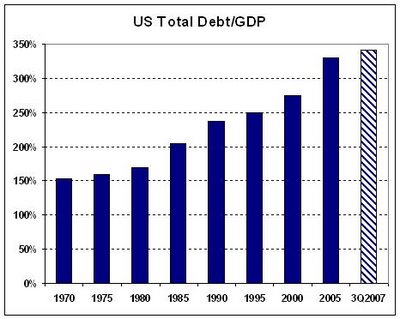
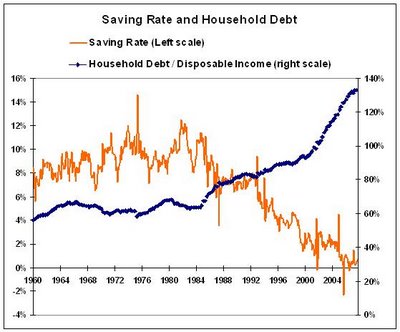
The main concern today is fiduciary adequacy and not liquidity. We have already borrowed so much (total debt is near 350% of GDP) that our ability to service existing debt is more relevant than access to additional debt. The importance of the Fed to the economy is thus limited, and our fixation with what it does, or does not do, is a distraction from dealing with the real issues.
What are the issues?
- Forget the Fed; there can be no monetary solutions to fiduciary problems.
- Re-establish the relevance of fiscal policy as more than just discussion about tax cuts.
- Raise earned income, instead of relying on capital gains and portfolio income; create permanent high value-added jobs, targeted to exports.
- De-leverage.
- Emphasize industry over finance and production over consumption.
Alan Greenspan: The Roots of the Mortgage Crisis
On Aug. 9, 2007, and the days immediately following, financial markets in much of the world seized up. Virtually overnight the seemingly insatiable desire for financial risk came to an abrupt halt as the price of risk unexpectedly surged. Interest rates on a wide range of asset classes, especially interbank lending, asset-backed commercial paper and junk bonds, rose sharply relative to riskless U.S. Treasury securities. Over the past five years, risk had become increasingly underpriced as market euphoria, fostered by an unprecedented global growth rate, gained cumulative traction....
....The crisis was thus an accident waiting to happen. If it had not been triggered by the mispricing of securitized subprime mortgages, it would have been produced by eruptions in some other market. As I have noted elsewhere, history has not dealt kindly with protracted periods of low risk premiums.
Commercial Paper Rates and Outstanding

Calculated Risk comment: Worse than August. Worse than 9/11.

Crisis seen ending when distressed market buys
Many asset managers, like F&C Partners, are poised to snap up crisis-hit assets at deep discounts. Such demand could restore liquidity to the credit market, but it comes at prices that banks and other holders are not yet prepared to accept. "The problem is that if they write it down, then they are going to take a capital hit, their equity will be reduced and they will have to reduce the size of their balance sheets. They are stuck in a bind, clogged up," Culligan said.
"Whether it's banks, insurance companies, SIVs, conduits, basically the asset sides of a number of large balance sheets have shrunk to the point where it has seriously impaired or wiped out the equity."What needs to happen is an injection of equity, and the eventual sources of that equity are likely to be in the Middle East or Far East, he said. On Monday, Swiss bank UBS announced a $10 billion writedown and said it had obtained a capital injection of 13 billion Swiss francs ($11.5 billion) from a Singapore government entity and an unidentified Middle East investor.
UBS says Singapore investment 'first step' in reorganisation
UBS said Tuesday that the decision by Singapore's state investment arm to inject nearly 10 billion dollars in fresh capital is just the "first step" in a major reorganisation of the Swiss bank's activities.
UBS turned to the Government of Singapore Investment Corporation (GIC) to plug a 10-billion-dollar (6.8-billion-euro) hole caused by losses in the US mortgage crisis. These losses, coming on top of a 4.2-billion-Swiss franc (3.7-billion-dollar, 2.5-billion-euro) writedown announced in October, are the result of "a small group of people in investment banking," UBS chairman Marcel Ospel told an investor day in London. UBS will now move to "reposition its fixed revenue activities," Ospel said....
....UBS also said that a strategic investor in the Middle East, which it did not identify, is injecting an additional two billion francs into the bank. Ospel said that both these moves were "long-term" investments.
It is awkward, to say the least, for the West to complain when Asian and Middle Eastern government-owned investment pools shore up capital-starved banks that are vital to the world economy. It is like running out of gasoline in the middle of nowhere and being picky about who drives by with spare fuel. And the U.S. economy needs about $2 billion every day from foreigners to keep it going. It gets this money by borrowing or by selling off chunks of assets like Citigroup or Bear Stearns.
Even without counting the vast reserves of Asian central banks, sovereign-wealth funds, or SWFs -- an abbreviation once more common to personal ads than news columns -- today have about $3 trillion in assets and are on their way to $12 trillion by some estimates. They are bigger than hedge funds and private-equity firms combined, though those outfits magnify their clout with lots of borrowed money. And they pose at least three risks:
The first worry is backlash. Americans, with some trepidation, accept foreign investment in the U.S. -- especially when it comes in the form of jobs making Toyotas or price-reducing competition for cellphone service from Germany's T-Mobile. But the 2006 explosion over the proposed purchase by Dubai Ports World of operations of several U.S. ports single-handedly raised barriers for foreign direct investment around the world. It is a reminder how much anxiety there is about globalization and how quickly politicians can respond.
SIVs Shrink, Easing Concerns About Fire-Sale, Rescue
Devised by former Citigroup bankers Stephen Partridge-Hicks and Nicholas Sossidis in 1988, SIVs aim to profit by borrowing at least 10 times the initial funding provided by long-term capital or income noteholders. The money is invested in hundreds of securities from asset-backed debt with AAA credit ratings to bank bonds. Mortgage debt made up 23 percent of SIV assets, with most having no direct subprime link, Moody's said in July.
Capital noteholders, who are first in line for losses, received annual returns from 2 percentage points to 2.75 percentage points more than benchmark interbank rates, based on a Moody's survey in 2005.
SIVs profit by using top credit ratings to borrow at low short-term rates. The model had broken down by September when money market investors either stopped buying SIV debt or charged as much as 6.3 percent on 30-day asset-backed commercial paper, the highest rate in more than six years. SIVs were left paying more to borrow than they were earning, Moody's said in a report in September.
``The market is being divided into two camps,'' said Tawadey at BNP Paribas. ``We are seeing a polarization between the banks that have the strength to support their SIVs and take up some of the implicit obligations, and some of the U.S. institutions that are already facing other pressures, such as higher credit card delinquencies and subprime losses.''....
....Citigroup's ``outsized'' investment in SIVs and collateralized debt obligations, bonds based on underlying assets, puts the biggest U.S. bank in a ``precarious position'' that may trigger a breakup or merger with a competitor such as JPMorgan, CreditSights Inc. in New York said in a Dec. 9 report.
Citigroup offloads assets from SIVs
Citigroup has slashed the size of its struggling off-balance-sheet investment funds by more than $15bn in two months through quiet side deals with some junior investors, according to people familiar with the business.
The news that the troubled US bank has been finding ways to offload assets from its structured investment vehicles (SIVs) without resorting to fire sales comes as Société Générale on Monday became the latest bank to announce a bail-out for its own $4.3bn vehicle. SocGen's decision follows similar moves by HSBC, Standard Chartered and Rabobank in the past fortnight.
Citigroup to Assume Control of SIVs
Citigroup Inc. said Thursday it plans to assume control of the seven "structured investment vehicles" the bank advises to help them repay their debts. Citigroup will provide a "support facility" for its seven SIVs with investments totaling $49 billion and incorporate them onto its balance sheet. The bank previously said it had no plans to bring the SIVs onto its books.
SIVs are complex investment funds established by banks like Citigroup and sold to investors. SIVs borrow money by selling short-term debt like term notes and commercial paper, then using the borrowed money to buy bank, mortgage and credit card debt that yield higher returns.
The funds profit off management fees and the spread between how much they collect on the investments and how much it costs them to borrow.
SIVs jumped to the forefront of this year's credit crisis when many of the investments they held, particularly mortgage investments, lost a lot of value as demand for risky debt shriveled.
This triggered concern that lenders would be unwilling to keep lending to SIVs. The viability of a SIV hinges on its ability to continue borrowing short-term money. If it is unable to renew loans, it has to find new sources of cash or liquidate its investments to repay lenders.
Moody's Investors Service and Standard & Poor's -- two of the three major credit-rating agencies -- were considering downgrading the ratings on several of the world's roughly 30 SIVs, including the seven Citigroup created.
Citigroup will bring the SIVs onto its balance sheet in order to protect their credit ratings and give them time to sell their assets, the bank said.
CIBC's Big Subprime Secret Might Cost Billions: Jonathan Weil
Canadian Imperial Bank of Commerce has a big skeleton in its vault. And the bank's executives are doing a ham-handed job of trying to keep it there.
CIBC's lightly guarded secret is the name of a ``U.S. financial guarantor'' that faces a possible downgrade on its A credit rating and is ``not necessarily rated by both Moody's & S&P.'' That's how CIBC last week described the company that is insuring $3.47 billion, or about a third, of the collateralized- debt obligations it holds that are tied to U.S. subprime mortgages.
The company's identity matters because the bank said these hedged CDOs were worth just $1.76 billion at Oct. 31, down almost half from their face amount. If the guarantor goes poof, CIBC loses its hedge on these derivative contracts. And the Toronto-based bank would have to recognize the loss, which is growing.
All the King´s Horses or Rearranging the Deck Chairs on the Titantic?
Essentially, we can assume MBIA is on super-secret probation,’ said Rob Haines, an analyst with CreditSights. Michael Cox, securitisation analyst at RBS in London, said the next two weeks would be a critical period… ‘[These companies] have become the focus for those searching for the next domino to fall as the credit crisis unfolds,’ he said. MBIA insures just over $1,000bn of municipal and structured finance bonds. However, it only had the ability to pay $14.2bn of claims as of September 30.
Washington Mutual Will Take $1.6 Billion Writedown
Washington Mutual Inc., the biggest U.S. savings and loan, will write down the value of its home- lending unit by $1.6 billion in the fourth quarter and cut about 6 percent of its workforce as mortgage-market losses increase.
Washington Mutual, led by Chief Executive Officer Kerry Killinger, also slashed its quarterly dividend to 15 cents a share from 56 cents and forecast a loss for the quarter, according to a statement yesterday from the Seattle-based bank. Provisions for bad loans will be $1.5 billion to $1.6 billion, more than the $1.3 billion the company previously predicted. It plans to shutter 190 of 336 home-loan centers.
Fitch Ratings and Moody's Investors Service Inc. lowered Washington Mutual's credit rating, citing the firm's deteriorating mortgage assets. The bank has lost 56 percent of its market value this year, the worst performance in the 24- member KBW Bank index, amid declining U.S. housing prices and record home loan delinquencies. Washington Mutual said it plans to sell $2.5 billion of convertible stock to shore up capital.
``They're clearly concerned the industry will stay in a negative mode for an extended period,'' said Richard Bove, an analyst at Punk Ziegel & Co. in Lutz, Florida. ``The fact they're laying off so many people indicates they're concerned this is not just a one-time event.''
Freddie Mac expects $10-12 billion credit losses
Freddie Mac expects to see credit losses of $10 billion to $12 billion on the book of mortgages it currently owns, the mortgage finance company's chief executive said on Tuesday....
....In the coming months, Syron said, the public will increasingly see the distressing public face of massive foreclosures and that could imperil the entire economy.
"We have seen a ton of foreclosures but we have not seen a lot of pictures of people standing in front of their house with their furniture on the front lawn saying 'What am I going to do?" he said.
"As that starts to happen, and it will happen, I am afraid of the impact that this has," he said, citing a risk that a public concern over the housing market could curtail consumer spending.
Subprime-hit German banks search for partners
The owners of battered German lender WestLB emerged from crisis talks on Wednesday saying that they would be happy to sell a stake in their subprime-hit bank.
The comments are the latest sign of the worsening condition of German banks in the wake of the subprime storm.
Earlier, the state of Saxony, which owns rival lender SachsenLB, said it hoped to sign a deal to sell the stricken bank to a rival despite a row over who pays for the bank's dud investments in subprime mortgages.
Last week, WestLB warned that the crisis in financial markets was getting worse as it skidded into the red and said 2007 losses would mount to hundreds of millions of euros.
German Investor Confidence Decline to 15-Year Low
Investor confidence in Germany dropped more than economists forecast in December, reaching the lowest level in almost 15 years, as rising credit costs dimmed the outlook for economic growth....
....The cost of borrowing euros for three months rose to the highest since December 2000 today as banks hoarded cash to cover their commitments over year-end.
The euro interbank offered rate, the amount banks charge each other for such loans, rose 3 basis points to 4.93 percent, the European Banking Federation said today. That's 93 basis points more than the European Central Bank's benchmark rate
The slump in global credit markets may force banks, brokerages and hedge funds to cut lending by $2 trillion and trigger a ``substantial recession'' in the U.S., Goldman Sachs Group Inc. forecast on Nov. 16.
Northern Rock takes $574-million credit hit
Northern Rock said it had taken a £281-million ($574 million) hit, or two-thirds of its market value, from its exposure to the credit crisis, adding to its woes as it brought in a new chief executive....
....Northern Rock is being auctioned off by its advisers after it became Britain's highest profile casualty of the credit crisis, but the future of that process has been thrown into doubt in recent weeks, with two suitors withdrawing....
....Northern Rock said the £281-million writedown included a £118-million hit from its investment in structured investment vehicles (SIVs) and a further £32-million from its investment in the more highly leveraged SIV-lites.
HBOS pain takes UK bank writedowns to £2bn in a week
HBOS has become the fourth UK lender in a week to announce a multi-million pound writedown on the back of the turmoil in global credit markets, taking the total written off by UK banks in the last seven days to almost £2bn (€4bn).
The bank this morning said it wrote down £520m on its investments, three days after Lloyds TSB revealed a £200m hit on its own portfolio and a week after Royal Bank of Scotland reduced the value of its assets by £950m as a result of its exposure to US sub-prime.
Northern Rock continued to add to the woes of the UK banking sector, saying this morning it had written down its collateralised debt obligation portfolio by £281m.
HBOS was forced to take a the £520m charge against its £80bn portfolio of floating-rate notes and asset-backed securities.
Florida Fund Reduced By $1.9 Billion After SIV Losses
Managers of the Florida pool were willing to gamble local government money on SIV debt because they had the safest credit ratings and offered higher yields than other short-term fixed- income investments. Now, downgrades and defaults on those holdings have left schools and towns statewide without full access to cash they are accustomed to drawing upon for routine expenditures such as payroll for teachers and police.
``Who would invest in a fund that had the kind of risk they did?'' said Michael Geoghegan, chief financial officer at Broward County, which includes Fort Lauderdale.
Geoghegan pulled out the county's $200 million investment in the pool in mid-November after he learned the fund held SIV debt that had been downgraded below investment grade.
Florida says $9B can't be pulled from fund
Local governments will be able to withdraw no more than a quarter of the $12 billion they have invested in a Florida-run investment fund before next spring -- because the fund doesn't want to sell the investments at a loss.
Investing agencies, including many in Central Florida, also found out that at least $350 million of their cash is tied up in investments whose ratings are so low that their value "truly is a question mark," according to Simon Mendelson, a top manager with BlackRock, an investment firm hired by the state to salvage the pool. It won't be known until later next year -- when the investments mature -- whether they'll be worth anything, he added.
Mendelson spoke during a nearly two-hour conference call to representatives of hundreds of cities, counties, school boards and other agencies across Florida with money in the Local Government Investment Pool. He was joined by executives of the State Board of Administration, which until last week managed the fund.
Florida Official Seeks Probe of Investment Pool
Florida's top finance official asked for an investigation of policies that led the state's local government investment pool to invest in securities tied to the subprime mortgage market.
State Chief Financial Officer Alex Sink, in a letter yesterday to Florida's inspector general, Melinda Miguel, asked for a probe of whether the State Board of Administration's securities purchases violated its investment guidelines. Cities and schools withdrew $13 billion from the $27 billion fund last month after learning it held subprime-tainted debt that had defaulted or been downgraded.
Fed Forecasters Who Were Right See Funds Rate at 3.5%
The three most accurate forecasters of U.S. interest rates say the Federal Reserve will need to lower borrowing costs below 4 percent to prevent credit markets from seizing up.
UBS AG, Deutsche Bank AG and Dresdner Kleinwort were the only primary dealers of U.S. government securities to correctly forecast a year ago that the central bank would reduce its target rate for overnight loans between banks to 4.25 percent, according to a Bloomberg survey. The median estimate of the 22 firms was for a decline to 4.75 percent.
The economists now say policy makers will cut the target by at least another half percentage point because banks are raising costs for loans amid mounting losses from securities tied to subprime mortgages. The difference between the interest banks and the government pay for three-month loans, called the TED spread, rose to 2.21 percentage points yesterday from 1.59 percentage points on Sept. 18 when the Fed began lowering rates.
``The financial impact from subprime started off the chain reaction,'' said Maury Harris, chief U.S. economist in New York for UBS, Europe's biggest bank by assets. ``The decline in home prices was the genesis of everything that's happened,'' Harris said in a telephone interview. ``The economic impact is showing up now.''
Morgan Stanley issues full US recession alert
Morgan Stanley has issued a full recession alert for the US economy, warning of a sharp slowdown in business investment and a "perfect storm" for consumers as the housing slump spreads.
In a report "Recession Coming" released today, the bank's US team said the credit crunch had started to inflict serious damage on US companies.
"Slipping sales and tightening credit are pushing companies into liquidation mode, especially in motor vehicles," it said.
"Three-month dollar Libor spreads have jumped by 60 to 80 basis points over the last month. High yield spreads have widened even more significantly. The absolute cost of borrowing is higher than in June."
"As delinquencies and defaults soar, lenders are tightening credit for commercial, credit card and auto lending, as well as for all mortgage borrowers," said the report, written by the bank's chief US economist Dick Berner. He said the foreclosure rate on residential mortgages had reached a 19-year high of 5.59pc in the third quarter while the glut of unsold properties would lead to a 40pc crash in housing construction.
TD sees ‘significantly slower economic growth' as credit crunch bites
Problems in credit markets are more serious and more persistent than initially thought, and “the dominant economic theme for 2008 will be significantly slower economic growth in the United States, Canada and around the globe,” TD Bank economists said Thursday....
....In the United States, “we still don't believe that a recession is the most likely scenario, but the risks have become acute,” commented Mr. Alexander.
He added: “While there has been much talk about the ability of the global economy to decouple from a U.S. economic slowdown, this assumption is likely to be tested and debunked in the coming quarters.”
The combined actions of the world’s central banks on Wednesday smacks of a real fear that the world’s financial system is in trouble.
Injecting liquidity — that is lending money to banks — when short-term interest rates rise is perfectly normal in this age in which central banks target interest rates.
What is not normal is the Fed using auctions “to inject term funds through a broader range of counterparties and against a broader range of collateral than open market operations.” That move, the Fed says, “could help promote the efficient dissemination of liquidity when the unsecured interbank markets are under stress.”
Or, as a senior Fed official — that’s what the Fed wants him called — told reporters, “This is not about particular financial institutions, with particular problems. It is about market functioning.”
The New York state Attorney-General has sent subpoenas to banking giants after announcing an investigation into the sub-prime market crash. Banks are being charged with irresponsible lending after giving loans to people who would never be able to make repayments plus misleading investors over mortgage-backed securities....
....Mr Cuomo suggests that the banks creating the derivatives could be in trouble for failing in their legal obligation to ensure that prospectus information on the derivatives being sold was true.
Mortgage fix eluded lawmakers in 2001
The state of California had a chance to curb lending practices that would later contribute to a crisis in subprime mortgages when it set out in 2001 to regulate so-called "predatory" loans.
But lawmakers, many of whom took campaign contributions, trips to Hawaii and Rolling Stones concert tickets from subprime lenders, narrowed the legislation so much that consumer protections covered only a tiny percentage of mortgages, a review by The Bee found.
Saying they didn't want to dry up the market by being too restrictive, lawmakers produced a bill that let most lenders easily avoid making loans that triggered homebuyer safeguards.
Freezing Mortgages or Freezing the Real Estate Market?
The administration initiated a new plan to freeze introductory rates on subprime mortgages preventing them from resetting to higher rates for five years. However, there are some who believe that this plan focuses energy in the wrong direction.
Eli Tene, the President of I Short Sale, Inc., a leading nationwide loss mitigation service provider, believes that the freeze is just another sign that the administration does not have the necessary tools to deal with a crisis. "If the goal is to help distressed homeowners, the mortgage rate freeze is missing the target," says Tene.
Tene highlights four significant pitfalls in the plan that should be considered:
1. The plan is limited to loans made at the start of 2005 through July 30 of 2007, and will cover loans that had been scheduled to reset to higher rates between January 1, 2008 and July 31, 2010.
2. The plan targets only homeowners that are current in their mortgage payments. In other words, it ignores the growing number of homeowners who have already missed one or more payments. These homeowners continue to face foreclosure with no way out.
3. Freezing rates does not necessarily mean the rates will be low enough to allow the homeowner to stay current. Some mortgages have already adjusted and many of those who need to pay them cannot afford to do so.
4. The sheer notion that the housing market prices will increase, thus allowing homeowners to refinance their current adjustable rate mortgages does not hold water. On the contrary, the mortgage freeze will just assist the lackluster performance of the real estate market and will now lock both the property owner and the lender for a longer period of time.
The Capital of Slumping Home Sales
Many of those sales depended on adjustable-rate mortgages with tantalizingly low initial payments, and now that those mortgages are much harder to get, there aren’t many buyers willing and able to pay $500,000. Yet sellers in Paramount haven’t adjusted to the new reality by cutting their prices very much. Instead, the real estate market has frozen.
On Sunday, Luis Perez and his wife, Hilda, held their fourth open house since putting their apricot-colored stucco home on the market in August. They have reduced the price once, by about 5 percent. They still haven’t received a single offer.
Since the summer, only about three homes a week — including houses and condominiums — have sold in Paramount. In the third quarter of this year, only 30 homes changed hands, down from 134 in the third quarter of last year.
That 78 percent drop is bigger than the decline in any other ZIP code in the country, according to an analysis that a research firm called DataQuick Information Systems did for me. The biggest declines can generally be found in moderate-income towns on the outskirts of major metropolitan areas, where adjustable-rate mortgages had become the norm.
Ahead of the Bell: Mortgage Bill
A House committee is scheduled to vote Wednesday on legislation that would permit judges to shrink the size of home loans for bankrupt homeowners -- a mortgage-mess remedy supported by consumer advocates and ardently opposed by the lending industry.
Many Democrats say the proposal is a better way to help homeowners than a plan to freeze interest rates announced by the Bush administration last week and negotiated with lenders and investors.
Mortgage-industry leaders say the proposed legislation would open a floodgate of bankruptcy filings, further threatening the industry's already shaky footing. Lenders, they argue, would be forced to charge higher rates to offset any unpaid loan balances that would be reduced in court.
Foreclosures triple across region
"People are desperate," said real estate analyst Jack McCabe of McCabe Research and Consulting in Deerfield Beach, who has closely tracked the local decline.
"A lot of people weren't trying to buy a house over their means, but nevertheless they got caught up in this," he said. "Now they're emptying their savings, but for a lot of people it makes sense to cut their losses."
Indeed, tightened finance rules in the wake of the "subprime loan mess" plus a huge backlog of unsold homes on the market make it difficult for many cost-burdened homeowners to refinance with better terms, or to sell. In Palm Beach County, for instance, there's a four-year supply of homes for sale, according to Illustrated Properties Real Estate.
That leaves foreclosure as the last unhappy option for squeezed homeowners, as climbing rates in the Treasure Coast show.
Let's put it all together and attempt to answer the original question - when will the mighty US consumer shut off spending? The truthful answer is, I don't know. But I know where to look for very credible signs preceding the spending cuts: weekly jobless claims.I also know something even more important: given the hand-to-mouth existence, high debt and rising inelastic expenses, significant job losses will lead to deeper and faster spending cuts than ever before. That will be the critical point, not only for the consumer, but for the entire US economy.
The face of foreclosure: Tales of broken dreams
The lawmakers said they would propose a 90-day stay on foreclosures and a five-year stay on interest rate resets until the current foreclosure crisis subsides. The lawmakers also said they would support legislation to ban certain kinds of lending, including commissions that reward brokers for getting borrowers to pay more than they have to.
In Alameda County, 9,454 homeowners are in some stage of foreclosure this year. Either they have defaulted on their mortgages or received a notice of trustee sale of their home from the bank, according to statistics from the Home Mortgage Disclosure Act and the Housing and Economic Rights Advocate, based in Oakland.
The number of Alameda County homeowners receiving notices of default — meaning 90 days past due — on their mortgages soared 50 percent in the first nine months of 2007 over the same time last year. Such notices stand a good chance of evolving into foreclosure.
A long, cold winter in store for the poor
Virtually everyone is shuddering this year at the high cost of home heating oil.
Worst off are low-income families, who face heating-oil prices anywhere from 10 to 22 percent higher than last winter with less assistance from the federally funded Low-Income Home Energy Assistance Program. While the Bush administration falls down on the nation's moral responsibility to care for its poor and vulnerable, a few local souls are striving to make sure no families go without heat this winter.
Will the Free Market Kill Suburbia?
I wonder how much of the $6.3 trillion market for home loan bonds represents the failure of suburban sprawl as an economic engine for the US economy. Sprawl is the unsustainable growth model that bond investors are fleeing as if their hair were on fire. What an irony it would be, if the free market kills suburbia.
Far from being what the market wants, sprawl is a Ponzi scheme that depended on the securitization of mortgages into pools mixing form, content and risk into an unrecognizable hash. It was great bait--"what the market wants"--until the trawler nets came up empty.
A complete analysis of what percentage of subprime trouble is represented by low density, scatter housing has not been published. By 2005, this much is clear: the multi-billion dollar market for production homebuilders had been saturated. Mortgage brokers stimulated by egregious compensation practices were fishing in the final pool that had not dried up: prospects who could scarcely afford to rent, much less buy a home.
True to form, the fine print on those hundreds of billions of sprawl-linked bonds did not include anything like the true costs of sprawl: aquifers destroyed to plow more production homes on poor topsoil, wetlands gobbled up at a fearsome rate, putting drinking water supplies for whole cities at risk, not to mention the role of gas-guzzling automobiles as an priori condition of long commutes from tract housing to places of work.
The Growth Machine in the United States depends on the externalization of true costs and on bond buyers being agnostic. All that mattered was the assurance of ratings agencies and bond insurance to cover any unforeseen damages.
Personnel
Archives
- December 2008 (1)
- October 2008 (1)
- July 2008 (2)
- June 2008 (2)
- May 2008 (6)
- January 2008 (2)
- December 2007 (8)
- November 2007 (9)
- October 2007 (11)
- September 2007 (14)
- August 2007 (14)
- July 2007 (10)
- June 2007 (9)
- May 2007 (11)
- April 2007 (9)
- March 2007 (11)
- February 2007 (11)
- January 2007 (11)
- December 2006 (12)
- November 2006 (16)
- October 2006 (13)
License

This work is licensed under a Creative Commons Attribution-Share Alike 3.0 United States License.
This has the feeling of Soros vs BOE all over again, yet with bigger stakes and even bigger players. But as I said last week, $400 billion for financial companies is a tidy sum, but they can withstand that - the real dominoes start when the fractional banking system works in reverse, pulling credit from an economy based on credit-growth, then causing positive feedback on economic cycle/bank earnings...Goldman will be updating that note in 3-6 months.
Ouch! Stoneleigh your hurting me fer sure %}
I'm sure you saw this from CR;
"Consumers Use the 401(k) ATM"
http://calculatedrisk.blogspot.com/2007/12/consumers-use-401k-atm.html
IMO this is the negative result of manipulation of the economic realities by TPTB.
I understand that they have to do what ever they can to avoid economic collapse, or at least appear to be doing so, but without the correct information people WILL make bad decisions like this.
I swear to buddha it looks more and more like this is being orchestrated.
One would like to think that at least some people realize what is going on and just plain cash in the retirement plans despite penalties and move them into inflation indexed treasuries or gold.
Unless these plans are invested exclusively in guaranteed treasuries, and almost none are, they will be worth little or nothing eventually. This does not even consider inflation and the possibility of withdrawals being blocked.
musashi, I agree that a few far-sighted folks may well take their futures into their own hands.
I'm vested in a Defined Pension Plan; up to a couple of years ago I was delighted that I had a benefit that's a dying breed. Now I feel the oposite. The managers bought whatever the brokerages were touting that month, which included SIV and subprime CDO paper. I can opt to self-direct my account, which lets me "choose" between a "growth mutual fund" or an annuity from an insurance company (which I'll bet is up to its eyeballs in "high yield" paper). No mention of gold or oil-service ETF's; I'm sure that's just an oversight that will be soon corrected...HAHAHAHAHA.
So now I'm doing ELP with a vengeance, as I've realized that my retirement is pretty much up to me.
PLAN, PLANt, PLANet
Errol in Miami
No need for orchestration, methinks.
With home equity withdrawals off the table, people have nowhere left to turn but plastic debt, of which we've seen countless stories and examples, and of course their pension provisions, of any shape and form that they can get their hands on.
I'm not familiar with the ins and outs of these plans and funds, but if it's anything like I presume it is, there's hefty premiums on early withdrawals.
The deepest tragedy lies in the cases where this "equity" is used merely to pay off mortgage and credit card debt.
The penalty typically is only 10%, and of course depending on the type of plan if the funds were not taxed going in then they are taxed as regular income. The penalty only applies for people younger then 59 1/2
There also are ways to make emergency withdrawals but for short periods and then they have to be paid back in.
If you withdraw on Jan 01 then the tax isn't due until 15 1/2 months later, but the banks may take some of it out up front to try and deter withdrawals.
People that go into retirement accounts to make payments on RE they can not afford are delusional, they will default later anyway in almost every case. These accounts are federally protected even in the case of bankruptcy and are the best (only?) hedge honest people that proceed in good faith have.
They dangle all these relief bills out there to give the middle class hope of a bailout if they can just hang in there long enough. It's a trap.
They will never help middle class people, there are no FEMA free money credit cards for the flooded cities in WA state, they are just trying to pick the middle class clean.
Bingo, I think we have a winner.
Couldn't agree more.
MEW, 401k, plastic... We still forgot one option:
If people default on the 396% interest loans, what then? Look for a rash of busted kneecaps and bodies turning up in rivers with feet encased in concrete.
I swear to buddha it looks more and more like this is being orchestrated.
Soup, Read this post from the previous Fin. RU.
(Read the whole article.)
http://canada.theoildrum.com/node/3355#comment-276849
John
Thanks Samsara - I read the snips the other day and intended to get to the whole article but...
Wow! I can't talk right now... just WOW!
I notice he is writing this from the relative safety of CHILE.
souperman, I second that WOW! Maund's analysis unfortunately fits the facts...
I'll also note that another wise macroeconomic writer, Enrico Orlandini, has chosen to live in Peru. I'm seeing a pattern here...
PLAN, PLANt, PLANet
It sort of dovetails with Ilargi's Goldman post below.
Goldman has (and had) undue influence over the Fed, Treasury and some foreign central banks. Their people are everywhere.
This much is a fact.
The question is where does Goldman's loyalty lie, and who pulls their strings.
Add the all powerful PAC that basically determines which candidates face off in the elections.
You tell me who is controlling the show.
You tell me who is controlling the show.
That's the over arching question isn't it?
I don't know, but I know more than I did a few years ago.
Here's a few clues. If nothing else if you digest all of this you will have no illusions on how money works or where it goes.
Enjoy, (sort of)
John
----------------------
First, Goldman Sachs and the Gov. There is NO daylight between them.
Sachs does Gov.
http://tinyurl.com/22dlpe
And THEIR bank, The Fed.
AMERICA'S FORGOTTEN WAR AGAINST THE CENTRAL BANKS
Here's a tid bit.
from 1929 to 1933 11,630 banks of the total of 26,401 in the United States to go bankrupt. This allowed central bankers to buy up rival banks and whole corporations at a deep discount.
It is interesting to note that biographies of J.P. Morgan, Joe F. Kennedy, J.D. Rockefeller and Bernard Baruch indicate that they all managed to transfer their assets out of the stock market and into gold just before the crash of 1929.
{Note the: 11,630 small family Savings and loans that became Fed banks.}
http://www.financialsense.com/fsu/editorials/dollardaze/2007/1020.html
Watch these video's on Money and The Fed.
Court Case involving the Fed.
http://www.silverbearcafe.com/private/criminal.html
Fed backers
http://www.silverbearcafe.com/private/rothschild.html
This one. Copy it to your disk. PDF warning. An incredible book of a LOT LOT of American History of the Fed.
The Secrets of the Federal Reserve
http://www.sandiego.indymedia.org/media/2007/02/125026.pdf
IMF / WORLD BANK DESTROYING COUNTRIES
http://www.unitypublishing.com/Government/IMF.htm
John F. Kennedy vs The Federal Reserve
http://www.silverbearcafe.com/private/JFK.html
Thanks for putting that together Samsara.
I had some of that but there are some real jewels in there.
Sure would like to get my hands on a copy of that USA Banker's Magazine, August 25 1924.
When does something like this go from being conspiracy theory to OMG come on everyone lets waste these effers?
And to add conspiracy to conspiracy, check this out from 2005...
And this goes to that for the NOC's in nationalist countries that actually work FOR their citizens it makes sense to withhold as much oil production as they can get away with.
Reminds me of Catherine Austin Fitts' discussion of the Red Button:
http://www.solari.com/articles/MoneyChangersInterview.htm
She argues that no one wants to stop unethical behavior (press the Red Button) because it would mean giving up our investments and pensions.
It never occurred to me until recently that TPTB would press the Red Button (stop the economy) in order to create Demand Destruction and slow down FF consumption.
It never occurred to me until recently that TPTB would press the Red Button (stop the economy)
World power consumption = population X rate of consumption
And
World power consumption (seems to) = World power production.
So if World power consumption is dropping due to less production, will the population be adjusted or will the rate of consumption be adjusted? Ya know - if there are TPTB who can bend things to their will for their convience?
how do the canadians here feel about a goldman alumnus set to take over as head of the central bank? time to dump the loonie for gold! oh wait, goldman just issued a short gold for 2008 recommendation. these are the same criminals hugely responsible for the mortgage mess, yet they claim to be perfectly hedged and have profited by shorting the subprime indices.
Not a good sign, but it was to be expected when we elected MonkeyBoy Jr.-on the positive side, we lucked out by not having him as our fearless leader when Condi was talking about Hussien turning NYC into a melting crater.
souperman2 said,
"I swear to buddha it looks more and more like this is being orchestrated."
I don't swear to buddha....but yeah, it's a whipped hysteria the likes of which is only possible in the internet era...as deepthroat said, "Follow the money."
You will see assets selling to the winners for a dime on the dollar once the blue and white collar schmoe's are shaken dry....
Years ago, I was told that to measure who had the power in a culture, look for the tallest buildings...the Egyptian priesthood had the pyramids, the Gothic priesthood had the Cathedrals, the Dutch began to surpass those with the "counting houses" of the Colonial traders....now look at any major city...
The tall towers belong to the financial services (misnomer that) and the medical community....
We are seeing a battle as to who can get to the boomers remaining money and investments...the biggest nest egg in history. At first, it looked like the medical community would get it....but the financial/banking community needed a way to get there first....break their investments down, and get the assets they have worked for on the cheap. They found it. Of course, many "post boomer" gen X and Y young are going to get caught up in the slaughter....but like the boomers in the 1970's, they have time in front of them....for the 45 plus year olds now, they (we, I should say) are running out of time.
These people will have to be VERY SHARP to avoid being driven into panic and making bad choices, or simply being confused by the media hysteria and panic machine, which is now working overtime. Let's admit it, we all will have to be VERY SHARP. This is a well organized attack, and will strike in ways that are as yet totally unexpected. Closer to TOD's agenda, those who have been amazed at the way in which "Peak Oil" has suddenly been embraced by the MSM....think about it. It now fits the agenda of the financial community.
But yeah, it's orchestrated so well it would make Leonard Bernstein jealous. :-)
RC
ThatsIt, it's too late for "These people will have to be VERY SHARP to avoid being driven into a panic and making bad choices..."
IMO they already made their bad choices. Rather than being panicked, they were seduced: into cash-out refies and 'investment' RE and SUV payments and credit card purchases of plasma TV's. They are now contractually obliaged to pay off that debt and bankruptcy has been "reformed". The trap is already sprung. The average 'consumer' can squirm around, or even chew off a leg (cash out the 401K), but trapped they are.
PLAN, PLANt, PLANet
Errol in Miami
...and bankruptcy has been "reformed".
With all the "HELP" the people, You Won't see them do anyything to the bankruptcy laws.
The minority bill to allow mortgage cram downs is outrageous.
It rewards criminal behavior and would totally lock up the economy as no one with a single active brain cell would ever loan a dime to anyone in the US again.
These POS are actually trying to break contract law that is as old as the ages.
The power of the sovereign is who ones turns to to enforce the contract. If the sovereign opts to not enforce, there is no contract....is there?
Sure. That's why they get "removed". It happened before.
The "Calculated Risk comment: Worse than August. Worse than 9/11." points to theoildrum.com.
Thanks - fixed.
When big finance announcements are delivered on a Friday after market close, something’s always wrong. Here’s a prime example. Canada non-bank ABCP has been dead (dare I say braindead) for 4 months, and at the deadline (sic), nothing’s been resolved. Not even the large write-downs already on the table (up to 50%, reportedly) are enough. Or the idea to turn short term ABCP (max: 270 days) into 9-year (!!) paper.
What to do now? Let’s say we agreed on a restructuring plan, and then in the same breath push the entire thing 3 more months ahead. That sounds positive, don't it? But we won't divulge any details, that'd spoil the jolly spirit. We'll claim confidentiality issues.
In the real world, we all know what it means: the paper still cannot be sold, unless, and that’s perhaps, at steep discounts. As in more than 50% below face value. We’ll all just keep hoping that the markets will revive. Problem is, we see one thing only out there: markets getting worse, not better.
Air Transat has turned heavy, and early, to the eggnog, we must assume: a 7% loss is very far removed from reality. One has to wonder why they do this. Then again, they did announce a 44% profit drop today. Could that be the reason?
The managers at Québec's largest pension fund, the Caisse, even though they're about to buy some more time, will not have a happy holiday season. They may be thinking of flying to the Caribean, never to return. Sooner or later a loss of $5-$10 billion must be made public. And the public won't like it.
Why does Transat take that ultra light write-down?
Maybe it’s just pieces falling together.
The aviation industry has a 1% profit margin, provided oil prices are $78 a barrel, with $190 billion in debt. And that is with heavily subsidized plane manufacturers, as in Boeing, Airbus, Embraer and Bombardier.
With banks reluctant to make loans, a 1% margin just won't cut it, one can safely assume. The risk of default is way too high.
Here's the recent trading activity for ABCP in Canada.
http://www.perimeterabcp.com/TradeHistory.aspx
The 'live' markets is equally exciting.
http://www.perimeterabcp.com/default.aspx
(It would be funnier if my employer didn't have >$350M in this stuff.)
Very impressive!
I thought I had mis-loaded the page because there were no transactions on it.. Then I got it.
Serious question then. If there are zero bids for this stuff, does that mean it is worth zero?
Or is there a "If I sell it, I will have to realise the loss - so I won't sell it" mentality here..?
One could have asked the same question in relation to some of the best farms in the US during the Great Depression, which were repossessed and put up for auction but received no bids. In an illiquid market, potential buyers don't want to risk bidding too much, and as value will likely fall over time they can afford to sit on the sidelines and wait.
Sellers probably wouldn't want to sell for what they might be offered now, and may well choose to hang on in the hope that the market will recover. Sellers resisting a 'haircut' are currently preventing agreement being reached on converting short term ABCP obligations to long term, even though this risks a firesale of assets that would result in much larger losses.
Of course the losses may well happen anyway - just ask Argentine bond holders from a few years ago. Converting short term bonds to long term and then defaulting on them later is not a new phenomenon.
Investor group misses debt deal deadline
The blame for that failure is put on Canadian banks' reluctance to accept part of the losses, but I think there's something else going on. The Canada non-bank ABCP has some peculiar quirks, it cedes much more to the swappers, the EU banks. That's why the Wall Street ratings agencies never rated it, only DBRS did. From Oct 1 2007:
This below is from Sep 28 2007.
What an insane mess, this ABCP thing. It's dead, accept it, you'd think. But then again, how do you explain to Québec's pensioners that you just lost them $20 billion?
No. You daren't. But it was funny.
Can you or anyone explain why the Canadian dollar is crashing vs US dollar last few weeks? Its gone from 1.11 to .98 (where it was a few months ago, true) but the same selloff hasn't occured with rest of $ basket.
Is it linked to canadian banks being worse off in this mess? I haven't followed closely enough.
That spike had no link to the real world, it was a flight from the USD towards whatever was available. Reality has set in now.
Canada is about to fall on its face real hard. Would anyone who reads our Round Ups still claim that Canada's economy is in such a superior position compared to the US? If so, we're not getting through. Canada depends on US consumers for over half its economic activity, I'd guesstimate.
For one, Canada has one lonesome claim to fame, being an energy superpower, but all of it goes slower and costlier than initially presumed. Yes, receding horizons. I'm on record saying that the oil sands will be dead by 2015, unless slave labor is introduced. No need to revise that one.
Canada's banks, as we will soon see, are not in good shape at all, and neither are its funds. The ABCP story in a good example of what is wrong over here. The two main pension funds, Ontario Teachers and the Caisse in Québec, have been competing for the best returns, and investing in tainted dirt to achieve them. That bell will soon toll. The same goes for pension funds worldwide. Being old will mean being very poor.
Canadian banks manage to do the brave face charade till now, but that won't last long. The CIBC finds it increasingly harder to hide away its mortgage losses, which will be substantial, but that's not its main problem, not even close. There's a much bigger monster lurking in that stocking, see below. My infallible eggnog hunch is the CIBC will fold next year, kind of like Canada's Citigroup, forcing other banks to expose themselves to the scrutiny of bright sunlight. And why would the CIBC be the only fool in the crowd?
Thank you.
I think the energy resources will prop up Canada vs US in future - but you are right - perhaps that energy is just too costly...lots of miles and lots of cold in between transport hubs...if tar sands is a bust - then what???
Maybe this is a silly question, but here goes: is it possible for the Fed itself to become insolvent? I had always believed the stories about 'Helicopter Ben' printing dollars to avoid deflation, but now I'm beginning to understand that the Fed can't do that - the Treasury creates dollars, the Fed creates credit. So if the Fed loans out money on collateral that later turns out to be worthless, can't they fold just like any other bank would? Or will the Treasury start cranking out REAL dollars to save them?
And many thanks to Stoneleigh and Ilargi for pulling all this together!
You're welcome, from both of us.
Actually, cranking out real dollars would sink them as it would devalue their holdings, which is one reason to suggest that printing real dollars is highly unlikely at this point. Another reason is that printing dollars would result in the US being caned in the bond market - not a choice an addict dependent on overseas borrowing is likely to make.
IMO we will see credit deflation and depression for a number of years, but following that we could well see the printing of actual dollars. IMO globalized financial markets are unlikely to have survived the shock, so international debt financing wouldn't be possible at that point anyway. I think capital controls we be reimposed over the next few years, and that the volume of trade will also fall substantially, as it did during the Depression.
Other than actual printed paper money we carry around in our wallets (which is a tiny fraction of all the dollars sloshing around the world) I didn't think the US government could actually create money. The govt is financed (almost?) entirely by tax receipts and borrowed money.
Virtually all the so called "money" in the modern world is really credit-based currency. The currency is created when banks make loans and destroyed when the loan is paid back or the borrower defaults. By manipulating the rates it charges banks, the Fed encourages/discourages banks from creating money by making loans. The Fed can create money directly by buying Treasuries. It probably has a few other tools for making money that I'm not aware of.
The Fed can also buy & sell gold, but I think that's fundamentally different because gold is a real asset. As an aside, it is an interesting question as to whether there is any gold left in Fort Knox, or whether the Fed & investors now own it all. I don't think there's ever been an accounting, and the Fed is never audited.
Wow. That is so wrong headed I don't know even where to begin.
Let's start with In the Beginning.
Somewhere along the time line of human history, people started making "promises" to each other. Example: "If you plow my field, I will give you something of equal "value" to compensate for the labors which you expend for my benefit".
And thus money was born. And man saw that it was good. So he created mo' money. He created it out of sheer thin air just as in the beginning and continued to do so at ever increasing rates and with ruses of ever increasing ingenuity.
Now we're racing ahead of ourselves. Recall that In the Beginning there was no "money". However, by issuing IOU's of a type that could freely move through the marketplace and be accepted as "legal tender" having "value", people created the fictional tokens they refer to as "money".
Money is only as good as the veracity of the promises (IOU something of equal value) behind it.
The US government makes lots of promises. Example: Let's go to war against the Iraqi people, take their oil as war booty and make ourselves fabulously rich. We will borrow money from the future and pay it back with the oil booty we get from the Iraq war campaigns. This is a business venture that is guaranteed to work. It's mission accomplished even before we start. Trust us. Our word is like gold.
This is no different than when the Roman armies marched against other civilizations and took the booty. You know: vini vici verdi; that kind of thing. It's simple business. You create money out of thin air by "borrowing" from the future with the promise to pay it all back and with interest to boot. You then take the artificially created money and "invest" it in a war campaign. If all goes as planned, the return on investment vastly exceeds the initial borrowings and no one is the wiser for it.
If all does not go as planned, then it's Hello Houston I think we have a problem.
That's where we are now. We're at the Hello-Houston-I-think-we-have-a-problem (H-HIT-WHAP) stage. We're not living up to the "promises" we made. We were too arrogant. Too sure of ourselves. Too infallible.
great video previously posted on TOD. It is about 47 min long, but explains it so that a 6 year old could understand it.
Money as Debt
http://video.google.com/videoplay?docid=-9050474362583451279&hl=en-CA
Agreed.
I think I've seen most of that video but did not have the patience to sit through the whole thing because indeed it is delivered at a grade school level.
Another video/movie that TOD readers interested in this could watch is It's a Wonderful Life - (1946, Frank Capra) (James Stewart, Donna Reed). In it there is a part where George Baily' (Jimmy Stewart) tries to halt a run on the bank by explaining to his neighbors why the "money" is not in the bank but rather out "there" helping everyone to own a Pottersville home. What good boy George doesn't bother to explain to his neighbors is how the bank fabricates mo' money out of thin air by charging interest; or how in the beginning, there was no "money" and people just invented the whole thing.
Money is neither good nor evil.
"Debt" is a funny word because it's one of those frames that economists like to throw around in order to hide the more simple concept of what's going on.
I like to think of money as a "promise"; a promise that is either kept or not kept. Peak Oil means the promise can no longer be kept, namely, the promise of a wonderful life.
Ilargi or Stoneleigh
Could some of you comment on this?
I am an amateur armchair economist, but i have read a lot about this ongoing creditcollapse.
One thing that i really don´t understand is the derivatives. Last i read that BIS estimated worldwide derivatives at 618 trillion USD, about ten times world economy. And the growth in these instruments have been very high recent months.
Wat does that mean? Derivatives are not money in them selves. So what in the hell are they, and who is holding the bag?
I have read about possibilitys of derivates meltdowns, and possibly meltdown of the whole financial system. But if the derivates melt down, why should the money we ordinary people hold disappear? I mean everybody is not speculating in derivatives. And if derivatives are worth 618 trillion USD. What is this 618 trillion, is it borrowed money, or is it just fictional, or what the hell is it????
A derivative is an investment vehicle (i.e. something brokerages sell) that is derived from another, more tangible vehicle. For example, you can purchase options to buy a stock, say Microsoft, at a certain price. The option contract is a derivative. The Microsoft stock is the primary investment the derivative derives from.
The price of a derivative is theoretically based on the price of the underlying thing. For some things, like MSFT, the price is easily verified, and so the options to buy MSFT will track the price of the stock in a very predictable way. For other derivatives is it much harder to figure out what they're worth, particulaly ones based on long-term loans backed by tangible collateral (which is what you've been hearing a lot about).
Now an options or futures contract is a very simple kind of derivative. There really is no limit to how complicated they can get. What is so troublesome about the recent explosion of derivatives is few people have a clue as to what underlies the derivatives and how much they really are worth. I suppose that's part of the point.
I don't think the derivatives are worth more than 1/2 a quadrillion dollars. I think that's the total trading volume. So, if I sell you a derivative for $100, and you turn around and sell it to someone else for $110, that counts as $220 of derivative activity.
Even so, it is just stunning that the total world market for derivatives is at least an order of magnitude larger than the collective GDP of the world. I think it is also a sign that the end is nigh.
As Shargash rightly states, there's not $700 trillion "worth" of derivatives out there. But you still may want to assume that perhaps 20% of it is, and right there you're talking 10 times US GDP. If, in turn, 20% of that fails, say in the same way that ABCP all of a sudden wasn't trading anymore, that spells trouble, big time.
These things work miracles in times of growth, real or fictional, but they are prone to produce a biting backdraft when growth stalls.
And so yes, a derivatives meltdown may well initiate a collapse of the financial system.
A very nice article on credit derivatives is this one from March 2006, by Gillian Tett at the Financial Times.
Thanks for your answer.
But if the derivatives represent 618 trillion dollars, are there 618 trillion dollars in money in the whole world, or is this some fictional sum that doesn´t exist?? I mean if this whole thing implodes as some guys thinks, what happens to our innocent peoples money then??
EDIT: I read somewhere, that there are not more than about ten people in the whole world that understands derivatives.
My guess would be that not only does the money not exist (actually I'm sure of that), but neither does the overwhelming majority of the credit because it is all leveraged.
Instead of a bubble maybe they should call it a bloated balloon. Everyone is so stretched that the slightest pinprick will cause the whole thing to tear apart.
I envision it like a cascading effect, something lets go, a counter party fails, and the avalanche starts.
On the other hand I tend to think that other parties exaggerate the numbers and the effects in order to blackmail regulators into the desired actions.
These "world statesmen" are no better then a kindergarten, when something happens the only concern is for it to be someone else's fault.
I suspect that if there were someone with the fuzzies to put a stop to it, lots of people would suffer severe losses but it would be survivable.
My argument would be that crashing it overnight without notice would be so unexpected and stun so many people into total inaction, that it would be much more survivable then a slow and painful squeeze during a protracted wind down.
I believe the figure of 618 trillion dollars refers to the option strike price multiplied by the number of contracts so the real amount of money involved is much smaller. The problem is the banks are allowed to net out their option positions and keep them off balance sheet. If a single A rated bank went bust the whole lot would unravel.
Remember that Warren Buffett described derivatives as 'weapons of financial mass destruction' here: http://findarticles.com/p/articles/mi_m4070/is_195/ai_114050444.
I would never want to bet against him.
A fellow in Asia whose name escapes me at the moment and who is considering one of the world's experts on derivatives claims that there are $19-$20 of derivatives for every $1 of real capital. That's the problem. It's musical debt chairs with 20 players running round and round but 1 chair when they all go to sit.
Here ya go GZ
Satyajit Das
The Credit Crisis Could Be Just Beginning
http://www.thestreet.com/newsanalysis/investing/10380613.html
The Wikipedia article on derivatives is pretty good: http://en.wikipedia.org/wiki/Derivative_%28finance%29
I should point out that ilargi and I aren't economists or professional financial advisers either, but we have put a lot of time into researching the financial system. In some ways I think being a professional in these fields can be more of a hindrance than a help - it can make it difficult to see the system from the outside and question the assumptions it's founded upon (hard to see the wood for the trees, so to speak).
Derivatives are bets on movements in the value of underlying instruments - in other words they derive their value from the changes in the values of other things. I would call financial assets in the derivatives market 'virtual money'. They have acted as equivalent to money, but that role is now being questioned, which is why the market for these instruments is rapidly becoming less liquid. I think of the derivatives market as a hollowed out structure so bloated through leverage in comparison with the relatively small amount of real wealth underpinning it, that an implosion is inevitable at some point. Derivatives purport to control specific risks while actually enhancing systemic risk IMO, which is why Warren Buffet refers to them as "financial weapons of mass destruction".
Nope, That’s Not Money
Much of our perceived wealth is actually credit-based, and therefore ephemeral. A derivatives market collapse would effectively crash the money supply, taking the over-exposed banking system with it. This would result in very little available money, and even less credit, which would have a profound effect on ordinary people. Liquidity is the lubricant in the economic engine - without it that engine will seize up.
"credit gained “moneyness,”....that's a great turn of phrase! I also liked this one:
"With a few months of hindsight, it’s now clear that debt-as-money was not one of humanity’s better ideas."
"A derivatives market collapse would effectively crash the money supply, taking the over-exposed banking system with it."
Of course, we have to ask exactly what is "the banking system", because just as "credit gained 'moneyness', everybody in their brother gained "bankiness".
LLP's, Hedge funds, Credit card issuers not attached to banks, Paycheck cashing services, pawn shops, Insurance peddlers, tax preparers, brokers and bakers and candlestick makers all tried to enter the banking business (last I heard, Walmart was talking about going into banking...whatever became of that?)
Why does everyone want to be my bank? Because of course if they can make the money that banks make without being regulated or governed as a bank, they can make an even bigger fortune than the banks do....well, at least that was the thinking of all these johny come lately lenders and, misnomer warning..."investors".
My bet is that the old fashioned regulated local banks are in better shape than many may think. But the public shares of many of them are going to get dragged down by the hysteria....making a great buying opportunity in a couple of years, IF you have the cash to buy...:-)
RC
Re: last I heard, Walmart was talking about going into banking...whatever became of that?)
I think they gave it up and decided to use the back door route. If you have a Walmart Credit Card they allow you to take out up to $60 dollars with each card use up to $200/month. To me this is "bankiness". In effect, the amount of your credit line is the amount in the Walmart bank and the customer can withdraw some with each use of the card. Of course it has to be paid off when the statement comes or else high interest rates accrue. But isn't this what banks do? I usually leave Walmart with more cash in my pocket than when I walked in the door. It saves a trip to the bank for pocket money.
Wal-Mart gets approval to offer banking in Mexico: NY Times
By Steve Goldstein, Nov. 24, 2006 -- Walmart has received permission from Mexico's finance ministry to open a bank in the country, after having difficulty doing so in the United States, The New York Times reported Friday, citing the company. As many as 80% of Mexicans don't have bank accounts, the report noted. link
The Ugly Side of Microlending Business week
Was originally published by the Myvesta Foundation under the title “American banks profiting on the Mexican poor.” (Afaik.)
Swede - there are all kinds of things that qualify as 'derivates' or use 'leverage'. Most of us use leverage when we buy a house - we put up 20% of 100,000 and the bank gives us 80,000 and we pay them interest until the 80 is paid off. In this case, leverage is dangerous to US but not really to the whole system. If real estate markets drop by 15%, my 20,000 is now only worth 5,000 - a loss of 75%. But the bank still gets its 80,000 after a sale. If the market is terrible and drops 50%, I lose my whole 20,000 and the bank loses 30,000 of its 80,000 (and writes down its' 30,000 as loss).
The impact of derivatives on the entire system is a function of size (600+trillion) and volatility of underlying instrument. As Stoneleigh said, a derivative is a bet (or contract) between two entities on the future price movement on 'something'. The vast majority of these derivatives are interest rate/currency swaps, which typically dont have huge volatility. Now if one puts up $1 million and makes a contract for $100 million, then even a small move can have an impact on the $1 million. Several summary points:
1)Unless a large number of counter parties go under, derivatives on financial assets are a zero sum game - one party loses - the other wins
2)In the subprime/Alt A markets, there ARE assets underlying these SIVS - the market could go down, way down, but people still need houses - there is just going to be a big markdown and merry go round on who lives in them. And yes, some will be vacant until they are cheap enough to have someone pay the price.
3)The market ALWAYS finds a way to take out the most leveraged players - there are many years in between 'leverage lessons' (the most recent being Amaranth/natural gas) so that collective memories of risk are erased, but leverage is like a heat seeking missile. Long Term Capital leveraged treasury securities betting on the spread between the US and European bonds - since they were over 100-1 in leverage - even a 1% move against them would cause their capital to dry up - there is a positive feedback system like a grizzly bear smelling camp food - he will rout it out until he finds it - LTCM was solvent until everyone got wind of their positions then tried to lean on those securities in the opposite direction, thus causing further positive feedback and their eventual insolvency.
4)Leverage (unfortunately) has been responsible for a good deal of growth. If we are trying to grow 'profits' and not real capital, then any mechanism that borrows from tomorrow to give advantage today is going to be favored. The 'evolution' of leverage is about to go through 'punctuated equilibrium' - what remains after much of the leverage is removed will be something that will no longer underprices systemic risk.
5)Banks will fail - and lots of hedge funds will fold up shop, but the biggest impact, IMO, will be on the consumer. Certainly no GI Joe with the Kung Fu grip for Johnny for Christmas next year, though I might be able to tweak a littttttle bit more on the credit card still this month..
Nate
Thanks for your great comment. I am still confused, but on a higher level.
Kenneth
I would also like to add; Like Henrik Tikkanen said:
I have all the information, now i would like to know what the hell is it all about??
Its all about excess, and addiction, in a world that in many very real ways would look like Disneyland to almost all of our 100,000 plus generations of hominid ancestors.
Prepare by diversifying your assets from 100% in 'financial capital' into a wide boundary diversified portfolio. And by this I dont mean stocks and bonds, but a)natural capital (water, forestland, animals that make you happy) b)built capital (real goods like solar panels, tools, thermally insulated buildings, etc. c)human capital (knowledge on how to do things other than trade stocks and write legal documents) and d)social capital - networks with people that you like and trust that have access to some of those other capital assets. Don't eschew completely financial assets - they will still be the glue for some time to come - but don't fall into the trap of listening to your broker putting all your money into stocks and bonds. That was the asset allocation of the generation preceding us. Those rules are about to change.
Then again, I could be completely wrong (but I doubt it)...;)
Nate you are half way there!
"Lay not up for yourselves treasures upon earth, where moth and rust doth corrupt, and where thieves break through and steal:
But lay up for yourselves treasures in heaven, where neither moth nor rust doth corrupt, and where thieves do not break through nor steal:"
Matthew 6:19
Now Nate please don't come back with that easy rejoinder about how even the devil can quote scripture, remember I did say you were half way there, in fact almost to the birth of Socialism ... "(d)social capital":)
BTW back to the current 'real' world, about cash there is serious broker belief (talk) that the U.S. printing presses will soon go into action, but there you go, talk can be cheap or in this case cheapening, in any event, keep eyes open and the feet ready to dance (to the tune that that particular true inflationary devil may play):)
Also BTW could you give me your definition of 'networking'. I see this as one of the more nauseating self seeking expressions of modern life, so I don't imagine you mean it the way I hear it.
And Swede, if I buy that mortgage from the bank, the bank makes a profit and reduces its risk but I gain a larger possible speculative gain than I otherwise would by using other investment vehicles available to me. I can in turn sell this and on and on ... I guess? PHOOEY!! All this means to me, all this sort of crap in our lovely global village, is that we end up with a global sandpile economy that is filled with strings that reduce local sand slippage risk but end up with a larger more hideous pile that when the strings start pulling the whole pile goes. There are no nations that are immune that can be focal points to rebuild from. All gone bye bye!
I am also wondering if those piles of money called the Sovereign Wealth Funds might act a little like countries once did and prop the whole mouldering morass up for a few more years, but in the end with those strings and also with the FF situation, the longer it lasts the more spectacular the collapse. but this is just my poorly informed half-assed position.
What I am doing? I am staying with a position very far down in pure cash in and Money Market(which I don't trust all that much either but will hold for income until I see bigger snapping an cracking in the system) and a leetle gold for the stomach's sake:)
My computer went to the hospital yesterday, so in order to get a 'loaner', from the store I purchased it at, I have made an arrangement to buy one and return it, no questions asked, when mine is repaired. I put this on my credit card and if the repairs take over a month I will roll over this purchase and not take on any interest and when mine is repaired will return it and remove the capital debt. That is the limit of the debt I will take on, that which costs the credit card company.
To ramble on ... About cash, I am looking at that like we once looked at gold in relationship to cash, as something that underpinned it . Cash now is like that underpinning the whole mass of new 'electronic' money and as long as it does not increase too fast it is okay to hold it. I do not care about the increase in the price of a new car or any part of that as long as the number of dollars are not printed in mass quantities. That is the thing to watch, the printing presses, IMO. Maybe I am talking a load but I see this not so much from economical terminology and with an educated viewpoint but from a rather helter skelter framework I somehow have built. So beware of that too (my disclaimer);) IN FACT BEWARE OF EVERYTHING, LOOK BEHIND OFTEN, DON'T GO DOWN DARK ALLEYS, WEAR A CONDOM IN DISCOLAND AND FOR GODS SAKE DON'T WEAR WET SOCKS NEAR ELECTRICAL APPLIANCES!!!
If that doesn't show the desperation of the retailers to temporarily show a profit, no matter how, nothing does.
Next thing you know they will make the hospital bill so high that you may want to keep the new one. LOL.
Also LOL,
Your point rings clarion call clear and even while I have what you southerners would call private medical insurance for the beast, I am sure that, if the repairs are extensive, they will try to pawn this cheapo off on me as a permenant replacement. Incidentally the caps lock on this one are intrusive to a degree that would make one look like Chernkov on a particularly fulsome day.
Hi CR
About cash. Is money in a bankaccount cash? I think it would be wise to have some cash in real notes that you can fold and hold in your wallet. Can you really trust digital money if TSHTF?
Professor Antal Fekete wrote, that real cash in notes could be worth more than digital money.
Hi Swede,
And I guess it is even worse in a money market account where I am keeping it presently. I agree it is good to have a little oak chest kicking about the joint with real notes playing something jolly like the Barrel Polka (kidding, some fiat notes in there too):)
Here is a little thing about Canadian Cash/debt, the little graph makes one want to rush to the nearest bank hollering "Gimmie dat cash".
Hi CR
Great link "Gimme dat cash"
After reading that,i am ever more thankful that i have all my savings in gold.
Now i really must go to bed, almost morning here.
Yeah, betting against your own clients sounds like a real confidence booster.
Nice story. Goldman says that there are independent divisions within the company, but they still use Goldman's money, presumably partly obtained from its mortgage department, to place bets that mortgages will fall.
Say, here's a minor question. For US citizens, how safe will I bonds be?
These are US bonds which are inflation-indexed, although with an unrealistically low computation of inflation. US citizens may buy either 30k or 60k worth per year from what I see online... 30 each of paper bonds and internet based bonds.
Any thoughts on how safe these would be? My mother has a fair bit stuck away in them. They're also still for sale by the US.
IMO they are as safe as paper is going to get, but they are still paper.
You have to weigh it against the capability of the particular person to defend physical assets.
Bear Stearns, Merrill Lynch and Deutsche Bank Subpoenaed for Mortgage Derivatives Fraud
The New York state Attorney-General has sent subpoenas to banking giants after announcing an investigation into the sub-prime market crash.
According to the New Zealand Herald, Atty Gen Andrew Cuomo has sent subpoenas to several banks, including Bear Stearns, Merrill Lynch and Deutsche Bank.
The banks are being asked to show how they assessed the quality of the home loans underlying derivatives such as mortgage-backed securities and collateralised debt obligations (CDOs), the newspaper says.
Mr Cuomo suggests that the banks creating the derivatives could be in trouble for failing in their legal obligation to ensure that prospectus information on the derivatives being sold was true.
http://www.bobsguide.com/guide/news/2007/Dec/10/Wall_Street_in_legal_tro...
That is what the above article is really saying. failing in their legal obligation to ensure that prospectus information on the derivatives being sold was true is FRAUD. We are talking criminal charges. Thing is, the whole Banking industry was probably involved.
The problem for US banks is that they can be legally forced to buy them back at face value if it can be shown that fraud was involved in the origination process. If that happens the banks will face ruin. The only alternative is that the big US banks can simply brazen it out by declaring themselves to be beyond international law and say "Let the buyer beware - you bought this rubbish, more fool you - tough luck, we're buying nothing back, it's your problem so get lost". In reality they would of course couch this message in diplomatic language. However, we can be reasonably sure that overseas investors and banks would not take kindly to this approach, and the US banks would find themselves quarantined as an international financial pariah which would also lead to them facing ruin. Thus there is now no way out of the enormous hole that they have dug for themselves, the towering sides of which are now starting to collapse in upon them.
http://www.321gold.com/editorials/maund/maund121307.html
Cid,
We ran that in the thread, see Wall Street in legal trouble
In 2008, we will see what will seem to be an insane amount of litigation. Tons of institutions, funds, private companies, towns, counties etc etc. all over the globe will lose hundreds of millions of dollars, if not much more.
As I've said before: those losses will make Johnny Cochran's salary look like a mere afterthought.
It will be very interesting to see how it plays out if for instance the Chinese government takes Wall Street banks to court in the US, or elsewhere?!, over alleged fraud in a $100 billion loss case.
There's so much money involved, anything will be attempted. The banks and lenders and ratings agencies will have good attorneys, but how can they beat a good 20% No Cure No Pay deal?
And fraud will be proven, no doubt there.
I agree. More constructive fraud [negligence so gross as to to constitute fraud] at the very top, than provable outright fraud ... but with about the same results.
Vast amounts of fraud by appraisers and loan officers as well as a lot of the supposed victims, the large numbers of borrowers who lied about their incomes.
What I am waiting for is the death of all the ratings agencies, the private mortgage insurers and the indictment of the GSE executives who surely knew they were abusing the public trough and who thereby kept this con game going well beyond the usual boom bust cycle.
BTW, I would not be surprised if Johnny Cochran personally [RIP] actually ends up billing a few hours here and there in the process.
http://www.nbc11.com/news/14858065/detail.html
Drudge has a report about the quickly developing fiscal crisis in California. They have gone from a projected surplus in August to a projected deficit of about $14 billion now. They are talking about across the board budget cuts of 10%. Expect to see more stories like this.
I think that new tax law is coming into play also. Where municipalities (city, county, state, ) now have to start declaring on their books Pension fund liabilities. It's being phased in.
Anyone heard of it?
So after across the board 10% cuts in every department they'll be spending what they spent last year.
re: California:
See the story we posted above, from the wallstreetexaminer:
Property taxes are often the main revenue for municipalities etc., and they are going to come down hard. Infrastructure maintenance anyone?
Electric cars are already a big maybe, but the roads to drive them on are an even bigger no-no.
And they'll play second fiddle to water and sewage systems.
You know how California can cut expenditures by 40%? Spend what they spent in 2003. I guess we didn't have roads and sewer systems five years ago.
Infrastructure maintenance anyone?
Odds are this is not the only big city with this problem.
http://www.jsonline.com/story/index.aspx?id=651608
At the rate Milwaukee city forces are working, the average neighborhood street won't be repaved or rebuilt for 163 years - more than a century longer than it's designed to last, according to a report released Thursday.
Report from city comptroller's office (pdf)
http://www.city.milwaukee.gov/display/displayFile.aspx?docid=601&filenam...
Alleys will wait even longer for renovation - an average of 272 years, or about 200 years beyond the end of their useful lives, the report says.
If all this unravels badly, the marginal energy demand will drop, potentially significantly. As everyone reading this site knows, there are no silver bullets to repel peak oil, and our steep discount rates mean we won't collectively act in a large way until the energy crisis is well known and upon us.
Market forces (higher oil and electricity prices) have caused dramatic growth in renewable build-out - particularly from wind:

If credit crisis drops oil and electricity prices 20%+, and makes private borrowing more difficult (higher rates or loans not available), then we lose a good deal of precious time in the slow motion plan of transforming remaining cheap high quality fossil fuels to build renewable infrastructure (as well as squeezing everything we can from expensive EOR and deep water drilling).
In effect, the credit crisis, however it unfolds from mild to severe, will make the eventual overall decline rate for energy (oil) steeper. Instead of 2% net depletion, we'll have 4%, or instead of 4%, we'll have 8%. A worldwide recession or depression may initiate a de-facto import substitution policy impetus, as many of the marginal inputs that have been cheaply produced around the world might not be easily available locally and regionally. Yet where will companies get loans to start local businesses.. (on average)?
I always knew Peak Oil would unfold differently than everyone expected (including myself). Things always do. As far as the future goes, the decline rate is key - a certain amount we can adapt to - too large a decline rate and tribal leaders follow strategies that worked for their ancestors, irrespective of how cooperative the conservation and renewable tribes are.
Thus the real risk of credit/derivative unwind isn't financial. Its energy. Because with lots of untapped energy, finance itself is subsidized. Without cheap energy, and large scaling of new sources, financial problems have permanent? headwinds.
Nate, I agree with your line of reasoning.
But I'll add that people will try very hard to keep the electricity flowing. What do you suppose are the chances for local Building and Loan or Electric Cooperatives arising on a local/watershed basis to build windfarms or smaller-scale hydro?
Or maybe the wealthy will finance and own the local hydropower dam and generator? That family will sure be 'old money' for generations!
PLAN, PLANt, PLANet
Errol in Miami
Nate, the impact of a 1930s style deflation might be more akin to what occurred in the 1930s [a slowing in increased consumption trends] that an actual decline in demand for crude oil.
The key IMO would be just how badly China and India are hit and to what extent to the emerging Chinese middle class is analogous to the American middle class of the late 1920s.
A very good article by Gillian Tett in the Financial Times here:
http://www.ft.com/cms/s/0/d9d8392a-a99e-11dc-aa8b-0000779fd2ac.html?ncli...
It looks like demand for US dollars (to buy oil and other things priced in $) is now beyond the financial system's ability to finance. This shouldn't surprise anyone. IMO the big issue is that China and Middle East OPEC are sucking dollars out of the financial system and not spending it. Hence the shortage of dollars. The root cause IS the global imbalances.
Last point about the recent reporting on SWFs. Sovereign Wealth Funds seem to have forgotten the very basics of banking. If they really are able to accumulate $15 trillion in assets by 2015 then someone, somewhere MUST take on $15trn of debt. It won't be the Anglo Saxon consumer (US, UK, AU, NZ) because they are maxed on debt. Unless the SWFs can find someone to take on the debt then they CANNOT have the assets.
who needs Anglo Saxon consumers when we have Anglo Saxon governments?
'Anglo Saxon' is the economists' code word for US, CA, UK, AU and NZ). In other words the countries which have run large current account deficits for years, except Canada recently. Yes, you could blame the deficits on 'Anglo Saxon' governments. It was their policies that did it. Would have expected something better than that from you, Nate...
Um...I knew what it meant -Im saying that the cabal of central banks will throw everything including the kitchen sink at this mess - the consumers might be maxed out on credit but the governments credit is virtually unlimited, until they turn into pumpkins at midnight. e.g. we don't need anglo saxon consumers if we have their governments. And don't expect too much from me - I'm just a guy living in the woods with his dog and a crapload of dirty dishes....
Well thank your lucky stars you aren't the guy living not far from here, with a dog but no dishes and not much else either. (That was social commentary and not a dig, okay.)
About that virtually unlimited virtual capital, IMO you could very well be right, with debt created almost endlessly but with more people dropping out of that golden ponzi scheme, into the woods, until there is just one credit worthy person left...Bill Gates:)
.
Hi Alan,
I don't have an idea how much wealth is involved in SWF's but have the feeling that it could be enough to keep our Humpty Dumpty world economy on the wall for a little longer than expected, though under new management. Any thoughts?
Here is a bit from an article titled:
Mergers and Acquisitions:
M&A Opportunities After the Credit Crunch
Article at: http://www.blakes.com/BWC/html/print.asp?article=564
And so we have two Gillian Tett articles in one thread. Good.
This one reminds me of some of the discussions that regularly pop up in the Drumbeat about the importance of being the reserve currency, and how it makes no difference what currency oil is priced in.
Ron Patterson for one can't ever shout out loud enough how easy it is to trade currencies on Forex etc.
Well, not so. Let's hope he reads this.
Not really.
The value of the assets at the time of purchase [or at market] is in dollars. The assets themselves are whatever they are. Could be US $$$s, but it but could also be real estate, stocks, Corporate bonds, metals, beanie babies or whatever. The dollars would be used to purchase the [fill in the blank] in the amount of those trillions in new sovereign fund "investments" would flow to the previous holders of those assets [i.e. be "recycled".]
Not certain that what is described in terms of a shortage of dollars is occurring, but if it is, what this is telling me is that the dollar is about to move up in the foreign exchange market as the dollar is now scare in terms of the Euro at the current exchange rate.
The alternative is that the money supply in dollars is growing slower [or actually declining] vis a vis the euro, but although possible, would require a bigger differential than seems plausible.
Swede said "But if the derivatives melt down, why should the money we ordinary people hold disappear?" Can anybody here quantify the threat (if any) that exists to the pension funds of people currently in work in (for example) public services? Do the pension fund managers speculate in the derivatives market and are the funds vulnerable to the global financial meltdown ilargi mentioned? I'm in UK, but is it much the same for all? What are the options for those who have for years, been paying money into such funds and fear it may disappear without trace before they can claim it at retirement?
You may want to read here for the Pension fund info.
Pension Tsunami
http://www.pensiontsunami.com/
And Yes, Pensions, Local Govs, etc have loaded up on bad debt via Subprime investments.
NO Retirement benefits I think.
Try Canadian Pension Funds(CPP):
http://www.cppib.ca/faqs.html
15. derivatives
Investor committee misses ABCP deadline
The Globe and Mail lays off the cheerleading for a moment. I’ve said for over a year that the pension funds are the ones to watch: they’re in very deep. Betting with other people’s money always feels uh, different.
Hello TODers,
As if this thread need more bad news:
http://www.washingtonpost.com/wp-dyn/content/article/2007/12/14/AR200712...
-----------------------------
By David Ignatius
Sunday, December 16, 2007; Page B07
What Bankers Fear
When airport rescue crews are worried that a damaged plane may have a crash landing, they sometimes spread the runway with foam to reduce the probability of fire on impact. That's what the Federal Reserve and other central banks are doing in pumping liquidity into severely damaged financial markets.
Make no mistake: The central bankers' announcement Wednesday of a new coordinated effort to pump cash into the global financial system is a sign of their nervousness. The global credit squeeze that began last summer still hasn't run its course, and the central bankers fear that the stressed financial system could pull the world economy into a deep recession.
------------------------
Bob Shaw in Phx,Az Are Humans Smarter than Yeast?
Same old thing, but a few additional insights.
The second graph is a good visual.
Subprime Securities Market Began as 'Group of 5' over chinese food.
All Y'all have a merry Christmas (or whatever winds your clock) and a not too "fluctuating" :-) or deflationary New Year.
Here is something from Nouriel Roubini's site for today 18th dec.
http://www.rgemonitor.com/blog/roubini