


Nuclear Power for the Oilsands
Posted by Stoneleigh on May 26, 2007 - 11:04am in The Oil Drum: Canada
This is a guest post by Brian Wang (advancednano).
In order for nuclear power to replace the burning of natural gas to power the extraction of oil from the oilsands involves about 4.4 GW of nuclear power per million barrels per day of oil extracted (according to Wayne Henuset,director of Energy Alberta Corporation. estimate of a 2.2 GW reactor separating 500,000 bpd). 10 million bpd would take about twenty 2.2 GW twin reactors. A detailed analysis is provided from the Nuclear Energy journal. It was written by Atomic Energy Canada and Canadian Energy Research Institute scientists.
A paper - Opportunities for CANDU for the Alberta Oilsands - from journal of Nuclear Energy (peer reviewed) is probably the definitive word on how much oil would be separated using a CANDU reactor.
SAGD can recover over 50% of the initial volume of crude bitumen in place. An average steam/oil ratio of 2-3 is required. Working from output levels of high quality steam of 62400 m**3/day, a cumulative steam/oil raio of 2.5, operating capacity of 93%, the results was consistent with a 146,000 barrel per day bitumen production.
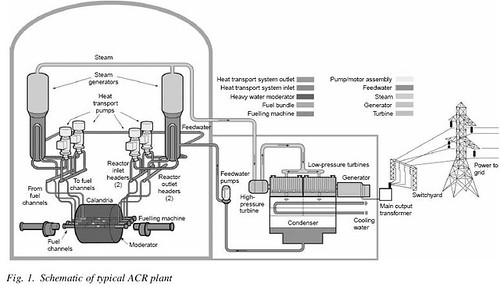
A typical advanced CANDU reactor
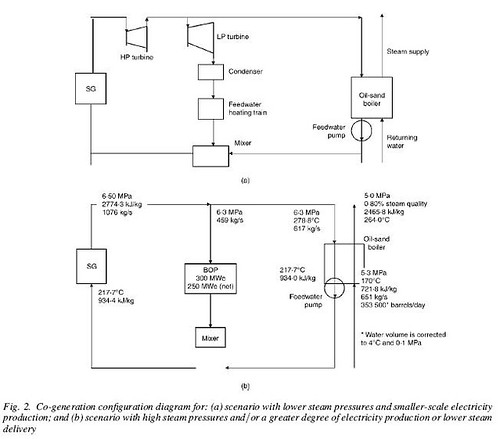
Configuration of a reactor as part of oilsands project
A 728 MWe (gross) nominal electric output ACR-700 design generates 1983 MW (thermal). The CANDU reactor can be adapted to provide steam of 2-6 MPa. An ACR700 would provide in one configuration 140MWe (net), 420,000 barrels/day/steam and supply pressure of 2.2 MPa. The production rate of bitumen using this steam would depend on the steam/oil ratios required in the SAGD wells. For steam/oil ratios of 212.4-224 degrees celsius the bitumen production rates would be 168,000-210,000 bbl/day. The project would achieve a 10% advantage in steam cost even if natural gas were at USD3.25/mmbtu.
The twin 2.2 GWe reactor proposal would generate 507,000 to 634000 bbl/day in a similar configuration with similar assumptions.
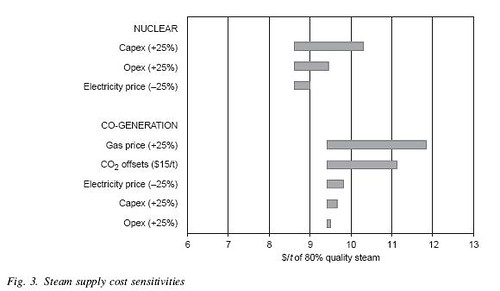
Cost Sensivity of the project
"One reactor (would be) in 2016 and the second one would be in 2017 ... We're taking it to where we feel there's less resistance (from the public)," corporation director Wayne Henuset told Reuters.
"We hope to site it and talk to the communities in the next two months," he said in an interview on the sidelines of a nuclear industry seminar.
Two further reactors are planned for a later unspecified date.
Canada's Natural Resources Minister Gary Lunn told Reuters in January that, in theory, he liked the idea of nuclear power for the oil sands.
Henuset said Atomic Energy of Canada Ltd. -- the government-ownedmanufacturer of the Candu -- estimated it could build the first reactor in 36 months.
He also said he hoped that nuclear waste from the plant would be stored either on site or in special chambers until it could be reused.
Shell Canada Ltd. Chief Executive Clive Mather told Reuters in January that although he was not ready to buy into the nuclear concept, it could offer a price advantage over time. Shell is a major oil sands operator.
The World Nuclear Association estimates natural gas is 60 percent of an oil-sands facility's operating costs.
A new Steam Assisted Gravity Drainage (SAGD) process has been developed and proven in Canada during the last decade. It is compatible with the steam conditions from CANDU reactors would release about 0.10 tonnes/barrel for extraction and upgrading of bitumen from much deeper deposits.
Reviewing the short history of oil sands production suggests that, based on current production and past rates of growth, production in 2050 would reach about 1.5 billion barrels/year (4 million bpd). About half would come from in situ projects. Presuming the production rate increases at a higher than historical rate of 5%/year, compounded annually, results in production of 3 billion barrels/year (8 million bpd) by 2050.
A single large dedicated CANDU 9 reactor could supply the steam and electricity to extract and upgrade about 600 million barrels of bitumen over a period of 30 years. The land area from which bitumen would be extracted is about 18 square miles requiring steam distribution and bitumen recovery piping from a centrally located 60,000 barrel/day plant of up to about 3 miles. Smaller reactors would be suitable for smaller production rates with shorter piping distance.
Henuset is quoted as saying that the 2.2 GW twin reactor would separate up to 500,000 barrels of oil a day.
In a speech to a high-powered business audience in New York last week, Prime Minister Stephen Harper said production from the oil sands — which now supply about one million barrels of crude a day — is now "on its way" to four million barrels by 2015, a target that exceeds the bullish 3.5 million barrels forecast used by the Canadian Association of Petroleum Producers.
Here is a pdf of a Wayne Henuset speech
The National Energy Board has forecasted that the oil sands production would increase fourfold by 2015, largely using steam assisted gravity drainage. If all the SAGD projects planned were to use natural gas as the fuel in cogeneration systems that would see natural gas demands in the region skyrocket to over 3 billion cubic feet/day by 2015. That's more natural gas than all the rest of Alberta uses now. 375 million cubic feet/day is replaced by the 2.2GW reactor. USD1.095 billion/year for the 375 million cubic feet/day if natural gas is at $8 per 1000 cubic feet.
[1000 cubic feet of natural gas is equal to 293 kWh.
320 billion kWh per year in 2015. Twenty 2 GW reactors needed to fully replace the natural gas usage]Putting the brakes on the oil sands development is not the answer. Canada needs the oil sands. Conventional oil and gas reserves are declining. Energy conservations are important and necessary but they won't eliminate the need for fossil fuels in our economy. In addition, oil sands activities will lead to significant economical impact not only to Albertans but across the nation with substantial increase in gross domestic product, employment generating over $123 billion in tax revenues.
It makes no sense to squander precious and declining reserves of natural gas to make oil in the oil sands. That's simply like burning gold to make coal. The answer for this is using nuclear power.
The first strategy is using CANDU nuclear electricity generation to extract the oil from the carbonate triangle involving potentially 450 [billion] barrels of bitumen. This is new. The second strategy is generating hydrogen electricity for the upgrading of the bitumen. The third is providing steam supply for the SAGD process in the oil sands; and finally, generating electrical needs for the utility companies in Alberta to keep up with our provinces projected growth.
One ACR1000 reactor would result in an annual displacement of around 500 million tons of CO2 compared to an equivalent gas fired generator accounting to a savings of $100 million, annually, of carbon dioxide cost if it was at $20.
So either you burn natural gas to get at oil from the oilsand OR you use new processes where you burn some of the oilsand to get oil from it OR you make a lot of nuclear reactors. If oil prices stay high and we go past peak oil and the prices go higher then it seems that making the nuclear reactors to extract the most oil for other purposes is the way to go. If all current conventional oil in North America had to be replaced with oil from the oilsands that would be about 24 million bpd. 9 billion barrels per year. If Henuset/AECL/CERI are correct in the 500,000-630,000 bpd estimate then 48 of the 2.2 GW twin reactors would be needed for the SAGD extraction process.
One way of viewing nuclear powered oil sands is to think of it as making a hybrid version of the global energy system.
Addendum on Water Supply
Of the total water allocated in the province, the oil and gas sector actually uses less than half of one per cent for water and steam injection processes (enhanced oil recovery). Water used for these purposes has declined from 88.7 million cubic metres in 1973 to 47.5 million cubic metres in 2001 – 37 million cubic metres of this was non-saline (fresh) water, 10.5 million was saline or brackish water. (Source: Water Use for Injection Purposes in Alberta report, Alberta Environment, 2003)
A CANDU reactor would (700MW) would generate 420,000 barrels per day of steam. A cubic meter is 8.38 barrels. Therefore, the (700MW) reactor would generate 18.3 million cubic meters of steam per year. 57.4 million cubic meters of steam for the 2.2 GW twin reactors. Water expands to 1700 times its volume in steam.
So the 2.2 GW reactor would be using 33,800 cubic meters of water for that amount of steam. Scaling up that amount of water usage 100 times would be well within the bounds of the water allocated for steam and water injection. The steam for the nuclear plants does not seem to be the limiting factor. Also, as I not further down this article 90% of the water can be recovered and recycled in the SAGD process.
The oil and gas industries complete allocation is 432.4 million cubic meters of water. (4.6% of 9.4 billion cubic meters of water).
The oil and gas industries gets 178.6 million cubic feet of water for steam and water injection. (1.9% of 9.4 billion cubic metres of water). This amount could get increased if needed.
If agriculture had to give up some of its water allocation, then in theory 33% of the the 9.4 billion cubic meters of water might go to oil and gas. The re-allocation can be reduced by using wastewater from the 11% of the water (1 billion cubic meters) that is used for people in their homes could be used. The oilsands industry could then be
scaled up 65 times from 2001 levels even still using the same wasteful methods as used in 2001.
Up to the end of 2001, Alberta had allocated over 9.4 billion cubic metres of water annually for a variety of uses. Allocations from surface water sources account for 98 per cent of this total; the remaining two per cent are from groundwater sources.
For 2001, the oil and gas sector was licensed to use 4.6 per cent of all the water allocated in Alberta; less than half (1.9 per cent) of this water is allocated for water and steam injection operations. By comparison, the agriculture sector (including irrigation) was licensed
to use the largest amount of water of any economic sector, at approximately 46 per cent. Municipal water supplies accounted for 11 per cent.
On page 25 of this report (Technology roadmap for the oilsands), it has chart which shows that thermal (steam) extraction of oilsands was using about 7 million cubic meters of water. This produced 125000 bpd. Scaled up 200 times, it would be 1.4 billion cubic meters of water, or 15% of Alberta's water. It would mean re-allocating water or re-using wasteawater or recycling more of the SAGD water and being more efficient, but it is feasible. Especially if there was great need because of any potential peak oil situations.
A criticism of some of this is that "even the oil industry is not looking at more than 4 million bpd from the oilsands". That is because the oil industry does not believe in peak oil. They are looking at 4 million bpd and thinking about new markets they would need to find to sell it.
So in summary, (since all the dots connections have to be spelled out):
1. There is plenty of water to scale up, even if water inefficient processes from 2001 are scaled up.
2. The water/steam for the nuclear reactors is not that large a demand and can be scaled up and the nuclear reactor/SAGD process is more water efficient than current oilsand methods
3. The steam from cooling any nuclear reactor used for SAGD can be 90% recycled
4. The water for the nuclear reactors can be wastewater
5. The SAGD process is more water efficient than other methods currently in use in the oilsands.
Also reviewing the other points that I have made in this thread:
In March 2006, Canada's leading private sector companies in the nuclear and power plant field, Babcock & Wilcox Canada, GE Canada, Hitachi Canada and SNC-Lavalin Nuclear joined together with Atomic Energy of Canada Limited (AECL) to create Team CANDU. The financial backing from those companies means
that cost overruns will be borne by them and not by the Canadian tax payer.
The project (the first 2.2 GW twin reactors) is expected to cost C$5.5 to 6.2 billion.
The 6 most recent CANDU reactors in S Korea and China were on time and on budget.
Another point is that a CANDU reactor Can generate 30-40% more energy from Light water reactor "waste" or unburned fuel and CANDU reactors can also breed Thorium.
Personnel
Archives
- December 2008 (1)
- October 2008 (1)
- July 2008 (2)
- June 2008 (2)
- May 2008 (6)
- January 2008 (2)
- December 2007 (8)
- November 2007 (9)
- October 2007 (11)
- September 2007 (14)
- August 2007 (14)
- July 2007 (10)
- June 2007 (9)
- May 2007 (11)
- April 2007 (9)
- March 2007 (11)
- February 2007 (11)
- January 2007 (11)
- December 2006 (12)
- November 2006 (16)
- October 2006 (13)
License

This work is licensed under a Creative Commons Attribution-Share Alike 3.0 United States License.
Brian,
I don't see a cost estimate for anything here?! Or who will pay what part...
Will Ottawa, re: the taxpayer, be on the hook for this as well, at the same time that they're losing billions on the Mackenzie pipeline?
As per my Law of Receding Horizons, you can be sure that any cost estimate we'll see eventually, will be based on present day oil prices. Hence, as oil prices go up, which is the reason the oilsands seem economically viable in the first place, so does the cost of mining them.
The oil from the sands gets more expensive for the exact same reasons that make it seem profitable. And you know what that means? That it is no longer profitable.
Also, of course, you can be sure that when an industry talking cheerleader head predicts 2016 as the date for the first operable nuclear plant, that's nothing but an optimistic construction date. Things like public consultation and permits are assumed "done". A realistic version then teaches you that nothing will be operable before 2020 at the earliest.
By then, you have to really seriously start wondering what will power the machinery required for construction and transport. What happens to the entire picture with oil at $15 a gallon? How about $25? I think we all know what happens: collapse.
And even if you ignore this mechanism, who would you produce the oil for? People driving cars? Who will drive a car at those gas prices? What carmaker will survive as car sales go down 75%? How many gas pumps will remain?
Oil decline will doom the whole infrastructure, as well as the economic system that already is stretched to the limit today trying to keep it alive. Any attempt to prop it up with $50 billion nuclear plants (see, there’s an estimate) is uttter lunacy conceived by people who are too myopic to understand how all elements in a system are interconnected. It’s also one more massive transfer of wealth from taxpayers to corporations. Well, the taxpayer will stop paying, out of sheer destitution.
The cost estimates that I have seen are C$5.5 billion to C$6.2 billion. I have not seen any indications of taxpayer support being required.
Rising oil fuel prices would make the project more profitable and more likely.
Gasoline costs people in many places in Europe $7 per gallon. They are still driving. The recent tripling in fuel pump prices over the last few years has only modestly lowered driving and slightly altered car selection to mroe fuel efficient.
300 gallons per year (12000-15000 miles per year depending on efficiency) would cost $4500/year at $15 a gallon.
There are 30 nuclear plants being built in the world right now. They are not showing big delays or cost overruns like you are describing. Show me where you see current nuclear plant projects with the delays and overruns you are talking about.
The May, 2007 stats for nuclear reactors are being built (30), planned (74) or proposed (162).
This is a 21% increase from from February, 2007. 266 reactors versus 219 reactors are now in the development pipeline. Since february, 2007 of 3 more being built, 12 more planned and 32 more proposed. This does not include the 10 more being discussed in the UK or India's plan for 10 more beyond older statistics.
The recent IPCC report indicates that increasing nuclear powers share of supply to 18% (up from 16%) is reasonable.
The EPRI (as reported in the recent Engineer Poet report from Clean Tech 2007 on theoildrum) adding 64 GW in the US by 2030 is part of an overall plan of carbon reduction.
The EIA 2007 energy outlook projects nuclear power going up 50% by 2030.
As I indicate the more the peak oil situation actually hits then the more nuclear plants there will be around the oilsands. People in the US could drive less OR dozens of reactors could be built in Alberta and the oilsands could be scaled up to Saudi levels and higher.
I see this deal getting rubber stamped and breezing through approvals. You think it will take four years to get approved. We can check back next year. The behind closed door handshakes have been done. Shell plopped down $571 million to buy rights that make sense when this deal is factored in.
===========
http://advancednano.blogspot.com
Why are the estimates missing from your post? What do they include? Decommissioning? Water rights? Waste disposal? Let's see numbers.
No, taxpayer support is never a part of the first phase. That would kill the project right away. It will be there later, though. It always is. Name one nuke plant that has not involved public money. And document it.
Look at what goes on with the Mackenzie pipeline. And Tony Blair swore two years ago no nukes would be built in the UK with any money from government. Look at him now.
More likely yes. More profitable no. That's faulty thinking. What cost for uranium is included in the budgets? One that is 25 times as high as present costs? 250 times? How about the water problems?
And that, you think, will go on forever? People will keep driving no matter what the price, obeying some boiling frog principle? Come on, get serious, this is no fun.
The American population is getting poorer by the minute, a fact that can't even be hidden anymore by borrowing ever more, or printing money. And they will be able to pay gas prices that are a multiple of what they are today? That, by the way, is exactly what the idea of profitability for the oilsands is based on. It envisions nothing like a 75% demand destruction in the US. But where will people get the money to pay those higher prices?
In a society such as ours, where everything depends on that same energy source, people make one and the same mistake all the time. They see one thing changing, which they interpret as an opportunity, and forget that everything else changes as well. That is Receding Horizons.
1/ That's a lot of money for a burger flipper. Any clue how much food costs will rise at those gas prices? Electricity, clothes, everything else? Ever gave that even one second of thought?
2/ 40-50 miles a gallon?
They will all have both the overruns and the delays. Try and name an example that has not had them. Well documented please.
Oh, there is no doubt we'll do a lot more damage than we have already done. It’s the one thing we really have a talent for.
Where will the feedstock come from? Where is all the waste going to go?
Nuclear power is labeled clean only by those invested in the industry. Are you?
Saudi levels, as in 9mbd? You have no idea what you're talking about, do you? We're getting p**sed off now, Brian, you can at least try to make some minimum sense. But you just simply have no clue what you're saying.
The most optimistic, and therefore least realistic, estimates go nowhere beyond 4.5 mbd. No-one has ever suggested higher numbers, and you simply double them? Whatever.
Dozens of nuclear plants? No-one has ever suggested that either.
You completely lost me there, on those two points. I’m starting to think you’re a trolling fraud.
Not a big proponent of democracy, are you? Presenting ”behind closed door handshakes” as if that’s something positive.
All in all, when you write a post like this, prepare it better. The Oil Drum, as far as I understand it, is supposed to be a serious forum, not a promo site for industries. And I think they made a big mistake allowing you to post this. There has to be some zero standard.
Here are links to list of reactors. When they started construction and when they came online generating power. It also lists how much power they generate.
You seem totally clueless as to how the world works.
I am saying that I believe before the scenario you presented where people stop driving, that the oilsands get scaled up and a lot of nuclear plants get built.
I am not presenting the fact that deals get made as positive..it is just a fact.
If you do not like my writing, then I am ok with that.
Where are your numbers. Data from sources ? Documented cases that prove your case ? I have not seen any sources or links from you. Just ranting opinion . The one off topic example of the McKenzie pipeline.
US
http://www.iaea.org/cgi-bin/db.page.pl/pris.powrea.htm?country=US&sort=&...
Canada
http://www.iaea.org/cgi-bin/db.page.pl/pris.powrea.htm?country=CA&sort=&...
China
http://www.iaea.org/cgi-bin/db.page.pl/pris.powrea.htm?country=CN&sort=&...
France
http://www.iaea.org/cgi-bin/db.page.pl/pris.powrea.htm?country=FR&sort=&...
Japan
http://www.iaea.org/cgi-bin/db.page.pl/pris.powrea.htm?country=JP&sort=&...
Russia
http://www.iaea.org/cgi-bin/db.page.pl/pris.powrea.htm?country=RU&sort=&...
Slovakia
http://www.iaea.org/cgi-bin/db.page.pl/pris.powrea.htm?country=SK&sort=&...
India
http://www.iaea.org/cgi-bin/db.page.pl/pris.powrea.htm?country=IN&sort=&...
Taiwan
http://www.iaea.org/cgi-bin/db.page.pl/pris.powrea.htm?country=TW&sort=&...
http://advancednano.blogspot.com
Any chance you will answer any of my questions? Or some IAEA list is all you got?
9mbd, Brian? Dozens of reactors in Alberta? You sure you don't want to think that over?
Where are the data about delays and cost overruns?
All I see from you are industry and lobbying files. Which for the Oil Drum is way below par.
You write a post, defend what you say. No strawmen.
http://www.aecl.ca/Projects/CANDU-P/Wolsong-P.htm
several Candu 6 reactors completed on time and on budget in the 90s in South Korea.
The IAEA list has detailed information on construction times.
In general if they completed roughly on time then they would be roughly on budget.
Do you understand the original article? Apparently you do not.
The point I was making is
1. there is details on the thermal energy and electrical energy and how that will translate into generated oil
2. It shows detailed cost assumptions. It also shows sensitivity analysis where if there were delays or problems or changes in prices how that would effect the project. So if you have some other assumptions you can run the numbers yourself. Fire up an excel spreadsheet. You do know how to use a spreadsheet.
3. You want to find numbers on delays and overruns. Look it up and Google it yourself.
4. I have answered your questions. Sometimes the answer is that you have put up a strawman or your question is absurd. Those are also answers.
The 9mbd, I already said that is my opinion on what will happen before some doom and gloom scenario.
5. What I have said is the one twin reactor looks certain. The other possible reactors are based on calculations of IF reactors are used for most or all of the oilsand powering.
6. A lot of what is said here on the oildrum are scenarios based on crunching numbers and using researched facts.
=====
http://advancednano.blogspot.com
All you have done so far is patch together a bunch of industry and lobby quotes. That is way below par for the Oil Drum, and in no way belongs here.
Not because of me, but because of the people who write posts here that have high levels. These people deserve to stand apart from what you write. Also, the readers who come to TOD for them, for Stuart Staniford and Robert Rapier et al., should feel confident that posts contain some minimum level of truth, effort, research and understanding of the topic. You are nowhere near, you haven't even tried to get an opinion that could provide a counterweight to all the corporate sales talk. So you insult two groups of people. Both deserve much better than this.
When I ask you questions, there are no answers, other than links to bland IAEA files or more of the same industry snake-oil. I take that to mean that you don't know the answers to the questions. Where's the waste going to go, Brian, what's in the budget for securing it for the next 100.000 years? How much in the budget for decommissioning the plants in 2060? Never mind, you have no idea, do you?
Costs are crucial factors in these matters, not unfortunate incidents falling by the wayside. Cost assumptions by AECL are worth less than the paper the numbers are printed on. They're not proof of anything at all, apart from an active PR department in the industry. At $290 million annually in taxpayers' money, that's hardly surprising. And that's just AECL's subsidy.
If these are the people who pay you, you need to come forward and say so. If not, I can't imagine why you would post this; certainly not to be taken seriously. I'm sure you didn't expect to, not here of all places. People here do actual crunching of numbers and researching of facts, they don't copy quotes from promo flyers.
The answers for your question is in the articles. Were you unable to read them.
They already said the waste (unburned) fuel will be stored on site. Just like all other fuel for Canadian reactors currently operating are stored on site.
I have already answered your questions. You complain that I don't have the answers while in fact I did answer your questions. Which you could not take the time to contribute by simply reading what I had already provided or googled.
So I find your whining worthless when you do not read or try to understand.
I found all of the details and answers that you were unable to do for yourself.
So your welcome. I know you want to thank me but you are embarassed by your inability to read wikipedia or google. I guess you have some kind of internet dyslexia. Should we start an internet fund raiser for you. You say that numbers are crunched here. Why don't you prove it. I have not seen your crunched numbers. Dazzle me with your number crunching savant skills. I say savant skills since you are unable to communicate without insult tourettes or actually completely reading a set of articles or information.
In a few years we will see who is right about the world. I bet this project happens and your statement about $15/gallon does not. So this is a little preview of the future. I also bet that by 2025 the second oilsand reactor is also operating.
Well, this is useless Brian. You can't answer my questions, nor defend your points, because you have done no research.
Pointing back to the same industry promo clips that your entire 'post' is based on, is void of any meaning. It does, however, make abundantly clear what the level of your thinking and writing is.
And that is, as I said, way below par for TOD. I'm starting to think you were set up, and you'll be the laughing stock of the family soon.
In the meantime, are you going to tell us if you work for the nuke industry? Personally, I can't figure any other reson why someone would produce this drivel.
PS I didn't make this personal, you did, And you're not very good at that either.
PS 2 You say:"You say that numbers are crunched here. Why don't you prove it."
I'm sure Stuart et al will really appreciate being cut to size in this manner.
HeIsSoFly,
Any idea how much energy is lost when instead of direct use of natural gas or nuclear they are used to refine this third product oil?
Seems like we are trading one lame horse for another lame horse, and that to run a senseless horse; the auto industry.
As far as multiples of nuclear plants, where is all that water to come from, I am led to understand that present use is about maximum? Could be wrong here though and as well maybe it would be a goodly step in removing our treaty obligations with the first nations, you know that part that goes....'So long as the sun shines the grass grows and the rivers run'. Get those nukes steaming away and with Monsanto having a lock on the death of grass and just about everything else green and growing all we would have to do then is wait for a solar eclipse and voila this devastated land would really be ours...the only question is would we want it?
You obvisouly do not comprehend the scope of what is happening with the resurgence of the nuclear industry. 30 reactors being built right now. $60+ billion going into to that.
In Canada, they already have all the local, provincial and federal support. Candu cut big money deals with Hitachi to ensure no taxpayer financed overruns. They do not need anyone readig the Oil drum to agree with them.
I am saying prove anything that you "HeisSofly" are saying. None of what you said has any number crunching. None of what you say has any research. I am saying that you cannot figure your way out of a paper bag. It is why you think because information that upsets your world view is presented you think that someone must be paying me to present it.
you say that you did not start making it personal. Reread your first posts. You are a silly liar and a buffoon.
===============
http://advancednano.blogspot.com
Waste will be stored above ground in ponds until is become more economical to run it through a different nuclear cycle than dig up new nuclear fuel.
The above statement HAS ALWAYS been proven TRUE.
There was an article somewhere about how recycled waste has higher ppm concentrations of precious metals than commercial ORE. This means that for Gold and Copper we are closing the cyclic loops, and will likely transition to sustained development!!!
That statement is merely stupid. There has never been a viable next nuclear cycle other than the weapons vs power generation one, which are entirely different levels. There are no breeders in the world today, and there never will be again. It's just nonsense contocted by horny 10th grade males.
France used to have one, it was uneconomical to run.
What is meant is that humans can recognise the value of waste and knowing that it can be reprocessed if nessiary means that it will not be sealed away.
The 4th gen nuclear fuel cycles are on the way, far from today, but I speak of the future.
Your statement of 'no more breeders' flys in the face of experience. Some places burn trash for power, TRASH!
The Russians has a functioning Fast Breeder Reactor (560 MW) Beloyarsk 3
http://advancednano.blogspot.com/2007/04/status-of-nuclear-breeder-react...
Russia has funded and restarted construction on their 800MW fast breeder, which they also are discussing selling to Japan.
China has a 75 MWth FBR under construction scheduled for divergence in 2010
India is making FOUR 500 MW fast breeder reactors.
http://www.india-defence.com/reports/2854
Japan will be reopening the Monju reactor in 2008
http://en.wikipedia.org/wiki/Monju
So by 2008 back to two breeder reactors.
In 2010, 4 breeder reactors
In 2012, 5 breeders generating abot 2GW of power.
============
http://advancednano.blogspot.com
About 8% of the nuclear waste (unburned fuel) (66000 tons/year) that is generated in the world each year is being reprocessed into MOX.
http://advancednano.blogspot.com/2007/04/status-of-nuclear-breeder-react...
COGEMA La Hague site, France 1700 tonnes/year
Thorp nuclear fuel reprocessing plant at Sellafield, United Kingdom
900 tonnes/year
Rokkasho nuclear fuel reprocessing plant, Japan
800 tonnes/year
Mayak, Russia 400 tonnes/year
B205 at Sellafield, United Kingdom 1500 tonnes/year
Kalpakkam Atomic reprocessing plant, India 275 tonnes/year
The French reprocessing has been going on for decades.
Do you not tire of being wrong?
===================
http://advancednano.blogspot.com
Here are links to list of reactors. When they started construction and when they came online generating power. It also lists how much power they generate.
You seem totally clueless as to how the world works.
I am saying that I believe before the scenario you presented where people stop driving, that the oilsands get scaled up and a lot of nuclear plants get built.
I am not presenting the fact that deals get made as positive..it is just a fact.
If you do not like my writing, then I am ok with that.
Where are your numbers. Data from sources ? Documented cases that prove your case ? I have not seen any sources or links from you. Just ranting opinion . The one off topic example of the McKenzie pipeline.
US
http://www.iaea.org/cgi-bin/db.page.pl/pris.powrea.htm?country=US&sort=&...
Canada
http://www.iaea.org/cgi-bin/db.page.pl/pris.powrea.htm?country=CA&sort=&...
China
http://www.iaea.org/cgi-bin/db.page.pl/pris.powrea.htm?country=CN&sort=&...
France
http://www.iaea.org/cgi-bin/db.page.pl/pris.powrea.htm?country=FR&sort=&...
Japan
http://www.iaea.org/cgi-bin/db.page.pl/pris.powrea.htm?country=JP&sort=&...
Russia
http://www.iaea.org/cgi-bin/db.page.pl/pris.powrea.htm?country=RU&sort=&...
Slovakia
http://www.iaea.org/cgi-bin/db.page.pl/pris.powrea.htm?country=SK&sort=&...
India
http://www.iaea.org/cgi-bin/db.page.pl/pris.powrea.htm?country=IN&sort=&...
Taiwan
http://www.iaea.org/cgi-bin/db.page.pl/pris.powrea.htm?country=TW&sort=&...
http://advancednano.blogspot.com
¿Who pays for the insurance?
Not the owners. There is a law that makes them not responsible of any damage they cause above a cap.
The government also pays but not the whole amount neither.
So you can say that the public around the nuclear plant "pay" for the insurance, by not being insured.
'mencial' links the Wikipedia article on the Price-Anderson act, which obviously does not apply to nuclear power reactors in Canada, and suggests that owners do not pay for insurance, which an honest article would not say, although conceivably a Wikipedia article on a given day might.
Reactors built to heat tar sands so as to drain the tar out will obviously assist in perpetuating accidents of the sort listed here, aside from the coal-mine ones, and here. But at least the gas that would otherwise have had to be piped to the tar sands won't have to be, and the risk of another New Mexico or Ghislenghien gas pipeline disaster will be alleviated.
It's instructive to divide the number killed by gas pipeline explosions and the like in a country in a year by the fossil fuel tax revenue received by that country's public purse in a year. Typically government gets several tens of millions per death. Where it substitutes fossil fuels, nuclear energy prevents virtually all those deaths, but it also prevents the revenue.
By asserting that nuclear operators don't buy private insurance, and offering as evidence a law in one country that requires them to do so*, persons with oil- and blood-stained cheque-cashing hands sometimes try to distract attention from this. The charade gets a little thin when they have to choose between putting their personal skins on board a diesel boat or a nuclear one, and they choose nuclear.
--- G. R. L. Cowan, former hydrogen-energy fan
http://www.eagle.ca/~gcowan/Paper_for_11th_CHC.html :
oxygen expands around boron fire, car goes
* Some other countries' laws are reviewed here.
He Is So Fly
Sorry I failed to attribute the Law of Receding Horizons to you below. I could't remember who invented it. I believe it is a terribly important insight that will govern much of what happens from now on.
An update on this article is that the Globe and mail reports that Shell is buying 70% of the power from the reactor.
So Shell main customer.
Local support about 300 to 5 against.
Local government, provincial government, federal government all on board.
The cost is C$6.2 billion. It looks like a primarily commercial deal for the main building of the reactor. The project will probably have whatever standard government business support and tax incentives that any such business would have.
==========
http://advancednano.blogspot.com
Advanced,
Nice article. I think your carbon credit values are low. Ultimately we will need a $100/ton tax to get any serious changes going. Including carbon credit, the payback looks like about 6 years versus a 40+ year life out of a reactor.
CANDUs are very flexible - they can burn all kinds of fuel, so fuel cost won't be a problem.
Sure nuclear isn't perfect, but it's way ahead of wasting natural gas for steam generation.
Actually the ACR's can burn the spent nuclear fuel from American Light water reactors.
So the American's can send their nuclear waste, (plus a not small number of dollars :-) to Canada and get Oil in return...
Candu explains their Darlington project and quote the ontime construction the S Korea plants and two more recent projects in China
http://www.canducanada.ca/eng/budget.html
Wikipedia description of CANDU reactors
ttp://en.wikipedia.org/wiki/CANDU
Discussion of Candu in a management magazine
http://www.managementmag.com/index.cfm/ci_id/3071/la_id/1.htm
A Macleans article
http://cnews.canoe.ca/CNEWS/Rogers/Macleans/2007/05/03/4150972-mac.html
First, last spring, AECL executives created "Team CANDU," an alliance with big private companies, which Lunn duly applauded, saying the participation of players like Hitachi and SNC-Lavalin boosts his confidence that any future Canadian reactors projects will be completed without any risk that taxpayers would be on the hook for cost overruns. Second, last fall, AECL struck its deal with Energy Alberta to push the oil sands concept that carries such obvious appeal for Harper and his Alberta base.
AECL gets about 290 million per year in support from Canada. Plenty of big Canadian corporations get support.
============
http://advancednano.blogspot.com
Interesting stuff. It does seem a good fit to use the 2/3 of power of nuke plants, waste heat, for the steam to assist tar sand extraction. Natural gas is too valuable for that. The water requirement doesn't seem too high from Wikipedia. It's much better than destructive surface mining.
It makes more sense to build nukes where they burn natural gas (or oil) for electricity (if no NG in base load, also build pumped storage or build nukes in an area with a fair amount of hydro) and burn NG to extract tar sands.
1) Construction costs will be VERY high anywhere near Ft. McMurray, cheaper to build nukes elsewhere.
2) Tar sands are close to NG production, save on transport costs.
3) Processing plants already built or under construction are designed for NG, not nuke. Projects in the pipeline should use almost all available water.
4) NG based tar sand technology can be adapted more easily to new technology/processes than nuke based (scrap costs are less).
Best Hopes for Systems Thinking,
Alan
I think it is insane to waste precious Natural Gas on the tar-sands. And I have a lot of doubts about Nuclear, but to the extent more reactors are built, it would be much more productive just to generate electricity and feed it into the grid.
Shut the tar-sands down, ultimately, they’re a waste.
Antoinetta III
They turn a profit still, dont they?
Alan, you are too kind. I would add that it would make more sense to use the nukes to support electric rail and electric cars, and leave the bitumen in the ground.
MicroHydro, agreed at least partially. While I can see that nuclear energy makes a lot more sense than natural gas, the economic fallacy is turning clean electricity into fuel for the internal combustion engine. Wouldn't it make a lot more sense to convert our transportation needs to electric and bicycles ?
The only thing that makes electric non-competitive is the costs of storage. If we had Alan's electric rail for long distance commutes and quick-charging batteries for scooters and cars we could do it today, end global warming threats, end air pollution, save petroleum for petrochemicals, and make massive amounts of jobs and real prosperity retooling the transportation industry. Its a mental attitude thing, and good leadership from our various governments is lacking.
"420,000 barrels/day/steam" seems to need editing. Similarly, how is it that "steam/oil ratios of 212.4-224 degrees celsius" makes sense? Steam-oil ratio could be dimensionless -- mass over mass -- or could have dimensions of (kg steam)/(barrel oil), mass over volume; it's not a temperature.
--- G. R. L. Cowan, former hydrogen-energy fan
http://www.eagle.ca/~gcowan/Paper_for_11th_CHC.html :
oxygen expands around boron fire, car goes
Well spotted - but I think 420Mb/d of steam simply means that quantity of boiler feedwater, converted to (wet?) steam for injection. IIRC a CEGB 500 MW turbogenerator consumes about a ton per second of superheated steam, equivalent to about half a million barrels per day feedwater, so the numbers look about right.
OTOH, a steam/oil ratio expressed in Celsius is pure nonsense. This is the sort of thing that leads me to suspect that someone has no clue what they are writing about; the first thing to look for in engineering analysis is dimensional (units) consistency, if it ain't got that then it ain't worth zip.
THIS IS PERFECT!!!!!
Everyone. Think. About. This.
Nuclear has HIGH HIGH initial costs. If someone could estimate how many nuclear reactors would be required to be built to service the steam needs for Bitumen Sands we are in business. If OilCo's build enough, they (and us by proxy) shoulder the investment.
We USE the NEED FOR CHEAP oil to BOOTSTRAP NUCLEAR POWER generation in Canada. When all the bitumen totally runs out, a simple retrofit (everyone ignores sunk costs) (with low cost, relative to building NEW NUKE plants) turns the plants into electricity generators!!!!!!
This allows for a smoother transition, and lets the electrification of transportation which is so widely talked about, occur quickly.
Someone tell me I'm wrong, cause it seems like a very good solution. (except for the water requirements, but those are already being handled I suppose)
G.
Hi Gil,
Sorry to be negative, but no.
(1) Reactor cores and pressure vessels are subject to intense neutron bombardment and vibration, and have a finite lifetime.
(2) They are buried deep in a massive reinforced concrete containment structure which has to be cut apart to get them out (or replace the reactor) - simpler to let the containment become the disposal site.
(3) The Athabasca (and Orinoco!) oilsands are a long way from centers of electricity demand.
Thanks for the input.
boo on everything being ruined.
i have no rebuttals!!
/would have been nice however!!
re: nuclear power as an energy source
David Fleming would seem to suggest that nuclear power is not a large scale viable option.
sorry for a link to a page of mine, as i dont' know of an official source for this pdf (it was emailed to me)
Just watched "The Inconvenient Truth". A great movie, though a little bit politically painted.
Personally I'm tired of repeating the same old arguments - this time I'll just tell all nuke naysayers that maybe it is about time to get their heads out of their a**es and try to grasp the big picture. A picture, in which there are certain "inconvenient truths", noone has so far gone around yet:
1) People will not stop driving or reduce it that much. Nor will they stop using electricity - from coal or nuclear - it is our choice, really;
2) Tar sands and oil shale will be developed, period. Whether using natural gas, coal or nuclear - our choice again;
3) Uranium will not "run out", the same way we will not "run out" of iron, lithium or copper - we will just use it more efficiently or recycle it.
4) So called "renewables" (excl. hydro) are not much more than political boondoggles, in some cases planting the seeds for certain enviromental disasters. We will be lucky if those ever substitute 10% of the energy we use, even combined with efficiency gains.
5) We are currently in a window of opportunity which is slowly closing before our eyes - the opportunity for mass producing nuclear power on a global scale and electrifying our transportation - the only technically viable alternative of using coal, oil and gas for the foreseeable future.
6) NIMBYsts deserve to be shot - unfortunately the ones who will judge them are not born yet, and by the time this bill becomes due, they will be long dead;
This all comes down to the point that we have a choice which we need to make today - and given the options we have, I'd like to ask the nuclear deniers, nitpickers and self-appointed energy specialists: are you ready to take the responsibility for the consequences of your options??
LeviK - well and hard put
Im afraid I have to resort to support your views - for the most part.
In the back of my mind I have this wishfull-thinking though ... although impossible due to the reality called TIME.
If all crudeoil used for transportation TODAY
- "in a magic stroke" where channelized and reallocated TO GENERATE electrisity ONLY - AND all cars underwent the same magic trick and TURNED ELECTRIC ...
In such a scenario we would be much better off -
1) concentrated powerplants , thus easier to handle the CO2-issue at a few places only. Instead of millions of polluters (cars) spread all over the place ... impossible to deal with.
2) energy-efficiency would have risen many-fold (at lesat doubled), as an el.motor may be 80-90% efficient, as compared to the 15r% efficient ICE.
3) using the latest i technlogies for OIL-TO-ELECTRIC IN POWERPLANTS WOULD EASILY DRAIN CRUDE (PETROLEUM) FOR 70-80% OF ITS ENERGY CONTENT ..
4) MORE ...? Yeah , maintaining an el.car is next to nothing, and so forth ..
.... some said (MLK) "I have a dream ..." , but I guess my dream is just that.. at least for the very short term of the day of tomorrow
BUT this "dream" is actually the way to go- ADDING the concept of TIME - starting tomorrow. This planet shall under all circumstances scale down its energy uses - for wastefull unnecessities..
- small electric cars for local transport (advanced 2 seater radiocars), and for long/medium distances =>> train.
"Mass producing nuclear power" will not happen.
Law of Receding Horizons.
LRH will kick in only if/when the system enters irreversible collapse.
IMO there is enough "operating reserve" in our current establishment, to allow transitioning to something else without necessary crashing the whole damned thing. 10 years for picking up, 20 years for implementation and we could be there. In 30 years we are still going to have at least half of the oil&gas supply we have today, and I could easily imagine the world still functioning with that much.
Of course with time the operating reserve decreases and hence my rant.
That's silly.
We have plenty of oil left to produce lots of petrochemicals and build nuclear reactors, if we make them strategic priorities as they ought to be.
Keeping the grid going and powered is essential and ought to be regarded as a national, and global priority to save civilization---along with avoiding irreversible climate collapse.
In this environment we'll be entering a time of harsh choices, between the mediocre, the bad and the worst. Of these, nuclear is the mediocre.
If mass producing nuclear power won't happen---then mass production of all the other full renewables, solar wind and biomass, will fall even sooner, because they cost substantially more and make substantially less output. I desperately wish it weren't so, but we can't argue with the laws of physics. Renewables aren't limited by imagination, but immutable thermodynamics and geophysical facts.
I actually don't mind paying for that, up to some level, but to me the critical requirements to save humanity from barbarism is to keep electricity going and avoiding massive climate change---and of course food. I think food will be OK if the climate doesn't go too crazy---and we don't go too crazy for bad biofuels.
if we make them strategic priorities...
If mass producing nuclear power won't happen---then mass production of all the other full renewables, solar wind and biomass, will fall even sooner, because they cost substantially more and make substantially less output
I see wind as choice #1 and nuke as #2 (or lower).
If we have strategic allocation of resources (primarily energy and embodied energy) in Year 1, the investment in wind will have paid back the investment by year 3.5 to year 5 (time to build + time to repay investment). Every 2 or less years after that, the wind investment will repay the invested energy again. In a decade, a very nice energy "profit".
A reasonable time frame for early new nukes is a decade (two Texas nukes announced in 2007 scheduled for 2015-2020, I would bet that #2 goes commercial in 2021+). Later a seven year construction time frame seems reasonable (4 to 5 years of physical construction). Only after a nuke starts producing power can it repay the invested energy.
I am unsure of what the energy payback is for the next generation of nukes, but it may be close to that of wind.
Given the head start of wind (as little as 18 months from financial decision to commercial generation when expanding an existing wind farm) nukes would have to have a VERY fast payback period to "catch up" with wind. And even "under construction" wind farms generate power as they are being built (each WT erected and connected is new power, regardless of the completion date).
After wind passes XX% of grid power (XX being 15% to 40% depending), then pumped storage and HV DC has to be built in addition to just the WTs. and this will tend to lower the payback calculations.
Best Hopes for non-GHG generation,
Alan
Nuclear power and wind power do to a large degree use different component suppliers and they fit different investors and locations. The real world solution is a mix of several electricity sources. Myself I prefer that near term wind power is built distributed enough to not need large investments in powerlines since they unfortunately are expensive to build. Wind power is hurt if it has to carry additional costs for grid strenghtening and is built in such an ammount that it needs new spare powerplants.
For Sweden I personally advocate long term investments in backbone grid capacity to have powerlines in place for new nuclear powerplants and very large wind farms if or when they are needed and makes economical sense. This is also good for power trading and redundancy lowering the downtimes.
Btw I am seriously downsizing my web debating. I have since a week started working professionally with enviromental issues within my party. Its almost chocking to suddenly be given a key to the Swedish parliament complex and becomming part of the support staff. I am no longer working more or less alone with these issues and have to be carefull since what I state can be interpreted as official Moderate policy.
Reading ToD and thinking about these issues has been very inspiering. I will continue to read ToD now and then and I will thank the contributing community by giving you translations of new Moderate enviromental policy when it is ready and made official.
I have enjoyed your contributions very much!
I wish you all the best in your new job.
Sweden, as ever, is way out in front on a lot of these issues, although tough choices on nuclear power remain ahead.
The Vattenfall stuff on global warming that they have published is excellent, by the way.
Good luck!
CONGRATULATIONS !!
stands & claps
I hope that you can still visit :-)
May I respectfully suggest that you review other nations policies.
Switzerland for small & microhydro (May I suggest a call to Vincent Denis at MHyLab.ch).
Germany for insulation and building standards (although Sweden is also VERY good, but one can still learn).
France for new tram lines. I have seen the plans for Mulhouse France (one of many small cities and towns in France with new tram lines). A town of 110,000 will have 3 lines by 2012. I would like SOMEONE to give LR55 track a real test.
And the United States for plans in dealing with those damn Norwegians and their oil that is truly Swedish (did Sweden cede offshore oil rights when they let Norway go ? If not, it is still yours >:-)
Best Hopes for Swedish Infrastructure (and Swedish North Sea Oil & Gas),
Alan
Nobody has asked me to not post here. I simply need to make life simpler to able to digest the new job and avoid making a fuss about things that are not important for solving enviromental problems etc or accidentially hurting my issues.
Its a new world for me although the basics are the same as on the municipiality level. One of my first personal observation is that the political side in our new government has few organizational levels and is very keen on listening to the public, companies and research on several levels. Its not PR, its real, its realy nice to find out!
Microhydro and so on should not be about the government choosing a technology but getting rid of red tape hindering development, encouraging technological development and setting up financial and social incentives for long term thinking and investments. Choosing the exact solution cuts out possibilities and a central government can never know about all of them.
I love to hear about different technologies since I am a technology nerd but we mostly need to find out how local or global capital, local or global knowledge and local conditions all around Sweden can get good ideas implemented. But as I have posted before I do have some favorites such as plug-in hybrids, biogas, electricity based society and nuclear power.
Doing something significant about GW and thus also PO over here is probably about shifting the consensus in a consensus culture withouth falling into any single solution traps like only ethanol or only nuclear power or only favoring a few companies.
Offshore oil were not known about when Sweden and Norway split but the Norwegians were very keen on sea travel and fishing rights. I strongly advocate close nordic cooperation and I hope Norwegians will invest more in Sweden. And I know you are joking.
But I do seriously imagine Sweden and the Nordic countries future as a stable well run resource creator and workshop that help stabilize EU and beyond in future troubled times. Thus we have a conflict between the greens that wants to downsize and leave EU to solve our local problems on our own and us who like growth to be able to ease the global problems and be important for large powers if things should get realy nasty.
I know we have succeeded when we start having Americans migrating here. :-)
I would suggest a long talk with Vincent Denis. He has long worked with one of the EU DGs on promoting small hydro. And a nice guy.
MHyLab is a very good resource. Founded by chief engineer of HydroVevey (he retired when evil Austrians bought the company), it applies large turbine design to small turbines with several innovative attempts to reduce costs. 5 people machine shops have built their designs (CNC machine tools required).
They have installed microhydro in potable water replacing pressure reducing valves (they found that they needed a bypass valve for half time during important football matches) and in treated sewage outfalls (one installed by helicopter).
1 MW to 100 watts.
Also, look at http://www.lr55-rail-road-system.co.uk/
and proposed in Edinburgh
http://www.edinburgh-tram.co.uk/track.htm
Lower costs can = more track !
Are you going to be able to visit ?
Best Hopes,
Alan
Oups, did it again "and be important for large powers if things should get realy nasty" is as far as I know not official policy but my own thought on how to handle the possibility of war-time bad times due to for instance runaway GW. Its also the kind of policy I would like to have our neighbours copy.
The absolutely worst outcome of GW and PO would be a political meltdown and fast burn of resources to fight resource wars. That could drain the mitigation resources for millions of people.
With or without uniforms and weapons ?
Best Hopes for Swedish neutrality, democracy and the King,
Alan
Agree. Your comments contribute a dimension to this site that won't be readily filled.
Dont be a stranger.
I just dont see wind being able to compete with nukes for scalability. The global wind resource is what, some 10 TW... but most of that is in cost prohibative areas such as the middle of the ocean or the stratosphere. You aren't going to be able to run most of human civilization off of this.
It offers strong growth potential in the short term to be sure, but not as a floor for the world in a growing energy market.
The economics of wind turbines are improving at a steady rate (a bit like Moore's Law for computers, but NOWHERE as steep).
The determining factor for massive increases in North American wind generation are primarily transmission. One pass in California will get a new 4.5 GW transmission line so that sites developed with 60 kW wind turbines in the "Great California Wind Rush" can be redeveloped with multi-MW wind turbines.
The old surveys of wind potential were based on now obsolete technology are still good for comparative analysis, North Dakota is still bigger than Texas :-) but not absolute.
Still, using out of date data, North Dakota could produce an average of 138.4 GW and Texas an average 136 GW. Transmission is the limiting factor, and the two in process transmission lines from Wyoming to Phoenix are the type of projects needed (along with pumped storage).
Add the Canadian Prairie Provinces and there is no problem with scalability of WT generation, just transmission and storage.
Wind turbines can be built MUCH faster than nukes, which is one of several reasons that nukes should be a secondary source of new non-GHG generation.
Best Hopes for renewable power,
Alan
Sure sure, but it was rising from zero, and in the past couple of years I understand capital production cost has actually risen; Maybe a blip because of supply chain issues.
This is a bit misleading. Several wind turbines can be built faster than a nuke if the geography is right... and if the power dispatchability is allready present.
But building a GW of baseload wind equivelant infrastructure that a GW nuclear power plant will get you, thats some 1000 wind turbines plus dispatch infrastructure. Where you allready have lots of dispatch (say anywhere theres a dam or primarily natural gas generation) I'm sure wind is a good choice if theres wind resource also. Lots of short term opportunities.
But what I'm saying is the total wind resource just isn't enough to run the whole of human civilization or a big fraction of it as global energy demand continues to grow. The only thing that can do that is nuclear and solar...
the total wind resource just isn't enough to run the whole of human civilization or a big fraction of it as global energy demand continues to grow
I look at wind + hydro + HV DC transmission (plus some reasonable conservation).
Which continents can run off of wind + hydro ?
Africa, South America, North America (75+%)
Europe, No, although UK, Ireland, Iceland, Norway, maybe Poland, Switzerland, Russia (euro) and some other places (Albania ?)
Asia, No but Siberia, Mongolia, Nepal, several central Asian Republics, much of Indian demand, and perhaps a third of Chinese demand (plus imports from Siberia & Mongolia)
New Zealand, Yes !
I am unsure of Australian wind resource, but I suspect it is enough.
I think that you underestimate the "non-solar" renewables. Geothermal can help in some areas as well.
Best Hopes for Renewable Power (including solar),
Alan
Hey HBird, since it is my law, I ventured to quote myself earlier in the thread: (it's funny to see people come up with their own idea of what Receding Horizons stand for, by the way, but I might have to define it a tad stricter)
Mr. Wang has no idea why, evidently. For him, profits must rise. However, even at present oil prices, the EROEI is closing in on 1. Doesn't look good...
I would love for people to understand better what the Law means, though. As you rightly say, a whole lot of things will simply never happen. But most folks can't seem to understand why that is, because they can't oversee all variables in a system.
And still, it's very basic. When oil prices rise, there's people who think that tarsands and ethanol become profitable. What they always invariably ignore is that rising oil prices raise the prices of tarsands-oil and ethanol as well.
With (corn) ethanol, there's another nicety: oil prices make ethanol seem profitable. But then the demand for corn goes up, and the price follows up as well. So now, the price for ethanol goes up, and so on and so on. All these things will self-implode. They have to, it's simple economics.
Why should they have to implode? How can a financial circumstance affect the efficiency of an energy generating activity? If Ethanol does have a positive EROI, why shouldn't it be profitable? What comes first, markets or physics? Are you insinuating that Ethanol has a negative EROI? If ethanol has a positive EROI, what's to stop us from making a closed-loop ethanol production system that does not rely on petroleum?
Obviously the root problem is a tightening energy market. How does that lead to the conclusion that activities with a positive EROI will become unprofitable? Isn't the positive EROI fundamentally the profit of such activities? I do not understand what argument you are making.
What are the immediate predictions of this "law"?
Where is the empiracle evidence of this "law"?
Here is a recent article showing record profits for the oilsand trust.
http://www.cbc.ca/money/story/2006/01/25/oilsands-060125.html
So the oilsands are profitable and became more profitable. In spite of some windfall salary increases from temporary supply/demand imbalance.
If the law is supposed to effect the nuclear plant construction then why are more nuclear plants being built and completed now when oil prices are 3-4 times higher than the period when almost no nuclear plants were being built?
Where is the evidence of your EROEI claims?
Do your standards of evidence and calculation only apply to others ?
==========
http://advancednano.blogspot.com
Humingbird,
The 'Law of Receding Horizons' is all very well and good when you argue within the box of our 'economy'. If it was the only measure I would not have been growing my own vegetables for years. Not if price were the only factor.
Edit, sorry, read this out of context re: nuclear/tar sands. Otherwise am positive on nuclear option.
Excellent points. The real cost of all the energy options need to be factored in.
This is how I understand your reflexion:
"We are in big trouble, let's launch ourselves in more troubles!"
And furthermore: when you say: tar sand WILL BE
developed, it is as a democratic decision as the use of nuclear energy..
You must be kidding. Was development of oil or coal a "democratic decision"? Or was the destruction of the ozone layer, the rainforest, the acid rains, or the inception climate change a "democratic decision"??
What we call democracy is a form of social organization that supposedly gives the people what they want. That's actually the reasons I'm claiming tar sands and oil shale will be developed - because this is what people will ultimately want. But we still have certain options to reduce or eliminate the damage we are preparing to cause no matter what - and nuclear is the only option which is both technically viable and with side effects which can be contained.
“What we call democracy is a form of social organization that supposedly gives the people what they want. That's actually the reasons I'm claiming tar sands and oil shale will be developed - because this is what people will ultimately want.” Posted by LevinK
Unfortunately, if we are going to be able to at all effectively mitigate Peak Oil, and do so without trashing the planet in the process, we are going to have to start dealing with real, long-term NEEDS, not WANTS. The implication is that if are going to get through the next few decades in any humane manner, we are going to have to trash our democracy, at least in its current, election-focussed form. Figuring out what to replace it with needs to be a discussion, but unfortunately, this won’t happen as long as most of us are still emotionally committed to our current system. Also unfortunately, if this discussion doesn’t happen, when everything collapses and the present political system is discredited, we are much more likely to turn to some sort of Fascism, or something equally as nasty.
Antoinetta III
Trashing a democracy has so far never resulted in a more constructive state. If you big guys fuck up you will get a hard time and it will also be worse for us in small countries.
Perhaps you are asking the wrong level of your government system to solve these problems. Perhaps they belong on the more agile municipiality to state level and not the slow moving federal level.
“Trashing a democracy has so far never resulted in a more constructive state. If you big guys fuck up you will get a hard time and it will also be worse for us in small countries.” Posted by Magnus Redin
This was no doubt true in the past 150 years, as we were all on the upside of Hubbert’s Peak. We were able to delay or fudge dealing with our NEEDS and spend most of our time and energy arguing over our WANTS. Very soon now, as we go down the Peak, the NEEDS are going to force themselves to the forefront and demand to be addressed substantially and without delay if we are to avoid massive tragedy, die-off, etc. On the downside of Hubbert’s Peak, it’s a whole different paradigm, and the rules and political systems of the pre-Peak/Plateau era will no longer be relevant.
Antoinetta III
And what is your suggestion, Antoinetta? All systems where a central authority has taken the right to define what the people want have failed and/or turned out even more environmentally destructive than ours.
All revolutions based on the utopic ideas born in someone else's mind have also failed. What to do?
First of all a transition to a sustainable system will inevitably happen. The real question is how such system will look like and will it feature human civilization and human species at all. For the latter to happen IMO it is absolutely necessary to avoid civilization collapse and a total societal breakdown. How do you think - how much will the hordes of hungry people care for the environment? Therefore I intend to defend civilization and the peaceful transitioning period at all means - and from what I've seen development of nuclear power is a critical component in it; all other options are either not workable or are causing gradual and seemingly invisible environmental degradation on a global scale.
I hope it does not sound too inflated but for me the struggle for nuclear power is no less than a struggle for our long term survival as a species.
Dear LevinK,
Darn, I was going to Say Cuba but when you come right down to it Cuba has less central authority running the country than we do. I imagine you are looking for an example that is more undemocratic than ours?
Disingenuously yours,
Crystal.
"That's actually the reasons I'm claiming tar sands and oil shale will be developed - because this is what people will ultimately want"
So you shouldn't be worry about the development of the tar sand industry, since that is what the people want, and in a democracy the people get what it wants??
I for one think that, faced with the choice between nuclear for tar sand VS less consumption, the people will choose the latter, AT LEAST in the area where the nuke would habe to be built (this is where the democratic choice can make a difference).
And I think that if Alberta (State and population) was utterly against tar sands, this industry wouldn't be florrishing...
I for one think that, faced with the choice between nuclear for tar sand VS less consumption, the people will choose the latter, AT LEAST in the area where the nuke would habe to be built
How long will this hold if the whole country is plagued by shortages? At some point you need to define the priorities at a higher level than that of the local NIMBYsm.
My fear is that when the shortages start the options chosen will be the most short-term, polluting and potentially disastrous ones - first of course there will be Natural Gas; after it turns not to be enough (very shortly) there will be coal; and only after then there will be nuclear. The difference will be that in say 2020 the pressure will be in the opposite direction, and nuclear will be build in a hurry and without sufficient public control.
It is very easy to see that this will be the exact sequence of stages if we let the events follow their own logic which of course goes to the path of least resistance. It is also very easy to see what the consequence of this path will be in the longer term - no less than a total environmental destruction.
What are the other options? The idea that the people will give up their cars because their grandkids will have to deal with climate change is so laughable that it's not worth discussing.
The only option I see is trying to preserve both the environment and at least some version of the current way of life - and nuclear is the only one that CAN do it. If we start now we can do it sanely and safely, without being time pressed by the circumstances; if we don't we will eventually turn to coal - what is your choice, manmax?
1) You mean people don't want to because they have been conditioned to believe it is their right to use as much energy as they like despite consequences to the environment and future generations...
2) This means nothing except that people will draw out their addiction to oil the faster these gets developed.
3-5) Are you comparing Uranium to the fourth most abundant rock-forming element - one that composes about 5% of the Earth's crust? Iron we will never run out of in any sense, no. But Uranium, like Oil, will come at ever greater costs in every sense - financial, environmental, political, etc.
The RAR (reasonable assured resource) base for Uranium is about 2.5 million tons. We will need more than that to feed the reactors we currently have for their life time. That is only about 450 reactors worldwide. Your view of an "opportunity" to mass produce nuclear power and electrify our transport would be looking at many 1000s of reactors, requiring what level of exploration/mining/refining?
Without even worrying about the cost of all infrastructure required, consider the effects of ramping up mining and refining. The wastes and chemicals required cause major concerns, despite the nuclear industry now pushing its "green" image. You may call these solvable problems, but all industries claim their problems are solvable... we live in the real world though. Industry gets away with whatever it can and fails to consider all problems.
These highlight only a couple of concerns:
http://www.porthopehealthconcerns.com/unresolved_concerns.htm
http://www.fluoridealert.org/WN-414.htm
This leads to (6). The fact that you think the solution to people opposing your point of view on this subject is to shoot them shows a lot about you. Yes I am willing to take the consequences of non nuclear proliferation. I see it as being a better world in the long run.
"You can never solve a problem on the level on which it was created."
Albert Einstein
Your estimate of uranium is way low as already has been debated at theoildrum.
http://www.theoildrum.com/node/2323
http://www.theoildrum.com/node/2379
Page 12 of this presentation indicates that there is 750 millions tons/year of flyash produced. Typically flyash has 100-300ppm Uranium.
http://www.ce.berkeley.edu/~paulmont/165/Mehta1.pdf
There is a project started to extract the Uranium from flyash.
http://www.world-nuclear-news.org/explorationNuclearFuel/250507-WildHors...
75000 -225000 tons of Uranium per year can be extracted from flyash. There is a lot of flyash from prior years of coal usage buried.
4.5 billion tons of Uranium in the ocean which can be adsorbed.
http://www.taka.jaea.go.jp/eimr_div/j637/theme3%20sea_e.html
Cost analysis
http://npc.sarov.ru/english/digest/132004/appendix8.html
4100 yen/kg.
Plus there is reprocessing of Uranium (to increase current efficiency and to use the existing waste) and high burn rate reactors.
==============
http://advancednano.blogspot.com
Well, we'll see what real world dynamics make of these theoretical possibilities in the future.
Also note, from your links:
"The adsorption equipment consisted of 52,000 sheets of the amidoxime nonwoven fabric, 25,500 sheets of spacer nets, four 40-tons anchors, four ropes, four buoys, several floating frames and so on. The total amount of uranium recovered by the experimental marine-equipment was 1kg ... of yellow cake during a total submersion time of 240 days in the ocean.
So for 1 kg of yellow cake you require 52,000 sheets of amidoxime, for 240 days.
This material begins as a nonwoven fabric made primarily of polyethylene. Amidoxime groups are attached to this fabric by a process called graft polymerization which involves irradiating the polyethylene with a high energy electron beam.
As someone else on this forum asked:
What is the cost of the hydrocarbon-based fabric?
Can the amidoxime groups made economicaly in the immense quantities required?
Any idea how much energy the high energy electron beam takes to make the absorbent material?
Once it's out of the water, how much energy does it take to extract the uranium from the absorbant?
Also, what chemicals are needed and wastes produced in making the amidoxime fabrics/getting the yellow cake out? What is the price increase as fossil fuels become more expensive? etc...
These are just some of the real world dynamics that need to be considered before you go claiming things like there are 4.5 billion tons of uranium there for the taking.
"You can never solve a problem on the level on which it was created."
Albert Einstein
Oh sheesh. You have flyash, black shales, reprocessing, higher enrichment, and CANDUs all as demonstrated mature sources of uranium for hundreds of years from light water reactors with reliable cost estimates. You have molten salt breeders, seawater extraction, fast neutron reactors, and uranium and thorium avaliable for miles down from any type of rock you dig in your backyard as demonstrated technologies.
On top of that technology advances every day. Its just as likely this entire conversation will be made pointless because some jerk figures out how to make solar/nuclear fusion/magic pocket blackhole energy converters cheaper than any energy source today.
You have to have every mature and demonstrated technology be implausibly proven unworkable for this whole line of thought to mean anything. Not bloody likely.
I provided the link to the japanese/russian cost analysis.
Did you not read the details at the bottom ? Apparently no one wants to even read the entire link before asking the questions or denying the claim. If is not spelled out exactly in an oildrum comment then it is not proven.
Here is the link again
http://npc.sarov.ru/english/digest/132004/appendix8.html
Here is the copy of the table.
Table 2. Adsorbent production cost (production capacity = 10,000 tons/year)
Item Cost (billion yen/year) Percent Comments
Production equipment and amortization 0.165 billion yen/yr 3% 1.8 billion yen equipment cost
Precursor material cost 4.137 billion yen/year 84% 600,000 yen per ton nonwoven,
87,700 yen per ton for polymerization - reaction reagents
Operation expense (includes personnel) 0.62 13 personnel cost, repair cost
Total 4.93 100 unit cost of adsorbent
Unit cost of adsorbent 4.93 million yen/ton (4,100 yen/kg-U)
the biggest cost would be the precursor material.
Link to polyethylene production.
http://www.unipack.ru/eng/exhibition_page/1/2007/2/
You can divert 1% of the polyethylene for 10 years when you decide to scale up the seawater extraction. Then you can make a little over 1 of the 10,000/ton year processes each year. In ten years you have 100,000/ton year.
The world capacity of polyethylene production increased up to 70 million tons per year, the polyethylene output in 2005 amounted to 65 million per year
===========
I am comfortable with the Japanese/russian analysis. You can get Uranium out (proven experiment), the Uranium is there in the ocean. the 10,000ton/year proposed scaling up looks doable.
the process can be further optimized too.
====================
http://advancednano.blogspot.com
In case you have trouble reading the comment that I have below : the cost quote was 600,000 yen/ton unwoven + 87,700 yen per ton for polymerization
So if you think the cost of polymerization will increase then you can scale that cost factor up from the time of the study. The unwoven material is unlikely to go up that much because if new polyethylene got very expensive you can always recycle the hundreds of millions of tons of it that we already have.
the scaled up proposal was for 10,000 tons/year and it looks straight forward. Our chemical production and food irradiation production lines handle this quantity of material all the time. It was 40,000 tons of absorbant to make the 10,000 ton/year project. That amount of polyethylene is less than 0.1% of the world annual production.
to make 70,000 tons/year of uranium would take 280,000 tons of absorbant. About 0.4% of the world annual production.
================
http://advancednano.blogspot.com
I gather direct steam will require the nuclear plant to be sited close to the processing works. This isn't going to look right in my opinion, a nuclear facility that should be squeaky clean next to a 'dark satanic mill' that boils bitumen.
If numerous plants are built this might cut into Canada's uranium exports. There is also a slim chance that one day carbon taxes may reduce the disadvantages of biofuels relative to tar sands. This approach may lose public support after a few years, oil crisis or not.
New reader, but this brings up another topic I don't see addressed here.
How much oil gets converted to electricity now. Of that, how much could be converted to gas/diesel instead of fuel oil?
How much electricity would we have to replace with alternate generation methods?
If we use nuclear (fission) for that, how many years worth of fuel (as uranium) are availible, including growth projections in power needs.
Waste is a trivial problem. If you don't want to stash it in a pond, or a hole in the ground for later re-use, there are other solutions for PERMANENT disposal.
Oil has purposes that electricity will never replace (barring fusion powerplants that fit in a cubic meter or so), like aircraft and emergency vehicles, so it stands to reason we still need it. Wasting it on electricity seems silly.
That is from 2004 if I recall correctly.
You can see that oil makes up almost none of the US's electricity generation. This was a response to the 70's oil shocks.
So its not as if the oil sands are going to make electricity if that was what you were fearing.
A lot of poorer nation still use diesel genertors for the bulk of their electricty generation. Case in point, Senegal.
Response to the 70s oil shocks, and also decontrol of natural gas prices, which led to increases in supply and expansion of the pipeline networks.
Even New England now runs generation on gas (they are bringing in LNG from New Brunswick via Canaport, as well as the Boston facility).
I think there are still commercial turbines which run on fuel oil (or can run on fuel oil).
Excluding petroleum coke (a byproduct of refining that is nearly pure carbon AFAIK) which can substitute for coal, oil is used to generate electricity in the US and Canada:
1) On islands, Hawaii and Puerto Rico are major users. Prince Edward Island keeps a large diesel reserve in case the power line to the mainland is cut and uses it occasionally for peak demand. Unsure about Newfoundland.
2) Remote communities in Northern Canada and Alaska isolated from the grid. I think Yellowknife is oil fired electricity.
3) Peak power in locations with limited NG, such as Boston.
4) Emergency backup at NG fired electrical plants if NG is cut back.
5) Emergency generators.
Hope this helps,
Alan
Also I think they use oil in NA for 'peak power' gas turbines.
Not the combined cycle stuff, but for the 10 second or less cold start peak turbines. Where gas supply is not immediately available.
At least in the 70s, places like New York City used to keep these in barges in the waterways, to meet peak power surges.
I was unaware of this. I thought almost all peaking power was NG.
Do you have any further info on this?
http://www.ge-energy.com/prod_serv/products/gas_turbines_cc/en/stag/appl...
are the turbines ('any GE gas turbine can be modified to run on number 2 fuel distillate')
http://www.eia.doe.gov/cneaf/electricity/epa/epat1p1.html
shows petroleum as about 3% of all electricity production.
In Japan, it is closer to 20%.
If you think about it, all the power plant of a warship is is a gas turbine (jet engine) on its side, running on distillate fuel oil.
IIRC, in the 1970s electric utilities were parking these things on barges to supply peak power to cities.
Respectfully, after the 19th comment is posted, I suggest the essentials are getting lost. It's not a question about the energy efficiency that is the main problem here, for that is a subject on which we could conduct a worthwhile conversation. Bringing up that discussion, though, gives Mr. Wang way more respect than he deserves.
What is the main problem, and what is important, after following these comments so far is this:
Brian Wang has merely copied nuclear industry PR statements, and not provided any scientific or other counter arguments, He is unable to provide answers to totally legit questions. The whole thing rings so hollow, it's deafening.
Both these points come straight from AECL promo, and are not anything he ever thought about for himself. This is significant, because no-one ever suggested either 9mbd production numbers for the oilsands, nor more than a handful of nuclear reactors, at "best". He has simply copied it all from PR departments, heavily subsidized by Canadian taxpayer money.
So, once again and still respectfully, I suggest this whole post be removed. And I think the way to go is for Mr. Wang to ask Stoneleigh to remove it for him, before more damage is done, and more brittle ego's are shattered.
Rest assured, once this post gets in to the main thread at TOD, there will be little left of it. Jerome and Dave Cohen, just to name two, can have a field day with this.
TOD needs a minimum level to keep its status. This is nowhere near. I, for one, have been greatly impressed with Stuart Staniford's articles the past month. And call me stupid, but I think I owe it to him, though we've never met, to make sure no-one ever thinks his level of research has anything whatsoever to do with Brian Wang.
It's one thing if someone posts comments to posts, it's free unless you get truly obnoxious.
But for key posts, it's another story: I don't want to give Mr. Wang the satisfaction that comes with saying he posted on the same level as Stuart, because that is a gross insult.
Hi HeIsSoFly ... yeah it is going astray - isn't that typically for those interwoven issues ?? :)
I definitely follow and believe in your arguments for the "receeding horizons" - those are there to stay and be moved at the same time ... this logic is very important to be aware of, in order to be able to put forward calculated guesses for our common energy-future and how to deal with certain thinking for the same.
- I stand behind you on your overall assessment for these sticky-sands.
BUT as advancednano puts forward and seemingly also documents a reality for the first nuke-plant to be underway for the oil-sands, sounds plausible .. they have their arguments : gas is dwindeling ... ( wether "you/we" like it or not )
NOW - let them put up this nuke-plant and go ahead - the EROEI-issue will come back and haunt them alongside the issues on water, conterminations, spikes in yellowcake, more ..And i reckon the latter will fall 100% in line with other energies in a few years - as per energy content vs cost.
And that is about your receeding horizons - everything will catch up ... and even out.
What will you have Madam ? - Red , blue , pink or maybe yellowcake ? The price is the same Madam, 1 money - same price I said , 1 money!!!!
(the colours reflect different ways of getting hold of 1 kwh ... regardless of sourc
You mean the respective per-kWh prices are not the same now? What are they now?
--- G. R. L. Cowan, former hydrogen-energy fan
http://www.eagle.ca/~gcowan/Paper_for_11th_CHC.html :
oxygen expands around boron fire, car goes
Historically and Short version
Think of the fuel-cost for a HYDRo-sTATION, it is nothing at all - water is free.
All other power-plants need some sort of fuel which have to be mined - and the kwh/energy contained INSIDE THESE FUELS vary pr kg - easy/abundant=cheap, difficult/dwindeling=expensive .... IN THE END YOU HAVE ONELY EXPENCIVE LEFT !!! Look at crude today - remember this , compare next year ...
Easy - practical - handle/transportation wise Energies like gasoline and coal HAS BEEN "EXPENCIVE"...(relatively)
Difficult - impractical -dangerous Energies like yallowcake , hydrogen , liquid oxygen(rockets) Has been "cheap".. in it self - But circumstantial costs has been high (like the nuke-plant, containers, vessels and so forth ..
Figure this - yellowcake was at 7$ in 2001, today its 120$ (2007) - and one year ago it was only 40$ ...
that is 300% in one year
and in few monts maybe 2000 % over 6 years .....
Did your gas or electric bill rise in such steps during same time span?
- add your own imagination. A car is not a car.
Paal, no disrespect, but I feel we have some language issues here, English not being your first one.
My point is not about what Mr. Wang propagates, but about the fact that all he says comes straight out of industry promotional material, and he knows nothing beyond that, as evidenced by his silence when asked to clarify ("it's all in the articles".)
What gives him away are claims of 9mbd production and dozens of nuke plants. No-one ever said that (and for good reasons, believe you me), until AECL did, in the exact same documents that Mr. Wang about literally copies here. And they are the ones who stand to make billions from it.
Mr. Wang never answered my repeated question if he's paid by the industry. Maybe for good reasons too. And maybe we should all keep asking him that, until he answers. I wonder if Stoneleigh asked him, before leading him to slaughter.
By posing as someone who HAS done research, he degrades the fine people who give TOD the superb level it has, and tries to lift himself up to their level. That's not where he belongs. And that's my only issue here.
It's like Stuart Staniford would literally quote a Saudi Aramco document and present that as some divine truth. And then when you'd ask for clarification, he'd say: "read the Aramco document". It would break down all reputation TOD has built up, in a few short days. That's why this post doesn't belong next to Stuart's work.
I have no more intention on debating Mr. Wang on the issues, because he has sufficiently proven they are not his issues, he has nothing to say about them when asked.
Neither do I plan to discuss the quality of IKEA furniture with the 14-year old kid who puts those flyers in my mailbox every Sunday morning.
You are right - my tongue thrives best in Scandinavian waters....
Now -
I read through all of your arguments and I understood "you were after him for some reason" and initially he was slippery as a soap - but finally he came up with some sort of links for you ... BUT
I read the initial post from Mr. Wang titled "Nuclear Power for the Oilsands" solely as an informational article -
...AS in "canadian governments decides to build a nukeplant - for oilsand processing" - pure information as I saw it.
As for the utopian idea of 9 bbd I follow your view - although in a virtual world it could happen ... just theoretically I mean.
What ever happens to oilsands - they will go for it all the way till EROEI catches up with them OR a supernatural force tells the to give up this stunt for the better of humanity -
god bless - long live "receding horizons" :))
Paal,
This post is not information, it's a marketing tool. That is my point.
The Canadian government showers AECL in hundreds of millions in subsidies each year, because the government is part owner of the CANDU reactor design. How did they become part owner? By handing out hundreds of millions in subsidies. To justify all that bottomless pit dumping, they're now eager to build these things on Canadian soil. Which will be nothing else than hundreds of millions in subsidies being dumped in bottomless pits. Which they will then try to justify later by building more CANDU reactors, which will in effect be hundreds of millions in subsidies being dumped in bottomless pits.
It's a circle song. We'll keep on doing what we do until we can't.
And then we won't.
PS As you can see, there are people posting coments now that try to "discuss the issues." That is useless, because Mr. Wang knows nothing about the issues. All he writes comes straight from the AECL material. It's like reading from an IKEA folder and pretending to be a carpenter.
PS2 I know this because, unlike Mr. Wang insinuates, I did indeed read the industry's cheerleading book of rules.
I also quoted McCleans, Wikipedia, Globe and Mail and several other sources.
Where are any sources for anything you are saying ?
Try to prove the information is incorrect.
I am not paid by the nuclear industry. I do not need to ask if you are being paid, because I believe you are to stupid to be employed.
=============
http://advancednano.blogspot.com
HeIsSoFly:
I would also suggest that TOD would benefit from a minimum level of politeness, respect and good manners.
Why do you feel the need to lace your often cogent responses with abusive comments?
They add nothing to your arguments and would in fact be more acceptable .. or even mandatory .. over at www.peakoil.com
MM,
I think I lost it, never good, but there's limits, when he said in a reply that Alberta could produce at KSA levels and build dozens of reactors. Prior to that, I asked just questions.
Apart from the absurdity of the claims, I then noticed something I find much more disconcerting. My first thought was that it was strange, since I had never seen such notions before, whereas I follow the tarsands issue quite closely.
Then, when reading further in the AECL material, I saw where the claims came from: straight from their promo texts. And that, I think, is way below minimum for TOD. Where others go to great lenghts to provide objective analyses of their topics, here comes someone who does nothing but quote those parties that stand to benefit from outrageous claims.
Whether that's because Mr. Wang gets paid to do this, or doesn't know any better, or is simply lazy, is less important. And no, I still don't think it's out of place to say you think, when figuring out what a post consists of, that perhaps the writer is a troll or a fraud.
If only simply because when I figured it out, I felt abused. I don't come to TOD to read industry PR passed off as someone's opnion.
On this I must reluctantly agree.
I have worked hard to form my own positions and policy options (as have others). I am sometimes wrong, I use materials from others (although I synthesize them into something unique) but I post *MY* thoughts !
I would welcome a post from AECL ! As I welcomed the post by Vinod Kholsa. And would welcome ones from API, CERA, a rebuttal from Saudi Aramco (perhaps with previously undisclosed data :-), etc.
I also think that survey articles (this is what XXXX thinks or proposes) are also appropriate (it is hard to come up with even second order original articles EVERY day ! The Ghawar series may have been once in a lifetime, although I hope not).
A modest rewriting of the article indicating that it is a survey article on AECL plans, and here are the supporters, political climate, etc. would have been fine IMHO.
Best Hopes for good TOD articles,
Alan
In the first paragraph of the article I indicated who the source was. There was never any attempt to hide the source. The fact that anyone was "surprised" that it was written for a nuclear journal by AECL scientists shows that they did not read the article before shooting off their mouth.
Also getting offended about the article is silly. Just because someone tells you the truth about what the AECL, Shell and Energy Alberta Corp, Canadian Energy Research Institute believe and are going to do and how it might scale up...then you go on tilt because "you can't handle the truth".
also, you should care about their thoughts if they are the ones building the plants.
=============
http://advancednano.blogspot.com
Hey, for all the supposed inadequacies of his post, he sure got a big response and drew a lot of attention to the interconnection of Canadian oil policy to US supply. A hell of a lot more than my mutterings over the last few weeks have. Sure, he may not have taken a stand, but he got it up the flagpole and that's enough for me. He didn't have to attempt to finish the discusssion, just start it which otherwise wouldn't have happened. Sure, it isn't Staniford, but it got us reading what is in the official 'stew' a lot better than a few links. Bravo, I say.
Personally, I was thinking about how the golden age of North America came to a close with the demise of the buffalo. Despite the toys and towers it's been downhill ever since. Maybe Manitou will rule again. Glad I'm upwind in BC. The future will happen, with or without 'us'.
This is exactly why I ran the post, although I disagree with it. There is far too little awareness of these issues in Canada. We need to have an informed public debate rather than allow the energy industries to present us with a fait accompli as they currently seem poised to do. I find the commentary to this thread has been very valuable. May the debate now continue!
Stoneleigh, after reading your justification for posting this, and I'm on record for warning Wang early on, I still don't agree.
Posting nonsense may trigger discussion all right, but this ain't Hyde Park. Over there, from soap boxes, people can, and should, expect to hear anything and whatever. At TOD they should feel confident to expect, at least in "key-posts", to read informed and researched material. This ain't it.
When people are industry cheerleaders, TOD should present them as such. This wasn't done in Mr. Wang's case. How would you present Daniel Yergin or Vinod Khosla? They'd be welcome to post at TOD, but a proper introduction would be provided, so no-one would think their opinions were those of the forum that TOD is.
And what's more, theirs would be controversial opinions, but still opinions: they have research, no matter how faulty it may be. Wang has no research-based opinion at all; he merely copies industry PR. That’s a big difference; he doesn’t even try to make a case. To wit: he referred me back, when asked to elaborate, to the same AECL files he was quoting in the first place. It’s like someone on a soap box reading out loud grocery-store flyers.
And that means for new and/or unexpecting visitors that they don't know any better than this Wang blubber is on par with RR and Stuart. You may know it's not, but others can't know. Which is an insult to these fine contributors' non-paid time and effort. Which in turn is why that particular angle has to be made abundantly clear from the get-go, or not posted. In my infinitely humble opinion.
It has taken a lot of hard work from TOD contributors to establish a certain level of confidence in the quality of material posted. A few of these posts can break that down in a manner of days. That's how reputations are killed. One stain on one dress. Hey, don't look at me, I never had a reputation. Or a dress.
I’ll give it one more try: Stuart’s work on Ghawar is of such a high level that it deserves 1000 times more attention than it gets. His work of late constitutes a more than worthy successor/improvement to/of Matthew Simmons' work on Ghawar in Twilight of the Desert. And yes, I think Simmons should be man enough to acknowledge as much, in public. That would put this forum on the map that it belongs on. Haven't seen it yet. We're waiting, Matt...
( Yes, I know what you mean: maybe they're the same person)
So why the low attention span Stuart gets? Because his work is presented at the Oil Drum. Which is a fringe medium, a "way out there in left field" information source. You know how you could give people fodder to keep it there? By putting Wangalikes in the same queue as Stuart.
All the requests for people to rate TOD posts to Digg-It can be made redundant, by even the mere suggestion that they have the same level. It’s not about how you or me, or other TOD regulars see it, it’s about why you want Digg-It votes: to attract those who don’t know this forum. If Wang’s post is their first glance, and they have any sense, they won’t be back.
And that in turn hurts Stuart's work, and Robert's and Jeffrey's and Ace's, and JoulesBurn was brilliant a few days back, and we can go on a bit, this still is a rich place, even though Dave Cohen was lost because no-one here would stand up for him.
Know what I mean? I have no stake here other than that I learn a lot, and I'm quite convinced I couldn't learn that anywhere else in any comparable way.
And so, the least I can do in return, and I'm doing it here and now, is to stand up for the people from whom I learn.
I believe that energy and transportation policy and choices are mostly not made with the scientifically correct factors dominating.
Otherwise the world would not be using so much coal for power.
Money, politics are the big factors. Also, the technology/energy source that the group with enough of the first two (money and political power) is familiar with and is able to bring about is what gets picked.
Projects get greenlighted based upon whether they are believed to be able to achieve a particular rate of return. So it is useless to look at what people without money and power are hoping will be done.
===
someone else here was taking about Canada's power generation and started with an assumption that it is similar to the USA.
Canada's energy sources
http://en.wikipedia.org/wiki/Electricity_generation_in_Canada
http://www.neb-one.gc.ca/energy/EnergyReports/cndnnrgyvrvw2006_e.pdf
About 3.45 megajoules equals 1 kwh.
http://www.thecanadianencyclopedia.com/index.cfm?PgNm=TCE&Params=A1ARTA0...
In 1994, total electricity production in Canada was 533 508 GWh (gigawatt-hours). Of this total, hydro accounted for 61%, followed by nuclear power (19%), coal (15%), natural gas (3%), oil (1%) and other sources (1%).
To meet total requirements, an electric power system must have sufficient installed generating capacity to satisfy the peak demand and the capability to supply the total energy requirements. In 1994, total installed capacity in Canada was 113 877 MW. Of this total, hydro's capacity share accounted for 56%, followed by coal (18%), nuclear power (14%), oil (7%), natural gas (4%) and other sources (1%).
Electricity constitutes a significant market share of Canada's primary and secondary energy consumption. The contribution of electricity to total primary energy consumption has steadily increased from 14% in 1960 to 34% in 1994. In terms of volume, primary energy consumption delivered in the form of electricity increased from 463 petajoules in 1960 to 3350 petajoules in 1994, an average annual growth of 5.9%. This is more than double the average annual growth of nonelectric primary energy consumption of 2.5% registered for the same period.
========
Canada has a lot more hydroelectric power than the USA. The nuclear proportion of electricity is about the same for Canada and the USA.
Canada uses a lot less coal.
Canada has been the leading user of hydroelectric power in the world. but they are going to be passed by China.
http://advancednano.blogspot.com/2007/05/beyond-three-gorges-dam-more-hy...
=====================
http://advancednano.blogspot.com
Where is the taking apart of the points ?
No one has put out any unresolved points.
Water - resolved.
Also, AECL does not say 9 mbpd or dozens of reactors. I am putting that forward as logically following from peak oil. If peak oil happens then how much can the oilsands be maxed out and what would that look like.
=============
http://advancednano.blogspot.com
You have not addresses the cost multiplier effect of building anything near Ft. McMurray, or the logical disconnect of not building these reactors where they can reduce NG use for electrical generation, and burn NG close to the source to melt tar sands.
Or that current production (very high capital expense) is designed for NG use.
Nukes, especially low efficiency nukes like CANDUs, need lots of cooling water. If one does not want to boil off the water and the fish in to, water resources are minimal in NE Alberta.
BTW, lots of NG will still be needed for upgrading the tar sands to syncrude.
Alan
PS: To get a Digg, someone (including the author) has to set it up for others to just click on it.
I already quoted the total water supply in Alberta and the amount already allocated for the oilsands and for steam/water injection. There is sufficient water available for the Candu reactors. If you have other numbers or sources to back your claims about water then produce them. Otherwise my numbers and references stand.
the Fort McMurray prices are a temporary supply situation. the government and oil industry will be setting up larger pools of labor. Both sides of that debate
http://www.conferenceboard.ca/press/2006/OpEds/labour-shortage.asp
Moves to adjust immigration policies and train more workers
http://www.coaa.ab.ca/LinkClick.aspx?link=pdfs/Labour%20shortages%20key%20messages%20(June%202006%20Update).doc&tabid=81
from the: Speaking notes for The Honourable Rona Ambrose
President of the Queen’s Privy Council for Canada
Minister of Intergovernmental Affairs
Minister of Western Economic Diversification
http://www.pco-bcp.gc.ca/aia/default.asp?Language=E&Page=PressRoom&Sub=s...
The location of the first reactor will be where the customer wants it and where the first local community will take it. It will be where it can reduce natural gas usage for the SAGD process (thermal energy is about 3 times more than electrical.)
Saving the natural gas from being used for the SAGD heat means you can have more of it for upgrading or for pipelining out to US customers.
===========
http://advancednano.blogspot.com
Would it not be incredibly more efficient to electrify our ground transportations system (PHEV, EV, rail and light rail) with these nuclear power plants instead of use them to produce bitumen?
To rephrases that into a specific question, is it more efficient to:
1) use the energy generated by nuclear plants to produce electricity for PH/EVs (and perhaps use some the waste heat for district heating, or to heat biomass for fermentation, or something else)?
2) use the energy generated by nuclear plants to mine bitumen (and perhaps use some of the waste heat to generate electricty for PH/EVs, or to refine the bitumen, or something else)?
Too complicated for me to answer.
Paging Engineer-Poet!
Assuming that Canada's mix of energy use is similar to that of the US, you get the following back of the envelope sorts of calculations. Canada's current generating capacity is about 110 GW. Allowing for different efficiencies in a nuke plant and an ICE, fully electrified transportation would require about a 25% increase in capacity -- call it 27 GW. Twelve 2.2 GW reactors, built over several years as the transportation fleet is replaced, would suffice. Assuming those reactors are distributed in line with the population, and that most charging for personal transportation is done at night, the grid would need only minimal expansion.
If I were advising the Canadians, and they had already decided to build 22 reactors, and wondered if they should use the output to convert tar to oil, or do something else, I would suggest that they electrify their own transportation, and sell excess electricity to the US (I believe the evidence suggests we'll be short on generating capacity of our own). Keep in mind that the reactors themselves are only part of the infrastructure that would be needed for a 10 million bpd production from the tar sands; they would also need the equivalent of five Alaskan pipelines for transport, and existing refinery capacity (if they're selling to the US) is not in the right places.
more efficient to use new fission plants for other things? Probably. Doesn't change the fact that the oil is needed for a whole host of things that don't adapt to fission-electricity well (aircraft, etc).
The solution isn't to build the fission plant near a rail line instead of near the tar sands, its to build one of each.
JetA: "Would it not be incredibly more efficient to electrify our ground transportations system (PHEV, EV, rail and light rail) with these nuclear power plants instead of use them to produce bitumen?"
Exactly. Peak oil means anyway the beginning of the end of the internal combustion engine, with or without tar sands. Only 12.5 % of the fuel's energy arrives at the drive axle.
http://www.fueleconomy.gov/feg/atv.shtml
Nuclear power for tar sands is a desperate attempt to rescue something which will not survive at current usage levels.
I come back to the same redundant thought. We are still trying to save the personal car. It comes seeping through every article. I think this will end badly because we cannot get a grip on the future.
So what happens when we run out of
Bimuten(sp?)?
High quality Coal? (done that?)
High quality uranium ore?
It seems endless - all options lean toward an oil or "oil like" future. Something that will keep the party going.
Of course everybody is trying to save the personal car.
Before personal cars, everybody had personal horses.
They didn't use mass transit that much, and what there was, was horse powered.
A large fraction of agriculture was devoted to producing horse fuel.
I want to stop using bitumen and coal as soon as possible, and leave it in the ground.
Uranium---we'll have quite a bit for a long time, and thorium for a very long time. Unlike coal the waste products can be mined for more energy.
They didn't use mass transit that much, and what there was, was horse powered.
They *DID* use mass transit "that much". In 1920 the US (population 105,273,049, more than half rural) had subways operating in the larger cities and over 500 cities and towns with tram/streetcar lines.
The Garden District of New Orleans was built by millionaires in the 1830s to early 1850s. These are gold and silver 1840s dollars. (I live in the Lower Garden District, a more upper middle class area originally). There are still carriage houses and slave quarters in the Garden District but a distinct minority of millionaires kept horses (perhaps 1/4th, I need to redo a census, which requires walking through the Garden District :-). And evidence of only one carriage house in the Lower Garden District.
The St. Charles Streetcar Line opened in 1834/35 and operated under steam, horse, ammonia and electricity (since 1897).
Farmers had mules and horses. Merchants and trades people had mules and horses, but most millionaires did not. As I have seen Pat Taylor, our resident billionaire, on the streetcar, so did the earlier rich travel to their offices and stores.
Best Hopes for a Future like the Past,
Alan
Millionaires had carriages too and took carriage taxis.
Merchants and trades people had mules and horses, but most millionaires did not.
Right. In the future, most people will be like the merchants and tradespeople and farmers, like they were in 1890, even in New Orleans.
I don't disagree that a well designed city with electric streetcar service is a fabulous idea.
But there will always be a demand for personal ad-hoc point-to-point transportation and there's no way to wish around this. People who want to destroy cars for ideological reasons don't understand or care.
Millionaires had carriages too and took carriage taxis
The overwhelming majority of people and a small majority of millionaires did not have personal carriages (baed on physical evidence left).
There was demand for taxis, since a number of marble blocks are left in the sidewalks for people to mount into carriages. OTOH, very few hitching posts are left.
One could not call for a taxi by phone, one had to flag one down. Wearing out a horse looking for a fare seems like a waste.
One (including rich people) got point to point by transferring from one streetcar line to another (we had 222 miles) and walking. A 1/2 mile walk was quite acceptable back then. And most of Uptown New Orleans was within a 1/2 mile of the St. Charles Streetcar Line back then. But there were also Prytania, Magazine, Tchoupitoulas and Freret lines operating back then parallel to St. Charles and a number perpendicular to St. Charles.
Best Hopes for non-oil transportation,
Alan
Alan, I think you are 100% right on the mark. Getting politics, industry, bussiness, and people to re-arrange is the biggest part. We need rail.
Something to be optimistic about...
http://www.autoweek.com/apps/pbcs.dll/article?AID=/20060227/FREE/3022700...
This is a 6 stroke engine. Uses water injection for steam on a 2nd power cycle.
Typical 4 stroke intake/compression/(fuel)power/exhaust
6 stroke intake/compression/(fuel)power/compression/(water)power/exhaust
He thinks it would work well for diesel engine and specifically trucks. Uses heat to make steam. Engine runs warm without any water jacket/radiator system, not even cooling fins. he estimates 40% greater fuel efficiency. Uses 2 tanks one for water one for fuel.
If we are going down the back slope here this will definately buy us some time.
We just need some leadership and/or consistantly high FF pricing.
Here's a great quote from an article by Kunstler:
http://www.orionmagazine.org/index.php/articles/article/7/
I try to tell you guys there's a real reason that more people read Harry Potter novels than will ever hear of James Howard Kunstler.
On the other hand, I have to agree wiht Kunstler's "Eyesore of the Month" for May 2007:
http://www.kunstler.com/eyesore.html
And what's funny is that designer Danny Libeskind's metaphysical explication (as Kunstler calls it) is just about as much "some shiit" (as Kunstler calls it) as Kunstler's own convoluted explications of his own rabid irrational hatred and terror of "suburbia" and the automobile.
Kunstler, hop in a minivan and go out to a kids soccer game now and then, get back in touch with day to day hum drum life and drop the intellectual pretensions, will ya'?
Who was who said up this string that TOD needs some minimum cutoff point?
Roger Conner Jr.
Remember we are only one cubic mile from freedom (and the Canucks plan to nuke 18 square miles so we are closing in on it! :-)
These estimates of ramping up Canadian oil mining to 4 million barrels a day don't seem to consider the actual mining process. You can have 10 quadrillion gigwatts of nuclear generation up and running, but you still have physical constraints impeding the actual delivery of these rocks containing a little oil. Someone needs to examine the mining side of the equation before making outlandish claims of future production (I'm talkin' to you PM Harper).
Ghawar oil pockets remained near the crests in the upper crests of the anticlines of Ain Dar, Shedgum, and Uthmaniyah, Hawiyah was such a poor oil prospect that it was not considered in the intial mapping of Ghawar.
Why not use nuclear reactors for electrolysis of water to make hydrogen? http://www.msnbc.msn.com/id/6460036/
The spot price of uranium is now $125.00 a pound (5/21 - KITCO). This is yet cheap compared to how many BTU's sre output by a pound of uranium. There was one who speculated supply is as short as they might have to close reactors rather than open new ones. The stuff is supposed to be more common than silver, silver was not considered to be a common element, but a precious metal.
Back in the 70's they switched to smaller cars after the Arab oil embargo. Humvee closed a production line after Katrina. It was not because of their safety record, but because they were expensive to operate.
Where does the 3 year construction time come from? Average plant construction time is usually listed as ten years.
This is insanity piled on top of stupidity!!!
As if the environmental destruction of the Tar Sands wasn't bad enough you want to pile a nuclear reactor on top of it??????
Right at the moment we are turning a relatively clean and efficient fuel, natural gas, into millions of tons of polluted water, thousands of hectares of tailings and copious amounts of CO2 just to get a product that we then turn into petrol and burn at 15% efficiency in our huge SUVs releasing still more CO2. To continue this stupidity you want to pile on top the insanity of nuclear power to add to the polluted water and toxic tailings, nuclear waste to store safely for 500 years.
Apart from the completely glossed over problem of managing a hugely complex project of building a brand new variant of a fairly immature nuclear reactor type in the remote area of Alberta you have the second problem of where are you going to get the water to (a) cool the reactor (b) provide the massive amounts of steam for the injection (c) process the tar sands. Nuclear power cannot create water.
Finally as much as I abhor nuclear power if you are really desperate enough for energy and too hidebound to consider any of the vast array of suitable clean alternatives or to consider reducing energy consumption by simple efficiency gains then build the unmodified, reasonably tried and true reactors close to cities and produce a very high quality and zero polluting transport fuel - ELECTRICITY.
But I guess as always money will rule over good sense and the reactors will be built. Then comes the interesting question. When oil supplies become tight is Canada going to sell all its oil to the US leaving it with none???????? I guess if the US can unlawfully invade Iraq, invading Canada is a pretty small step for a desperate and energy hungry nation of oil addicts.
These unintended consequences of reactors in the tar sands can be removed by removing the desperation. With drug addicts it is always better to treat the addiction rather than increase the supply and hope they can live with it.
Reactors in the Tar Sands is simply feeding a unhealthy addiction.
As you said, money will rule over good sense.
I agree water is likely to be the limiting factor. I suppose a few years down the track the headlines will read "Tar sands run out of steam".
Wokka wokka.
If we are to believe in things we cannot see or touch, how do we tell the true belief from the false belief?
The ultimately limiting factor for using tar sands is the CO2 absorption capacity of the atmosphere. NASA climatologist James Hansen:
http://www.youtube.com/watch?v=f0hHlxaYNb0
Extracts:
"There is a huge gap between what is understood about global warming by the relevant scientific community and what is known by those who need to know and that is the public and policy makers."
"There is an urgency in the problem partly because of the large inertia in the systems"
"We had in the last 30 years 1 degree F (= 0.5 degrees C) warming but there is another 1 degree F that's in the pipeline due to gases already in the atmosphere just because it takes the climate system time to respond to the changes in the atmosphere. And there is another 1 F in the pipeline because of energy infrastructure which is in place for example power plants and vehicles which we are not going to take off the road even if we decide that we have to address this problem...you have to gradually make changes....."
"Even though the climate change so far is just beginning to be noticeable there is a lot more that's in the pipeline and if we don't get on a different course....."
"If we do follow that path [more and more CO2 each year], even for another 10 years, then it guarantees that we'll have dramatic climate changes that produce what I call a different planet...no ice in the arctic .....eventually very large sea level rises..."
"Icesheets are not as immutable as we once thought. We now have this spectacular gravity satellite which measures the mass of the Greenland icesheet and it shows that it has been decreasing by 150 km3 per year over the last few years and of even greater concern is the Antarctic ice sheet has also been decreasing at about the same rate.."
"the concern is that it is a very non linear process which could accelerate and the West Antarctic in particularly is very vulnerable and if it collapsed it could yield a sea level rise of 5-6 m possibly in a time scale as short as a century or two."
"We need to make changes now, that is in the next years"
"Not well understood: at least 25% of CO2 will stay in the atmosphere for more than 500 years, that's for ever"
"Just using the remaining readily available oil and gas alone will take us to appr. 450 ppm CO2, the maximum we can allow without producing a different planet."
"We cannot burn the coal or the unconventional fossil fuels unless we capture the CO2 and sequester it"
Have a look at the graphs showing how little oil, gas and coal we can burn before creating a different planet Earth:
http://arxiv.org/ftp/arxiv/papers/0704/0704.2782.pdf
Icemelt in Greenland
http://www.youtube.com/watch?v=K-ujWi_P0QU
Glacier Melting
http://www.youtube.com/watch?v=qbQjukRmLSg&mode=related&search=
Arctic Sea Ice summer Minimum 1990 to 2049
http://www.youtube.com/watch?v=MH8nJ5PMYhQ&mode=related&search=#
"Reactors in the Tar Sands is simply feeding a unhealthy addiction."
Well done, you summarize the whole thing in one sentence..
Thanks advancednano. This article gave me some very useful figures to use in my talks, which include a section on net energy. Net energy is one of the hardest concepts for people to understand, not because it is complex, but because we are not used to thinking in those terms. Net energy, or energy profit, is what underpins the economy as we know it. Only after you subtract out the energy that it takes to produce energy, do you know what society has as a potential to do. The energy used to produce energy is a societal energy cost.
Your example of nuclear power for tar sands production is an excellent example. Those 4.4 GWs of nuclear power to produce 1 mmb/d of tar sands are 4.4 GWs of energy that become a society energy cost instead of a society energy profit. Those reactors do not light homes or hospitals or schools, do not manufacture clothing, do not run electrified buses and streetcars, do not mill corn or wheat, or any of the other applications that we depend upon with electricity. The capital diversion, environmental consequences, water issues, and so forth are yet additional costs to society. The absolute superiority of conventional petroleum was that it cost--in energy terms--very little, and it provided us with an enormous energy profit, which we used to build the industrial, economic and societal complexity of the 20th century. By devoting such high quality energy to the production of tar sands, we are by definition reducing the potential to maintain such complexity--in basic terms, impoverishing ourselves.
Some may find that tradeoff ok, but there are many better uses to electricity than heating up tar sands (i.e. look at it from an exergy standpoint, not energy, and you'll see what a poor application of electricity this is). Will we go in this direction? I don't know, but the ignorance of basic energy principles and the desire to maintain business as usual is so strong, I think we may very well do it. And as a result, we will all be worse off.
Some may find that tradeoff ok, but there are many better uses to electricity than heating up tar sands (i.e. look at it from an exergy standpoint, not energy, and you'll see what a poor application of electricity this is).
I believe that the tar sands process will use the heat directly as opposed to generating electricity with that heat at the usual efficiency.
The actual choice in reality is whether to use natural gas or nuclear power.
Of those two alternatives, and assuming the tar sands will be used, then nuclear is indeed better than the only other feasible alternative, i.e. burning high quality CH4.
If you'd prefer investment be made into transportation electrification to replace oil demand, then that's an argument against tar sands in total.
I don't see why nuclear versus gas makes a difference here---tar sands are polluting and rather nasty any which way.
The other end of the problem is that transportation electrification is much more difficult than people suppose.
Transportation can use CH4 as well, and that's probably better than using tar sands until large-scale electrification, driven by nuclear wind and hydro, is feasible.
In the cogeneration concept, there is still electric generation, coupled with lower quality energy going to steam for bitumen extraction. Ideally, predominantly the the waste heat that would otherwise burden the Athabasca River would melt the tar. Every Joule turned from trash to treasure. Electricity used to generate hydrogen or routed via 1 MV lines to California. Protestors deterred by biting arctic gales.
Indy
So....
We need ~ 100Gwe of Nuclear to produce 24Mbbl/day...
What if.....
We replaced all lighting with LEDs... reducing power load for lighting 98%
We replaced all street lighting with LED solar powered units..
We built a modern rail network powered by electricity.
We built a modern grid capable of exploiting Midwestern wind and built the wind turbines.
We put PV on every roof and used the Michelin Car...
We put that 100Gwe to work powering all this...
WOULD WE NEED THE OILSANDS??????? Could we eliminate unemployment?????
INDY
Well, I was going to jump into this fight but thought better of it.
There have been so many wildly theoretical concepts thrown around without proper definition ("net energy", "societal energy costs", our old bugbear EROEI, and the horribly abused "receding horizons" {almost impossible to define that one mathematically} "the limits of physics", etc.) that trying to argue either side of this fight becomes lunacy in the truest defintion.
What we can do is extract a few inferences (there's a theoretical skill that is becoming a lost art in the world, "inference reading", more commonly known as connecting the dots) from the story as it was given to us in the keypost, some of which are a bit surprising, even though a few folks at TOD have been pointing them out for awhile (and often being ignored), such as:
(a) The readiness with which nuclear is being accepted as a serious option in the tar sand industry, given it's complexity, cost, fueling issues and waste disposal issues, not to mention security and politcal issues, indicate that all parties now admit that the tar sand industry is unsustainable and not profitable using natural gas as the driving fuel. The once discussed option of using the bitumin itself to drive the cycle it seems is being stepped around, given the even greater compexity of creating a bitumin industry overlaying the tar sand industry, and then attempting to create a carbon sequestering indutry overlaying the bitumin industry, which is essentially a CTL industry at it's heart. Frankly, without a massive imput of non carbon based power, this industry (bitumin to liquid, with hoped for carbon sequestering) is DEAD.
ONLY nuclear can provide the vast amount of heat energy needed to drive the cycle without massive carbon release and or waste of valuable natural gas (stranded gas is all that birthed this industry and suckered the investors in)
Question: Why didn't big promotors such as T. Boone Pickens mention all of this on "60 Minutes" when he was touting the tar sand debacle and sucking in the "investors" money?
(b) "Investors", you may have to wait a while longer for your money.
(c) If nuclear is viable (very, very debatable) in the tar sands, then it is viable in the oil shale industry (this has already been discussed on TOD). What we are seeing is the first step to the "energy alchemy" or "manufactured" type industry that CERA and other cornucopian groups have long been promoting, i.e., with enough nuke heat, you can turn almost anythng to a hydrocarbon liquid fuel. {of course, the inverse is true: If nuclear falls on it's face in the tar sands, it is equally likely to be a non starter in the oil shale industry.}
This makes the idea of "peak all liquids" almost impossible to establish by definition.
(d) This leads to an interesting question, however: If nuclear works (at least in theory) in the tar sand industry, works in the oil shale industry, then how long will it be before someone figures out you can put nukes in the coal producing regions of the world and melt your coal to a liquid? Or in the U.S., barge your coal to a few TVA nuke sites and add a couple of "nuclear CTL" units and melt it to a liquid there? Why not? Certainly environmental issues will not stop it, given that with mountaintop removal blasting, we are already seeing whole areas of forest blasted to bits with dynamite, in some of the most ecologically diverse areas of wilderness in North America. It must be said that in the tar sand area, at least the diversity of destruction is less, and the 18 square miles looks as small as a pocket square hanky compared to vast areas being blasted in the Appalachian region of the U.S. (but the press don't notice, nothing but us hillbillies live there anyway, right?)
(e) This string (LevinK in particular) has once more done the oil companies dirty work for them in essentially slandering and dismissing most renewables.
(f) In 30 or so years, the "tar sand extraction reactors" will either be (1) just another set of buildings that people live around and go to work at, the general public almost forgetting they are there like the dozens we have now, essentially forgotten on a day to day basis:
http://en.wikipedia.org/wiki/List_of_nuclear_reactors#United_States_of_A...
or (2) Dusty plans on the shelf of a library much like the endless studies and drawings of the "coal to syn fuel" projects of the 1970's.
The point being that we live around the risks of nuclear reactors all over the world every day. It is now a part of life on Earth. And despite the rantings of the zealots who support them, they alone have not proven able to overcome the worlds unquinchable thirst, some would say gluttony, for more and more energy. We have found that there actually is a limit to how fast you can design, build, fuel and operate {and then scrap) nuclear reactors, even if you have the will to do it.
Roger Conner Jr.
Remember, we are only one cubic mile from freedom
Ontario wanted more nuclear reactors. Brazil wanted new reactors. China wanted new reactors. The list goes on and on. I suppose if one had a long term uranium supply contract one might confidently build a reactor. Most of the world's uranium reserves are not currently developed, and some of the developed reserves might be produced over a mine life exceeding 20 years. The stockpiles of uranium have been dropping for some time as consumption demand exceeds production.
OPTI-Nexen (Long Lake) has a process to use tar sands to fuel development of their mines. They have a process to use SAGD oil recovery and upgrade crude onsite. They were able to convert their asphaltenes to synthetic fuel gas for the upgrading/cracking and as fuel for a boiler to generate steam used in the SAGD and electric power cogeneration.
I have been researching SAGD projects now for 5yrs, 28mb's of data mostly pdfs, weblinks etc, One must study the past and history to judge SAGD viability then Nuclear conceptual integration. I can roll out the stats on SAGD and Capex vs Opex but I won't here now. There is a large extension cord being built from Central Alberta down to California to supply electricity(this was several years ago) today I am not sure how far it is.
AEUB (Alberta Energy Util Board) and PTAC (Petroleum Alliance Canada) & the provinces universities, have worked on this since the late 70's and 80's pumping over 20 Billion into it.
The Pembina Institute released a study last year and was picked up by the Globe and Mail newspaper HERE. It states Alberta will run out of water by 2014. Keeping in mind, Total, of France has a pilot project ramping up in scale on SAGD (as well as 5 others) the main articles all point to the mining process, NOT the SAGD process. Given certain areas are deemed for mining, while other areas are econimically viable for SAGD. Costs of current mining, I beleive it will be phased out over SAGD.
The numbers created are all based on mining activities not SAGD, it is still in its infancy, please keep this in mind when discussing Tar sands opps.
OCB
OCB said: "The numbers created are all based on mining activities not SAGD, it is still in its infancy, please keep this in mind when discussing Tar sands opps."
rainsong also mentioned Opti/Nexen's process.
Both posts are probably worth re-reading in this extremely long thread.
I wasn't going to get into it either, but --
In the end, it still comes down to the fact that the real problem is we have to darn many people in the USA and the World! I have to believe that with the amounts of money everyone is talking about for all the various "projects" that for maybe 1/2 those amounts we could find a proper respectable way to reduce the USA and World population down to a sustainable level. Now all you have to do is define what a "sustainable level" is for the various parts of the country/world.
And if that doesn't start a big cat/dog fight I don't know what will.
And if we don't find a way to stop the projected growth in world population all the "projects" will be a waste of time and money as the water, food, oil, etc.... will all reach levels that will not sustain the projected population levels in the near future.
Cut the worlds population by 1/2 to 2/3 and all the "problems" magically go away. You would no longer have a need to extract the bitumen - at least in massive quantities - from the tar sands or oil from the the kerogen shale.
Or do I need to pinch myself to see if I am dreaming again?
AND, if I had all the answers to how to solve/do all these things I would not be trying to survive on a near poverty level fixed retirement income.
Think I'll go outside and "play" in the dirt (got a truck load yesterday) as all this thinking about the worlds problems gives me a pain where I sit.
Actually it is very easy to define mathematically. Lets say the cost of producing a barrel of oil equivalent is C, then
C = n x P + F
where n is the number of BOE used, P is the price per BOE, and F is non-energy cost.
then the required price for break-even is
P = F / (1-n)
Perhaps someone could plug in some realistic figures and see what we get?
Like S, as in Shell wants to build it, times H, as in Harper wants to be re elected; over I as investment, and T for technological boondoggle. SH over IT oughta do it. Add the religious vote and you have Holy SH/IT.
Good one, and on a Sunday too!
Thanks a million, Bob.
I've been asking for the past 3-4 months for a "scientific" statement regarding the Law of Receding Horizons. You're the first to try. I'm going to have to look it over more and better, but it looks good.
Someone in the thread suggested that as long as EROEI is positive, nothing else matters much. That of course is not true, and that's pivotal to the Law. You can't build a series of $20 trillion plants even with positive net energy, if it bankrupts you.
Similarly, and more illustrative for those who have trouble with the economics issue, factors like water availability and pollution consequences must come into play.
Right there is the next challenge, I think. And this one may be harder even, for we would have to find a way to value water and forests, a whole novel concept in physics and economics.
But first, thanks again.
You're welcome! I've had the formula in my head for a while, but it never had such a good name. It seemed to fit with your description.
Of course its a simple formula, there is more to things than just that. The capital question is very significant.
For example, look at the Channel tunnel (aka Eurotunnel). In principle, once built, travel from UK to France becomes virtually "free", it is just a train track after all. There is no need to buy and operate ferries. However, the construction overrun and bank loans are crippling Eurotunnel, and it seems people actually quite like travelling on the ferries. Eurotunnel are about to go bust, it looks like.
Investors are unwilling to make large capital investments, unless the risks are low. Investors prefer projects that can start small and scale up. I see a lot of projects requiring large capital investments to get off the ground, these rarely get the backing.
There is also an informal law of systems, which is that they always cost more than you predict. For some reason, the unexpected always involves adding costs. I have never come across a case where a project finds part way through it can be done a lot cheaper.
Costs only ever increase, they never decrease. It's a bit like Zymurgy's First Law of Evolving System Dynamics: Once you open a can of worms, the only way to recan them is to use a larger can.
For example, look at the Channel tunnel (aka Eurotunnel). In principle, once built, travel from UK to France becomes virtually "free", it is just a train track after all. There is no need to buy and operate ferries. However, the construction overrun and bank loans are crippling Eurotunnel, and it seems people actually quite like travelling on the ferries. Eurotunnel are about to go bust, it looks like.
And suppose it had just been built as a public works by taxation, with fares devoted to paying only the ongoing incremental costs? How popular would it be by then? If Eurotunnel the corporation goes bust, are they going to blow up the tunnel? Let's hope not.
The costs for Eurotunnel are sunk costs. What are incremental costs for ferries versus tunnel? What are they when Diesel fuel becomes very expensive? I presume that the trains are electrified.
Investors are unwilling to make large capital investments, unless the risks are low. Investors prefer projects that can start small and scale up. I see a lot of projects requiring large capital investments to get off the ground, these rarely get the backing.
There is an embedded assumption that the only things worth doing are the ones that investors want done.
The public vs private issue is a whole different can of worms, or two.
Cost overruns still apply to public projects, some people say they are worse, I don't know. A government still has to borrow money to fund the project and finance the loan with taxes, both of these have economic implications and consequences. I don't want to open the can of worms marked "politics"!
In practice, the UK government is not into public funding of big projects, they prefer at least public/private partnerships. France is quite different, they are willing to fund big projects that are socially useful, and as a result I think have better infrastructure.
I'm trying not to make any value judgements here, I'm just obvserving the practical problems with projects that require large capital investments.
Eurotunnel competes more with the airlines for short haul flights than it does with the ferries.
If you look at total cross channel traffic, Eurotunnel could never handle it all. Their comparative advantage (which is about to get even better with the new Kings Cross Link) is by charging a premium price for the central London to Paris traveller.
Costs only ever increase, they never decrease is wrong.
Construction Projects can finish early and under budget
the Bay bridge repair in San Francisco was completed in 18 days, 32 days ahead of schedule and millions of dollars under budget.
http://www.mercurynews.com/ci_5994233
the Candu projects in S korea and china were finished early and on or under budget.
Also, oil prices went down during the 1980s and 1990s.
Uranium prices went down during that period.
Oilsand costs went down during that period as well.
Moore's law of computers is all about computer costs going down.
The great hope of the renewable energy people is that solar and wind costs can keep going down.
Your "law" does not work for the period of the 1980's to the 1990s. Your "law" does not apply to computer technology, DNA synthesis, DNA sequencing, photovoltaic cells, commodity goods during down cycles, real estate worldwide over the last couple of years (and in past down cycles like Japan 1995-2005), small jet prices (very light jets), ecommerce/IT wages in 2001-2004, telecommunication bandwidth etc...
But of course you are happy with your "law".
You really should shop for your nuclear reactors someplace else. Everyone else in the world is getting theirs built for US$2 billion per Gigawatt. Areva the french nuclear company is also bidding to make the the oilsands reactor but I think Canadian politics has it going to AECL. The worst cost overrun was Darlington. Claiming 20 trillion is just silly.
================
http://advancednano.blogspot.com
The entirety of scientific enquiry is founded on the principle, espoused by the great Sir Karl Popper, of empirical falsifiability: any scientific theory can only be considered correct in the absense of anything proving it not to be. In other words, a scientific theory is only considered to be "right" if it has not yet been proven to be wrong.
So where is the falsifiability in this "law of receding horoizons". Where does the fact that their are so many easily found counter examples fit into this "law" ? Where do you say, ok we is does not apply to a lot of historical and current situations... it only applies under conditions .... and it can thus explain past data and would be applyable in future to predict ... if ....did not happen then the law would wrong.
How often does this "law" work ? So far it only seems to apply in the minds of some people who do not factor in reality.
===========
http://advancednano.blogspot.com
Construction Projects can finish early and under budget
That is true if a skilled and motivated workforce can be mustered and FEED, detail design and QC is well thought-out and procedures are followed to the letter. For the scale of what is planned in Alberta, module fabrication will need to be offshored.
It must be remembered that upstream oil engineering activities can often be "backyard mechanic"-type solutions, not the relatively more well designed efforts like building a refinery.
You do not melt coal to a liquid, Roger, in a CTL process. One would have thought that two years of reading TOD would have taught you this much but as usual, you ignore any and all facts that do not fit your pre-conceived notions and then spout ridiculous nonsense.
By the way, Roger, where is all that KSA "Empty Quarter" oil? You've also been spouting the idea that we are going to have a replay of the 1980s any day now and alternatives will be financially buried by an outpouring of oil production. So where's the oil, Roger?
Finally, when did LevinK slander or dismiss most renewables? His assertion was that he sees nuclear as a component in the bridge from here to a sustainable society. While that point can be debated, I do not once recall him saying renewables should be dismissed. Or are you taking liberties (again) with what others said so as to make more of your hyperbolic BS points?
Ghawar Is Dying
The greatest shortcoming of the human race is our inability to understand the exponential function. - Dr. Albert Bartlett
OR you use geothermal.
See also Tyler Hamilton's article Silence on geothermal deafening in the Toronto Star. Get to it thru his blog at http://tyler.blogware.com/blog/_archives/2007/5/7/2931328.html.
Nowhere in this article have I seen any attempt to address the water problem. I am not going to wade into the nuclear industry PR, because much of it is true, and some of it is just overly optimistic marketing spin, but a critical factor here is water. Already, at current production levels, they are warning of water trouble. Where will the water for 4 mbpd come from? Where will the water for 9mbpd come from? And 24 mbpd? That is a positively absurd number. Ridiculous. Not even the oil industry itself suggests anything over 4mbpd (because of the water problem).
Mr. Wang's article is incomplete unless it addresses the water problem and it appears that neither he nor any of the sources he cited factored that into their equations. There are other inputs here than just power. These include water and environmental costs, such as the massive settlement ponds and the toxic by-products they contain. A complete assessment would include those issues, as well as the costs of dealing with these issues.
In good conscience, I cannot DIGG this article, lacking such detail. If Mr. Wang would consider a revised article that tackles the water issue, then perhaps I might but in its current form, no.
Ghawar Is Dying
The greatest shortcoming of the human race is our inability to understand the exponential function. - Dr. Albert Bartlett
You are quite right that water is indeed the key issue in Alberta, and any plan for the energy sector which does not address this is fatally flawed.
Of the total water allocated in the province, the oil and gas sector actually
uses less than half of one per cent for water and steam injection processes (enhanced oil recovery). Water used for these purposes has declined from 88.7 million cubic metres in 1973 to 47.5 million cubic metres in 2001 – 37 million cubic metres of this was non-saline (fresh) water,
10.5 million was saline or brackish water. (Source: Water Use for Injection Purposes in Alberta report, Alberta Environment, 2003)
A CANDU reactor would (700MW) would generate 420,000 barrels per day of steam. A cubic meter is 8.38 barrels. Therefore, the (700MW) reactor would generate 18.3 million cubic meters of steam per year. 57.4 million cubic meters of steam for the 2.2 GW twin reactors. Water expands to 1700 times its volume in steam.
So the 2.2 GW reactor would be using 33,800 cubic meters of water for that amount of steam. Scaling up that amount of water usage 100 times would be well within the bounds of the water allocated for steam and water injection. The steam for the nuclear plants does not seem to be the limiting factor. Also, as I not further down this article 90% of the water can be recovered and recycled in the SAGD process.
The oil and gas industries complete allocation is 432.4 million cubic meters of water. (4.6% of 9.4 billion cubic meters of water).
The oil and gas industries gets 178.6 million cubic feet of water for steam and water injection. (1.9% of 9.4 billion cubic metres of water). This amount could get increased if needed.
If agriculture had to give up some of its water allocation, then in theory 33% of the the 9.4 billion cubic meters of water might go to oil and gas. The re-allocation can be reduced by using wastewater from the 11% of the water (1 billion cubic meters) that is used for people in their homes could be used. The oilsands industry could then be scaled up 65 times from 2001 levels even still using the same wasteful methods as used in 2001.
Up to the end of 2001, Alberta had allocated over 9.4 billion cubic metres of water annually for a variety of uses. Allocations from surface water sources account for 98 per cent of this total; the remaining two per cent are from groundwater sources.
For 2001, the oil and gas sector was licensed to use 4.6 per cent of all the water allocated in Alberta; less than half (1.9 per cent) of this water is allocated for water and steam injection operations. By comparison, the agriculture sector (including irrigation) was licensed to use the largest amount of water of any economic sector, at approximately 46 per cent. Municipal water supplies accounted for 11 per cent.
On page 25 of this report (Technology roadmap for the oilsands), it has chart which shows that thermal (steam) extraction of oilsands was using about 7 million cubic meters of water. This produced 125000 bpd. Scaled up 200 times. It would be 1.4 billion cubic meters of water. 15% of Alberta's water. It would mean re-allocating water or re-using wasteawater or recycling more of the SAGD water and being more efficient, but it is feasible. Especially if there was great need because of any potential peak oil situations.
A criticism of some of this is that "even the oil industry is not looking at more than 4 million bpd from the oilsands". That is because the oil industry does not believe in peak oil. They are looking at 4 million bpd and thinking about new markets they would need to find to sell it.
So in summary, (since all the dots connections have to be spelled out):
1. There is plenty of water to scale up, even if water inefficient processes from 2001 are scaled up.
2. The water/steam for the nuclear reactors is not that large a demand and can be scaled up and the nuclear reactor/SAGD process is more water efficient than current oilsand methods
3. The steam from cooling any nuclear reactor used for SAGD can be 90% recycled
4. The water for the nuclear reactors can be wastewater
5. The SAGD process is more water efficient than other methods currently in use in the oilsands.
Also reviewing the other points that I have made in this thread:
In March 2006, Canada's leading private sector companies in the nuclear and power plant field, Babcock & Wilcox Canada, GE Canada, Hitachi Canada and SNC-Lavalin Nuclear joined together with Atomic Energy of Canada Limited (AECL) to create Team CANDU. The financial backing from those companies means that cost overruns will be borne by them and not by the Canadian tax payer.
the project (the first 2.2 GW twin reactors) is expected to cost C$5.5 to 6.2 billion.
The 6 most recent CANDU reactors in S Korea and China were on time and on budget.
Another point is that a CANDU reactor Can generate 30-40% more energy from Light water reactor "waste" or unburned fuel and CANDU reactors can also breed Thorium.
Note: Stoneleigh. Did you want me to cut and paste this together for you or did you want to merge this yourself with the original article ?
===========================
http://advancednano.blogspot.com
The financial backing from those companies means that cost overruns will be borne by them and not by the Canadian tax payer
That statement flies in the face of history and political common sense. Just because the private companies can absorb large losses, certainly does NOT mean that they will.
Alan
The cost overrun claim is what was reported in various Canadian newspapers. Whether Canada's government or taxpayer can make it stick is up to them. AECL is pretty much under government control, so it is certainly within the governments control.
In terms of history, there have been examples where companies have borne cost overruns. Of course, the energy charges usually get passed on. But in this case the direct customer is Shell Oil.
btw: I am not guaranteeing that this will work out great. I am saying that
1. It could work out alright
2. It seems to be better than the alternative of burning natural gas to achieve the same goal
3. The industries and government appear to believe in it enough to green light the first twin reactor with a second twin reactor possible.
4. If the actual experience with those reactors goes well or not horrible, then there does not seem to be a technical reason why they would not scale up. There would be financial motivation to scale up and their seem to be cost and operational benefits to scaling up.
5. It looks like there will be real data after the first twin reactor is built. You will know exactly how much the first one cost and how well it performed. If it does OK. The second ones gets greenlit etc...
The cost overrun thing is mainly just a spin and side issue. As you recall the whole point of the oildrum and all the Saudi is running out of oil arguments is that things are going to get tough for civilization because of peak oil. If things get tough then even if your nuclear oilsand project costs double, you still press on. Also, I would point out again, I have provided all of the numbers so that people can plugin their own cost numbers and see the impact on the project. Run your own sensitivity analysis. I thought at the oildrum people argue the data and the numbers, so no one else is bringing data or calculations to the table.
If Peak oil does not happen or is not that bad then all of the scaling up of the oilsands can be done at a more leisurely pace. We can scale up to 4 million bpd and stop, because there is plenty of oil elsewhere. We can worry about cost overruns and a few billion here and a few billion there.
========================
http://advancednano.blogspot.com
Thanks for supplying the info and hanging around to take the heat and augment the debate. I had been hopeful that this topic would come to the Oil Drum when I heard that it was up for serious discussion in Canada. This seems like a reasonable direction for the Oil Sands to go. Like most on the site I hate to see society continue to destroy our environment, waste our resources, and facilitate an overconsumptive materialistic consumer. However we will need to mitigate the changes that our energy supply constraints will cause. I shudder to think of more coal and the other desperate measures that will be taken if/when the wheels start to wobble/fall off. Therefore I think this 6 billion Canadian investment is probably the right thing to do.
Thanks for the words of appreciation and for some of the other posters who expressed appreciation.
I have no problem taking heat as I have been around the internet block. I also do not mind someone actually calculating something (which might prove my current understanding to be wrong) or providing new information or a providing a well thought out question which can help to learn more about the current and likely future reality. I feel we all have to look at the real data and real situations no more how much we might prefer that they would be different.
========================
http://advancednano.blogspot.com
2. It seems to be better than the alternative of burning natural gas to achieve the same goal
I disagree. Better to use nukes to supplant NG electrical production than building them in high cost area close to NG production. For all the reasons stated earlier.
Alan
Depends on the expected future price of natural gas...
Alan
the virtue of using a nuclear reactor in the oil sands is you can use the excess waste heat.
*that* is why the technology is interesting.
Colour me sceptical. It's hard enough building a Bruce or a Darlington within 150 miles of the largest labour market in the country.
If you've been up Ft. MacMurray way, you'll know how difficult construction is up there: siting, soil conditions, labour shortages, accommodation, logistics. My G-d, it's *minus 40* in winter up there, habitually.
To build about the most complex civil engineering structure known to humans (the civil side isn't so bad, but the interaction with the electrical and mechanical).
It's a neat science project, but I can't see in practice anyone doing it. Not a full sized power reactor.
Thanks for supplying the info and hanging around to take the heat and augment the debate. I had been hopeful that this topic would come to the Oil Drum when I heard that it was up for serious discussion in Canada. This seems like a reasonable direction for the Oil Sands to go. Like most on the site I hate to see society continue to destroy our environment, waste our resources, and facilitate an overconsumptive materialistic consumer. However we will need to mitigate the changes that our energy supply constraints will cause. I shudder to think of more coal and the other desperate measures that will be taken if/when the wheels start to wobble/fall off. Therefore I think this 6 billion Canadian investment is probably the right thing to do.
Water issue was added and dealt with.
Proving tha 24 mbpd is not ridiculous.
Where is your mia culpa and Digg ?
converting what you thought was absurd into something that is difficult but clearly possible.
===
http://advancednano.blogspot.com